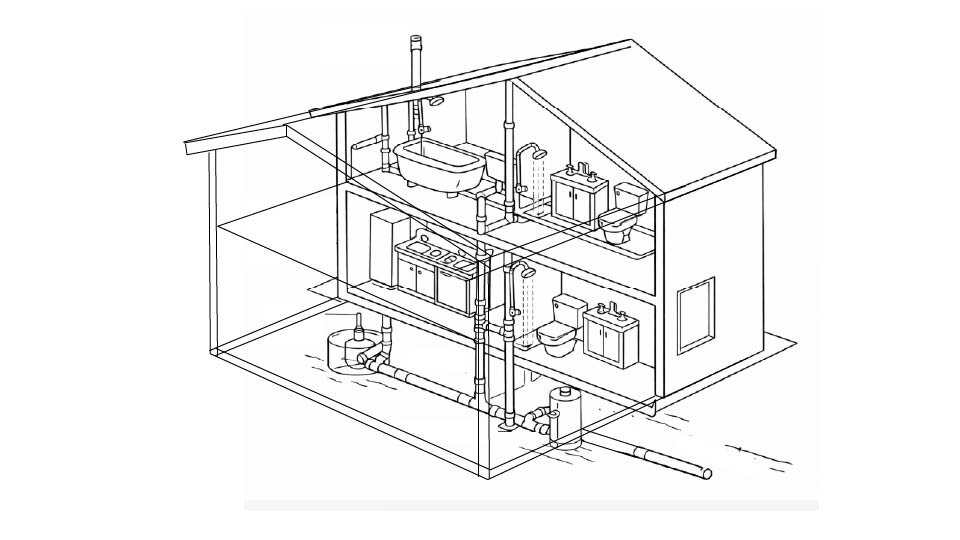
You turn on a faucet. Water flows.
You flush a toilet. Water disappears.
Simple, right?
Except behind those two simple actions is an entire system of pressure, pipes, traps, vents, and valves working together inside your walls. Most of it you never see. All of it you depend on.
Here’s the frustrating part: most DIY guides teach you how to fix a clog or a leak. Almost nobody teaches you how the system actually works.
That’s backwards. Because once you understand the system, everything else makes sense. A leak stops being terrifying. A slow drain stops being a mystery. You stop guessing and start knowing.
Let’s fix that.
Your Plumbing System Is Three Systems (Working Together)
Your home’s plumbing isn’t one thing. It’s actually three separate systems that coordinate constantly:
- Water Supply System – Pressure brings water in
- Drain-Waste System – Gravity takes water out
- Vent System – Air keeps everything balanced
Understand these three, and you understand your plumbing.
System #1: The Water Supply System (Pressure Does the Work)
Water enters your home through a main supply line—usually buried underground, coming from the city water system or a well.
Here’s the key principle: This entire system works because of pressure. Water is being pushed to every fixture in your home.
How It Flows
At the street:
- City water main delivers water under pressure (typically around 50 PSI, though it varies by location)
At your house:
- Main shut-off valve (this is where you cut all water if there’s an emergency)
- Pressure-reducing valve (optional, but common—reduces pressure to protect your pipes)
- The line splits into two paths: cold water and hot water
Cold water path:
- Travels directly from the main line to your fixtures
- No detours, no heating
Hot water path:
- Cold water enters your water heater
- Gets heated
- Travels through separate hot-water pipes to your fixtures
- Returns to the water heater (if you have a recirculation loop) or waits until you turn on the tap
The Pressure Is Everything
That shower that feels nice and strong? That’s water pressure doing the work. Your washing machine filling up? Pressure. Your toilet tank refilling after you flush? Pressure.
This is why:
- A leak under pressure sprays (scary, but fixable)
- Water heaters need to handle pressure (they have relief valves)
- If pressure suddenly drops, something is wrong (leak, valve issue, or supply problem)
Pro tip: Know where your main shut-off valve is. In an emergency (burst pipe, major leak), this is how you stop water from destroying your house. It’s usually near where the main line enters your home.
System #2: The Drain-Waste System (Gravity Takes Over)
Once water leaves your faucet and enters the drain, everything changes.
Pressure stops mattering. Gravity takes over.
How It Works
The basic principle: Drain pipes are slightly angled downward (about 1/4 inch per foot of pipe). This slope is intentional and critical.
Water flows downward through:
- Fixture drains (where water exits your sink, shower, toilet)
- Branch drains (pipes that collect water from multiple fixtures)
- The main drain line (the big pipe that carries everything out)
- Finally: the sewer line or septic system
There are no pumps in this system (in most homes). Just gravity and slope. Water naturally wants to flow downhill. The pipes just guide it.
Why Slope Matters (This Is Critical)
Too steep: Water rushes, leaves solids behind, clogs happen Too shallow: Water moves slowly, solids settle in the pipe, clogs happen Just right (1/4″ per foot): Water flows smoothly, solids move along, drains work
This is why:
- A slow drain often means improper slope somewhere
- Older homes with settled foundations sometimes develop drainage problems
- A plumber’s first move is often to check slope and pitch
The P-Trap (Your Secret Weapon)
Under every sink, you’ll see a curved section of pipe shaped like a “P” or “U”. That’s a P-trap.
What it does:
- Holds a small amount of water at the bottom
- That water creates a seal that blocks sewer gases from entering your home
- Prevents odors and dangerous gases (like methane) from coming back up
Why it’s there: Without the P-trap, your drain wouldn’t just smell—it would be a hazard.
Pro tip: If a drain smells like sewage, either the trap is dry (pour water down it) or it’s failed (call a plumber).
System #3: The Vent System (The Silent Hero Nobody Mentions)
This is the system most homeowners never think about. It’s also the most important one most people don’t understand.
Here’s what vents do: They connect your drain pipes to the outside air, usually through pipes that exit your roof.
Why that matters: When water flows down a drain, it creates pressure changes inside the pipe. Those pressure changes can:
- Make drains gurgle
- Siphon water out of traps (letting sewer gases in)
- Create vacuum conditions that slow drains
- Generally make the whole system misbehave
The vent system solves this by:
- Allowing air to enter the drain system
- Equalizing pressure so water can flow smoothly
- Keeping traps filled with water (so they stay sealed)
- Letting sewer gases escape safely (through your roof, not into your home)
Real talk: Vents are invisible. You rarely think about them. But when they fail (blocked by ice, leaves, or a bird nest), your entire drainage system acts weird.
If your drains are gurgling, your toilet is slow, or you’re getting sewer smells—a blocked vent is often the culprit.
How It All Works Together (The Complete Picture)
Let’s walk through what happens when you wash your hands:
- Supply phase (pressure): You turn on the faucet. Pressurized water travels through supply pipes and emerges at the faucet.
- Use phase: You use the water, control the flow with the faucet valve.
- Drain phase (gravity): Water enters the drain. Gravity takes over.
- P-trap phase: Water passes through the P-trap, which stays filled and seals against sewer gases.
- Flow phase: Water travels through sloped drain pipes toward the main line.
- Vent phase: Air enters through vent pipes, equalizing pressure and keeping everything flowing smoothly.
- Exit phase: Wastewater reaches the sewer line or septic system.
That entire sequence happens in seconds, automatically, every single time.
And it works because three systems do their job: pressure brings it in, gravity takes it out, vents keep it balanced.
The Key Components Every Homeowner Should Recognize
You don’t need to repair these yet. Just know they exist and what they do:
Supply System:
- Main shut-off valve (your emergency stop button)
- Fixture shut-off valves (individual on/off for sinks, toilets, etc.)
- Water heater and connections
- Supply pipes (PEX, copper, or PVC)
Drain System:
- P-traps (under every fixture)
- Drain lines (slope matters!)
- Main drain line (the big one)
- Cleanout access points (usually covered caps where you can snake a drain)
Vent System:
- Vent pipes (usually PVC, exit through roof)
- Roof flashing (seals where the vent penetrates the roof)
- Clean-outs and T-fittings (connection points)
General:
- Seals and gaskets (prevent leaks)
- Unions (connections between pipes)
- Shut-off valves at various points
Recognize these, and you’ll understand what a plumber is talking about when they explain a problem.
Common Problems (And Why They Make Sense Now)
Slow drains: Usually improper slope, a partial clog, or a blocked vent. Gravity can’t work if the path is blocked.
Gurgling sounds: Vent is blocked. Air can’t equalize pressure, so you hear it escaping through water.
Sewer smell: P-trap is dry or has failed. The seal is broken, letting gases through.
Leak under the sink: P-trap or connection is failing. Replace it.
Toilet won’t fill after flushing: Supply line issue, or the fill valve is broken. Pressure problem.
Water pressure is weak: Could be a supply issue, a shut-off valve partially closed, or a leak somewhere reducing pressure.
Sudden water backup: Main line clogged. Call a plumber—this needs professional help.
Once you understand the system, these problems stop being mysteries. They’re just symptoms pointing to which system has the issue.
Why Understanding Your Plumbing Changes Everything
When you understand the system:
✓ A leak feels manageable instead of catastrophic ✓ A slow drain makes logical sense (not magic) ✓ You know what questions to ask a plumber ✓ You avoid accidentally damaging something ✓ You can do simple maintenance (like pouring water down a dry trap) ✓ You work smarter, not harder
You’re not becoming a plumber. You’re just recognizing that your home’s plumbing is a system—logical, pressure-and-gravity-based, developed over more than a century, designed to move water safely and efficiently.
Once you see it that way, it stops being chaos inside your walls. It’s engineering. And engineering makes sense.
Related Guides You Might Find Helpful
- How to Choose the Right Fastener – When you’re mounting plumbing fixtures or accessing pipes
- How to Work with Drywall: A Beginner’s Guide – When you need to access or route pipes through walls
- How to Use a Voltage Tester – For safety when working near electrical systems in walls that might also have plumbing
- The DIYer’s Toolbox: A Beginner’s Guide to Essential Tools – Tools you’ll need for plumbing work
Amazon Affiliate Recommendations
Understanding & Documentation
Home Plumbing Diagrams & Reference Guide – Visual guides showing how different plumbing systems are configured. Handy to have when you’re trying to understand your own setup.
Plumbing Basics Handbook – Written for homeowners, not plumbers. Clear explanations of how systems work.
Essential Tools & Supplies
Adjustable Wrench Set – For tightening or loosening connections. Essential for any plumbing work.
Plunger Set (Different Sizes) – Cup plunger for sinks, flange plunger for toilets. You’ll need both eventually.
Pipe Wrench – For working on larger pipes. Grips and won’t slip.
Maintenance & Inspection
Flashlight with Headlamp – Plumbing work often happens in dark cabinets under sinks. A headlamp frees your hands.
Bucket & Shop Towels – Prepare for water. Always have these ready before opening a drain.
P-Trap Replacement Kits – When a trap fails, these are quick replacements. Cheaper than a plumber call for this one.
As an Amazon Associate, I earn from qualifying purchases. Click through the links above to support Skippity Whistles.
Plumbing work involves water, which can damage your home if done incorrectly. Always know where your main shut-off valve is. When in doubt about major work, call a licensed plumber.
3019
©2026 SkippityWhistles.com All rights reserved
