You flush a toilet. Water disappears.
You pull a drain plug. Water vanishes.
You pour water down a sink. Gone.
Simple, right?
Except you never think about where it actually goes. And that’s where most people’s understanding of plumbing stops.
Here’s the thing: understanding your drainage system is the difference between “my drain is slow, guess I’ll call someone” and “my drain is slow, here’s what’s probably happening and how to fix it.”
It’s also the difference between respecting your plumbing and accidentally destroying it with the wrong approach.
Let’s fix that. Because your drainage system isn’t complicated. It’s just invisible. Once you understand how it works, everything makes sense.
The Basic Principle: Gravity Does All the Work
Here’s the critical difference between your water supply system and your drainage system:
Water supply: Pressure pushes water to your fixtures Drainage: Gravity pulls water away from your fixtures
That’s it. That’s the fundamental difference.
Your supply system needs pumps and pressure. Your drainage system needs nothing but slope and gravity. Water naturally wants to flow downhill. Your pipes just guide it.
This is why:
- Drains don’t need pumps (in most homes)
- Slow drains usually mean improper slope, not a real blockage
- Backup happens when gravity can’t do its job (pipe is blocked or angled wrong)
- A clogged drain is just gravity fighting something in the way
Understand gravity, and drain problems stop being mysterious.
Where Water Actually Goes (The Journey)
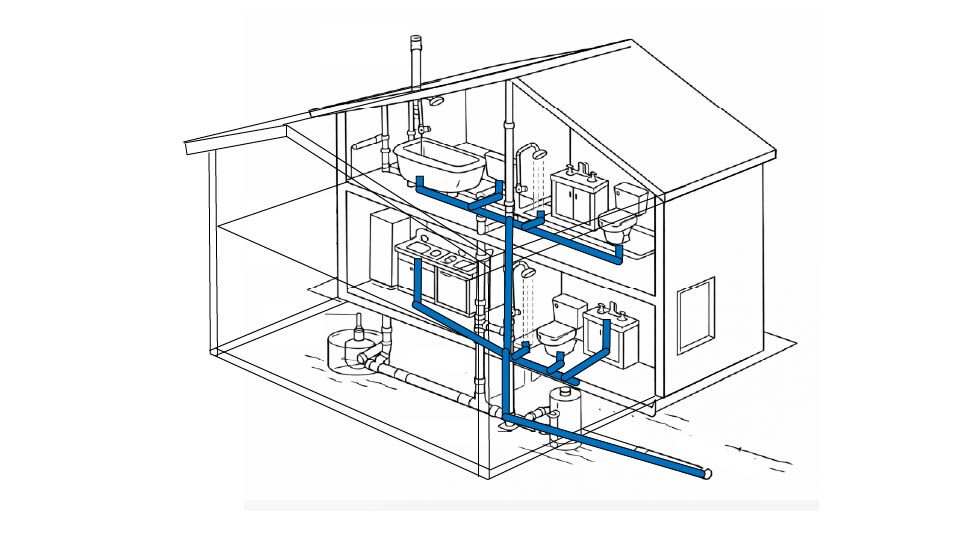
When you flush a toilet or drain a sink, here’s the actual path that water takes:
Step 1: The Fixture Drain Water leaves your sink, shower, or toilet and enters a small drain pipe. This pipe is usually 1.5″ to 2″ in diameter.
Step 2: The P-Trap (Your Safety Seal) Just below (or in) your fixture, there’s a curved section of pipe shaped like a “P” or “U”. This is the P-trap.
What it does: Holds water at the bottom, creating a seal that blocks sewer gases from coming back up into your home. Without it, your bathroom would smell like sewage constantly.
Pro tip: If a drain smells like sewer gas, the trap is either dry (pour water down it) or it’s failed. This is fixable.
Step 3: The Branch Drain Water flows through the P-trap and into a larger pipe called the branch drain. This is where water from one fixture or a group of fixtures combines.
Branch drains connect multiple fixtures to the main drain line.
Step 4: The Main Drain Line All the branch drains feed into the main drain—the big pipe that carries everything out of your house.
This main line usually runs under your house (in the basement or crawlspace) and heads toward either:
- The municipal sewer system (connected to the city)
- Your septic system (if you’re not on city sewer)
Step 5: Out of Your House Water leaves your home through the main drain and becomes the city’s problem (or your septic tank’s responsibility).
That’s it. That’s the entire journey. Simple. Gravity-powered. Elegant.
The Slope Rule (The Secret to Everything)
Here’s the one rule that makes everything work:
Drain pipes must slope downward at roughly 1/4 inch per foot of pipe.
That’s it. That’s the magic number.
Why that specific slope?
Too steep (more than 1/4″ per foot):
- Water rushes down
- Leaves solids behind
- Solids accumulate
- Clogs happen
Too shallow (less than 1/4″ per foot):
- Water moves slowly
- Solids settle in the pipe
- Sediment builds up
- Clogs happen
Just right (1/4″ per foot):
- Water flows smoothly
- Solids move along with water
- Nothing accumulates
- Drains work for years
Real talk: If you have slow drains and no actual blockage, improper slope is usually the culprit. An old house that’s settled, or a drain line that wasn’t installed correctly, can develop slope problems.
Pro tip: You can check slope with a level. Place it on top of a visible drain pipe and see if it tilts the right direction. If it’s flat or slopes the wrong way, you’ve found your problem.
The Vent System (The Invisible Hero)
Remember that vent system we talked about in the cornerstone post? This is where it becomes critical.
What vents do for drains:
When water flows down a drain, it creates pressure changes inside the pipe. Those pressure changes can:
- Make drains gurgle
- Siphon water out of P-traps (letting sewer gases in)
- Create vacuum that slows drains
- Make the whole system behave weirdly
Vent pipes solve this by:
- Allowing air to enter the drain system
- Equalizing pressure so water flows smoothly
- Keeping P-traps filled with water (maintaining the seal)
- Letting sewer gases escape safely (through your roof, not into your home)
Why it matters:
No vent or blocked vent = drainage chaos.
Gurgling drains? Likely a vent issue. Slow drains everywhere? Probably a blocked vent. Sewer smells? Could be a vent problem.
Real talk: Vents are invisible, so people forget about them. But when they fail (blocked by ice, leaves, or a bird nest), your entire drainage system acts weird.
P-Traps: The Unsung Hero
We mentioned P-traps before, but they deserve their own section because they’re so important.
What they are: A U-shaped (or P-shaped) section of pipe under every sink, shower, and drain.
What they do: Hold water at the bottom, creating a seal.
Why that seal matters: Without the water seal, sewer gases (methane, hydrogen sulfide, and other nasties) flow right back into your home. With the seal, they’re blocked.
Common P-trap problems:
Dry trap: If a drain hasn’t been used in months, the water in the trap evaporates. Sewer smell results. Fix: pour water down the drain.
Failed seal: Sometimes the trap cracks, develops a leak, or the seal fails for other reasons. Fix: replace the trap (fairly easy DIY).
Siphoning: If the vent is blocked, drain flow can create a vacuum that siphons water out of the trap. Fix: check/unblock the vent.
Pro tip: Check your P-traps occasionally. A slow leak under a sink is easier to fix now than water damage later.
Common Drainage Problems (And What They Actually Mean)
Slow drain (one fixture): Usually a partial clog (hair, soap scum, sediment) in that fixture’s drain or trap. The clog is restricting flow.
Slow drains (multiple fixtures): Could be a clog in the main line, or more likely, a blocked vent. If multiple drains are slow, the problem is downstream.
Gurgling sounds: Vent is blocked. Air can’t enter the system, so you hear it escaping through water.
Sewer smell: P-trap is dry or failed. The seal is broken, letting gases through.
Backup (water comes up the drain): The main line is clogged or blocked. This is serious—call a plumber. Don’t ignore it.
Water under the sink: P-trap is leaking. This is fixable but needs attention.
Slow drain after rain: Could indicate a damaged main line or a vent issue. Might need professional diagnosis.
Maintenance (Preventing Problems)
Keep drains clear:
- Don’t pour grease down drains (it solidifies and clogs)
- Use drain screens to catch hair
- Flush drains with hot water occasionally
- Use a plunger if a drain slows (before it completely clogs)
Check visible pipes:
- Look under sinks for leaks
- Check basement for moisture or damage
- Listen for gurgling (sign of vent problems)
Know your cleanout: Most homes have at least one cleanout—a capped pipe where the main line can be accessed for snaking. Know where yours is. It’s usually near the foundation or in the basement.
Don’t ignore warning signs:
- Slow drain today = clogged drain tomorrow
- Sewer smell = something’s wrong, fix it
- Backup = emergency, call a plumber now
Real talk: Small problems are easy and cheap to fix. Big problems (water damage, backed-up sewage) are expensive and gross. Stay ahead of it.
When to Call a Plumber (The Hard Truths)
Call a plumber when:
Main line is backed up: Water backing up from drains isn’t a DIY job. The main line is clogged or damaged.
Multiple drains are slow or backed up: This usually means a main line issue or a serious vent problem.
You smell sewer constantly: Even after pouring water in drains and checking traps, persistent sewer smell means something’s wrong internally.
You see raw sewage: Anywhere. Ever. Call immediately. Don’t wait.
Pipes are visibly damaged: Cracks, corrosion, or leaks in visible main drain lines need professional attention.
You’ve got slow drains and you’ve cleared the obvious clogs: If plunging and drain clearing don’t work, the problem is deeper (vent, slope, or main line damage).
Real talk: Knowing when to call a professional is just as important as knowing what you can fix yourself. Plumbers exist for a reason. Use them when you need them.
The Bottom Line
Your drainage system is beautifully simple: gravity, slope, and P-traps working together to move water away from your home safely.
Understand these basics, and most drain problems stop being mysterious. A slow drain makes logical sense. Sewer smells point to a specific problem. Gurgling drains suggest a vent issue.
You won’t become a plumber. But you’ll understand your own house, spot problems early, and know when to call for help.
That’s confidence. And confidence is half the battle.
Related Guides You Might Find Helpful
- How Your Home’s Plumbing System Actually Works: From Street to Sink to Sewer – The cornerstone: understanding all three plumbing systems
- Water Supply 101: Pipes, Valves, and Flow (And Why They Matter) – The supply side of your plumbing system
- GFCI & AFCI Outlets Explained: Hey, Push-Button Sockets! – Safety when you’re working near wet areas
- How to Choose the Right Fastener – When you’re securing pipes or fixtures
Plumbing work can cause property damage if done incorrectly. Always know where your main shut-off valve is. When in doubt about drainage issues, call a licensed plumber.
3021
©2026 SkippityWhistles.com All rights reserved
