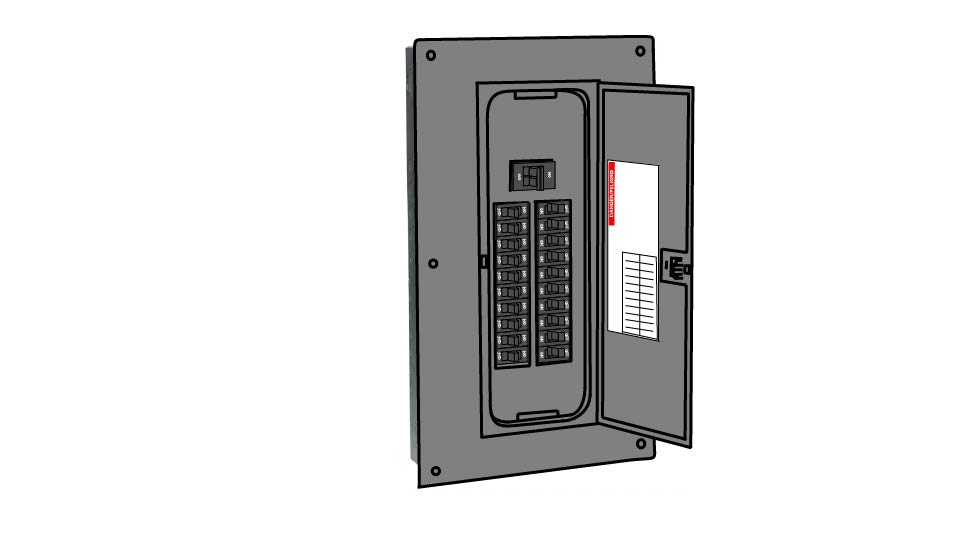
You open the breaker box door for the first time and stare at a wall of switches. Labels that may or may not make sense. Colored wires you’re afraid to touch. Maybe some breakers are different colors than others. What does it all mean?
Here’s the truth: your electrical panel isn’t complicated. It just looks intimidating because nobody ever bothered to explain what you’re looking at.
Let’s fix that. Because understanding your electrical panel is one of those foundational skills that makes every other electrical task make sense. You’ll stop being afraid of it. You’ll know when to call an electrician and when you can handle something yourself. And you’ll actually understand your own house.
What Is an Electrical Panel (And Why It Matters)
Your electrical panel—also called a breaker box, service panel, or main disconnect—is the central hub where electricity from the utility company enters your house and gets distributed to every outlet, switch, light, and appliance.
Think of it like this: The utility company sends power down the line to your house. Your panel is the traffic cop that says “okay, this much goes to the kitchen, this much goes to the bedrooms, this much goes to the AC unit.” It controls where the power goes and how much gets there.
Why it matters:
Your panel is the only place in your house where you can:
- Cut power to the entire house (main breaker/disconnect)
- Cut power to individual circuits (breakers)
- See the voltage and amperage your house is rated for
- Understand which outlets and devices are on which circuits
Without understanding your panel, you’re flying blind. With it? You’re in control.
The Main Components of an Electrical Panel
Let’s break down what you’re actually looking at when you open that door.
The Main Disconnect (The Big Switch)
At the top of most panels, you’ll see one large breaker or switch. This is the main disconnect—it cuts power to your entire house.
What it looks like:
- Physically larger than other breakers
- Usually labeled “MAIN” or “DISCONNECT”
- Often has an amperage rating (100A, 150A, 200A, etc.)
What it does:
- Cuts all power to the house simultaneously
- Acts as a safety shutoff in emergencies
- Lets you know your total electrical capacity
Important: Most panels have the main disconnect inside the panel. Some older or larger homes have it outside (separate from the breaker box). Know where yours is.
The Breakers (The Individual Switches)
Below the main disconnect are columns of smaller switches. These are circuit breakers.
What a breaker does:
- Protects a single electrical circuit from overload
- Automatically “trips” (switches off) if too much current flows through that circuit
- Can be manually switched on or off
What they look like:

- Single-pole breakers (narrow, single switch) = 120V circuits
- Double-pole breakers (wider, look like two switches) = 240V circuits
- Some are different colors (more on that in a moment)
Key point: Each breaker protects one circuit. That circuit might serve multiple outlets, lights, or appliances—but they’re all connected to one breaker.
The Neutral and Ground Buses
On the sides of the panel, you’ll see two sets of metal bars with multiple wires connected to them.
The Neutral Bus:
- Silver or gray metal bar
- Has neutral wires attached (usually white wires)
- Completes the circuit for power to return to the utility company
The Ground Bus:
- Green or bare metal bar
- Has ground wires attached (usually green or bare copper wires)
- Safety mechanism that provides an alternate path for electricity in case of a fault
Why they matter: These aren’t just random wires. They’re the return path and safety system for your electricity.
The Service Entrance
At the very top of the panel (outside), you’ll see where the utility company’s lines connect. This is the service entrance.
What you’re looking at:
- Usually three wires: two hot lines (power) and one neutral line
- These carry power from the utility to your panel
- The amperage rating here determines your house’s total electrical capacity
You won’t mess with this. It’s the utility company’s territory. Just know it exists and what it does.
Reading the Labels (And What They Actually Mean)
Every breaker should be labeled. If yours aren’t, that’s a problem worth fixing (call an electrician).
Labels tell you:
- What circuit that breaker controls
- What’s on that circuit
- How much power (amps) that breaker allows
Example labels you’ll see:
“Kitchen 20A” = The kitchen circuit, protected by a 20-amp breaker “Bedrooms 15A” = Bedroom outlets, 15-amp breaker “AC Unit 30A” = Air conditioner, 30-amp breaker “Water Heater 30A” = Electric water heater, 30-amp breaker
The amperage number is important: It tells you the maximum current that circuit can handle before the breaker trips.
Pro tip: If your labels are faded, unclear, or missing—take 30 minutes and re-label them accurately. Turn off a breaker, figure out what goes dark, write it down. Future you will be grateful.
Voltage: 120V vs. 240V (And Why It Matters)
Most of your outlets are 120V. Some appliances need 240V. Here’s the difference.
120V Circuits (Single-Pole Breakers)
What they are:
- Most common in your house
- Standard outlets for plugging in lamps, TVs, phone chargers, etc.
What’s on them:
- Outlets throughout the house
- Lights
- Small appliances
The breaker:
- Narrow, single switch, like the one pictured above
- Labeled something like “Living Room 15A”
Real talk: 120V is your everyday voltage. Most of your circuits are 120V.
240V Circuits (Double-Pole Breakers)
What they are:
- Higher voltage for power-hungry appliances
- Takes two hot wires instead of one
What’s on them:
- Electric water heater
- Central air conditioner or heat pump
- Electric range or oven
- Clothes dryer
- Some window AC units
The breaker:
- Wider, looks like two switches connected
- Labeled something like “Water Heater 30A”
Why it matters: These appliances need more power than 120V can provide. That’s why they get their own dedicated circuit and a bigger breaker.
Real talk: If you’re ever confused about voltage, check the appliance. If it’s large and power-hungry, it’s probably 240V.
Breaker Amperage: What Those Numbers Mean
The number on each breaker (15, 20, 30, 40, etc.) tells you the maximum current that circuit can safely handle.
Common residential breaker sizes:
15A – Light-duty circuits (lights, outlets in bedrooms/living rooms) 20A – General-purpose circuits (kitchens, bathrooms, outlets) 30A – Heavy-duty circuits (water heater, dryer, some AC units) 40A & 50A – Major appliances or sub-panels (rarely in homes)
Here’s the key: The breaker trips when current exceeds that number. So a 15A breaker trips around 15 amps. A 20A breaker trips around 20 amps.
Why this matters:
- If you keep tripping a 15A breaker, you’re running too many things on that circuit
- If a breaker is constantly tripping, either you’ve overloaded it or there’s a fault (call an electrician)
- You can’t just replace a 15A breaker with a 20A breaker to “fix” the problem—the wiring might not support it
Real talk: Don’t mess with breaker sizing. If you’re overloading a circuit, you need to redistribute the load or add a new circuit. Call an electrician.
Colored Breakers: What Different Colors Mean
You might notice some breakers are black, some are red, some are different colors. What’s that about?
Black breakers – Standard single-pole breakers (120V) Red breakers – Standard double-pole breakers (240V) Yellow breakers – AFCI (Arc Fault Circuit Interrupter) protection Blue/Green breakers – GFCI (Ground Fault Circuit Interrupter) protection or specialty types Tandem/twin breakers – Two thin breakers in the space of one (more on that below)
What matters: The color tells you the type of protection, not the strength. A red breaker isn’t “stronger” than a black one—it just handles 240V instead of 120V.
Colored breakers for safety:
- Yellow AFCI breakers prevent electrical fires
- Blue GFCI breakers prevent shock hazards
- These are smart upgrades if you don’t have them
Tandem breakers (sneaky ones): Sometimes you’ll see two thin breakers where one fat breaker should be. These are tandem or “twin” breakers—two circuits sharing one breaker slot. Some panels allow them, some don’t. If your panel has them, don’t add more without checking your panel’s specs.
How Much Power Does Your House Have? (The Service Size)
Look at the main breaker. That number (100A, 150A, 200A) is your service size—the total electrical capacity your house can draw at once.
What that means:
100A service – Older homes. Barely adequate for modern use. Can’t run AC + electric water heater + oven simultaneously without issues.
150A service – Medium capacity. Okay for a modest home but getting tight if you add electric cars, heat pumps, or large appliances.
200A service – Standard for modern homes. Handles most situations comfortably. AC, water heater, dryer, oven all running? No problem.
300A+ service – Large homes, all-electric construction, or future-proofing. Overkill for most residential.
Real talk: If you’re considering adding major appliances (heat pump, EV charger, electric water heater), check your service size first. If you’re at 100A, you might need an upgrade (call an electrician). If you’re at 200A, you’re probably fine.
What a Tripped Breaker Means (And What to Do)
Your breaker trips. The switch flips to the middle or all the way off. What now?
Why it tripped:
- Overload – Too many things running on that circuit at once
- Short circuit – A fault in wiring or an appliance
- Ground fault – Electricity escaping where it shouldn’t
- Age – Old breakers sometimes trip for no good reason
What to do:
Step 1: Unplug everything on that circuit Step 2: Switch the breaker fully off, then back on Step 3: If it stays on, plug things back in one at a time to find the culprit
If it trips immediately: There’s a fault. Don’t keep flipping it. Call an electrician.
If it only trips with certain appliances: That appliance is the problem (it’s drawing too much or it’s faulty). Stop using it and get it serviced.
If it trips randomly with nothing plugged in: Your breaker or wiring might be faulty. Call an electrician.
Real talk: A breaker doing its job (tripping when it should) is annoying but good. A breaker that won’t stay on is a red flag.
Safety Rules for Your Panel (Read This Seriously)
✓ DO:
- Turn off breakers when working on outlets or lights
- Test GFCI and AFCI breakers monthly
- Label your breakers accurately
- Keep the panel accessible and unobstructed
- Call an electrician if anything seems wrong
✗ DON’T:
- Touch the main breaker or service entrance wires
- Stick anything metal into the panel
- Ignore a breaker that won’t stay on
- Assume a tripped breaker is “no big deal”
- Let water or moisture near the panel
The golden rule: If you’re uncertain, don’t touch it. Call an electrician. Your panel handles deadly voltage—respect it.
Understanding Your Panel Empowers You
Once you understand your electrical panel, a lot of things make sense:
- Why you have breakers in the first place (safety and distribution)
- Why certain outlets are on the same circuit
- Why your AC and oven can’t run simultaneously on old service
- When you need an electrician vs. when it’s just a tripped breaker
- How to shut down power safely for maintenance
You don’t need to work on your panel. But understanding it? That’s foundational knowledge every homeowner should have.
Your panel isn’t mysterious. It’s just doing its job—quietly protecting your house and distributing power where it needs to go.
Now you know how it does it.
Related Guides You Might Find Helpful
- How to Work with Electricity – Complete electrical safety overview
- GFCI & AFCI Outlets Explained – Understanding those safety breakers
- How to Use a Voltage Tester – Testing if something is live before you touch it
- How to Use a Voltmeter or Multimeter Safely – Understanding electrical measurements
- How to Replace a Circuit Breaker – When you actually need a new breaker
Amazon Affiliate Recommendations
Panel Tools & Safety
Non-Contact Voltage Testers – Essential for confirming power is off before working near your panel. Safe, reliable, cheap.
Flashlights for Panel Work – Panels are often in dim basements or closets. A good flashlight (headlamp style is best) makes everything easier.
Wire Labels & Label Maker – If your breakers aren’t labeled, get these. 30 minutes of labeling saves years of confusion.
Understanding & Documentation
Electrical Panel Diagrams & Guides – Laminated guides specific to common panel brands (Square D, GE, Siemens, Eaton). Hang one on your panel door.
Home Electrical Inspection Checklist – If you’re upgrading or just want to understand your system better, a guide walks you through what to look for.
Safety Equipment
Insulated Tools for Electrical Work – If you’re ever working near your panel (not in it), insulated tools prevent accidental shock.
Circuit Breaker Finder – Plug this into an outlet, then flip breakers to find which one controls it. Super useful for understanding your panel layout.
As an Amazon Associate, I earn from qualifying purchases. Click through the links above to support Skippity Whistles.
Electrical panels contain high-voltage, potentially deadly electricity. Never work inside a panel unless you’re a licensed electrician. When in doubt, call a professional.
9015
©2026 SkippityWhistles.com All rights reserved
