You’re standing in front of a piece of plywood thinking: “I need to cut this in half.”
A miter saw won’t work—the plywood is too wide. A jigsaw would take forever. A reciprocating saw is overkill. And a handsaw? You’re not a pioneer.
Enter the circular saw. It’s handheld, it’s aggressive, it cuts through wood like it’s insulted by the wood’s existence, and it will absolutely remove your fingers if you’re careless.
A circular saw is the workhorse of DIY. It crosscuts lumber, rips boards lengthwise, cuts plywood, handles trim, and does a thousand other jobs. It’s the tool you reach for when you need to cut something and you don’t have a stationary saw available.
Understanding how to hold it, how to make it cut straight, and where to keep your fingers (spoiler: not under the blade) separates people who get clean cuts from people who end up with crooked cuts, nicknames like Stumpy or Knuckles, or worse.
Let’s learn how to use one without creating an emergency room visit.
The Core Principle: A Circular Saw Wants To Pull Itself Forward And Upward—Your Job Is To Control That
This is the mindset shift that separates confident users from nervous people holding the tool like it might bite them.
A circular saw has a blade that spins at high speed. As it cuts, the spinning blade creates forces: it wants to pull forward (into the cut), it wants to pull upward (toward your face), and if the blade binds, it wants to twist in your hands.
Your job: Grip it firmly with both hands. Keep it flat and level. Guide it along your cut line. Don’t fight the forces—just direct them.
Understanding these forces means understanding why you need both hands, why you keep the saw flat, and why binding is dangerous.
What A Circular Saw Actually Does
A circular saw has a circular blade that spins at high speed. You push the saw across material and the blade cuts through it.
The blade rotates continuously (unlike a miter saw’s single chop). As long as it’s running, it’s spinning.
You move the saw, not the material. Like a miter saw, the material stays still as you move the circular saw across it.
The cut isn’t automatically square. You have to keep the base flat and level to get a square cut.
It cuts aggressively. A sharp blade cuts through wood, plywood, lumber, even nails if you’re not paying attention.
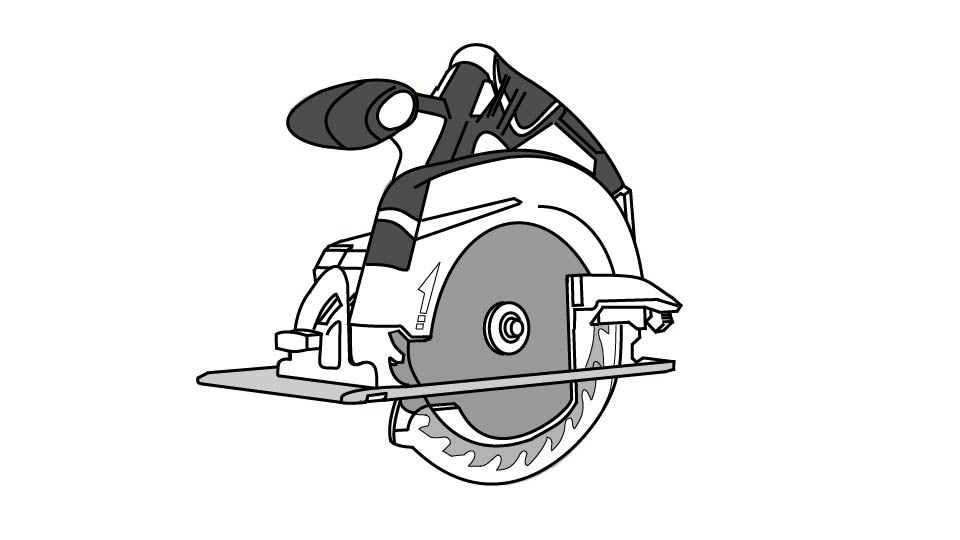
The Parts (What You’re Holding)
The Blade (The Cutting Edge)
This is the spinning circular piece of sharpness. Different blades for different cuts:
Crosscut blade: Many teeth, makes clean cuts across the grain
Rip blade: Fewer teeth, cuts fast but rougher, cuts along the grain
Combination blade: Medium teeth, okay at both crosscutting and ripping
Plywood blade: Fine teeth, makes clean cuts in plywood without tear-out
Real talk: The blade determines the quality of your cut. A sharp blade cuts cleaner and safer than a dull blade.
The Base (The Bottom Plate)
This is the flat metal plate that sits on your material. It determines if your cut is square or tilted.
Real talk: Keep the base flat. If it tilts, your cut tilts. If you’re having trouble getting straight cuts, check that the base is actually flat.
The Depth Adjustment (How Deep The Blade Cuts)
You can raise or lower the blade to cut different thicknesses of material. Most cuts, you adjust the blade so it just barely protrudes below the material.
Real talk: Don’t set the blade so deep that it sticks out 2 inches below the wood. It’s dangerous and unnecessary. Just slightly below the surface is plenty.
The Bevel Adjustment (The Angle Feature)
You can tilt the base to cut at angles (bevels). Most of the time it’s set to 0 degrees (square cut). But if you need a 45-degree angle, you can adjust it.
Real talk: This exists. You probably won’t use it much. Don’t stress about it.
The Guards (The Safety Feature)
There is a metal guard above the blade that protects your hand from the spinning blade.
There is a second, spring-loaded plastic guard under the blade that keeps the saw from cutting through whatever you set it on when you’re done cutting.
Real talk: Don’t remove these. Don’t defeat these. They’re there to keep you from accidentally hitting the blade. Respect them. On any saw, the guards are your friends.
How To Use A Circular Saw (The Safe Way)
Step 1: Set The Blade Depth
Raise the blade so it protrudes just slightly below the material. Not half an inch, just barely through.
Real talk: Deeper blade = more danger, more binding, less control. Just enough to cut through is perfect.
Step 2: Check Your Cut Line
Mark your material with a pencil where you want to cut. Use a carpenters square or tape measure to make sure your cut line is where you think it is.
Real talk: Measure twice. A cut in the wrong place means ruining material. Take time to get it right.
Step 3: Secure Your Material
Clamp your material so it doesn’t move or tip while you’re cutting. If it moves, your cut goes crooked.
Make sure that the bit of blade that extends below your material isn’t going to cut through anything you plan to keep.
Real talk: One-handed cutting with an unsecured material is how accidents happen. Clamp it. Use both hands on the saw.
Step 4: Position Yourself
Stand to the side of the saw, not directly behind it. Your body should be off to the left or right, not in line with the blade.
Why: If the blade binds and the saw jumps, you don’t want it coming at your face.
Real talk: This is serious. Take a moment to position yourself properly.
Step 5: Grip With Both Hands
One hand on the main handle, one hand supporting the front of the saw. Grip firmly but not with crushing force.
Real talk: You’re not fighting the saw. You’re guiding it. Firm grip, relaxed arms.
Step 6: Let The Blade Reach Full Speed
Press the trigger and let the blade spin up. You’ll feel and hear it reach full RPM. This takes a second.
Don’t start the saw with the blade engaged in the wood. This is the easiest and fastest way to bind the blade and tear up the wood, and worse. Always start the saw off the material.
Real talk: Don’t plunge into the cut immediately. Let it reach full speed first.
Step 7: Guide The Saw Along Your Cut Line
Once at full speed, move the saw forward smoothly along your cut line. The blade does the cutting. You’re guiding.
Don’t press hard. The spinning blade cuts on its own. Pressing hard just makes the saw work harder and makes binding more likely.
Step 8: Keep It Flat And Level
As you cut, make sure to keep the base flat against the material. If it tilts, your cut tilts. Constant, gentle pressure.
Real talk: The most common mistake is letting the saw tilt. Watch the base. Keep it flat.
Step 9: Follow Through
Once the blade reaches the end of your material, keep the saw moving until it’s completely clear. Don’t stop midway through.
Real talk: Stopping partway through creates a binding situation. Follow all the way through.
Step 10: Release The Trigger
Once clear, release the trigger and let the blade coast to a stop. Don’t force it.
Real talk: Let the saw stop naturally. Some saws have brakes. Some just coast. Either way, don’t force it.
Straight Cuts (The Challenge Most People Face)
Here’s the secret: circular saws aren’t great at straight cuts unless you help them.
Option 1: Use a guide Clamp a straight piece of wood (a 2×4 or a speed square jig) to your material to guide the blade.
Real talk: This is the professional way. You get straight cuts consistently.
Option 2: Use a rip fence Some circular saws have an attachment called a rip fence that guides along an edge. It works okay for simple cuts.
Real talk: Better than nothing, but a clamped guide is more reliable.
Option 3: Freehand and trust your eye You can just eyeball it and try to keep the saw straight.
Real talk: This works if you have steady hands and good depth perception. For most people, it results in crooked cuts. Use a guide.
Common Mistakes (Learn From These)
❌ Not securing your material The wood shifts while you’re cutting. Now your cut is crooked. Clamp everything.
❌ Starting the saw engaged in the wood Always start the saw above the material so that the blade gets the chance to spin up to full speed.
❌ Pressing too hard You think more pressure = faster cuts. Actually, it makes the blade bind and the saw harder to control. Let the blade do the work.
❌ Letting the saw tilt You’re distracted and the base tilts. Your cut is now beveled instead of square. Watch the base. Keep it flat.
❌ Freehand cutting without a guide You need a straight cut but you’re just eyeballing it. Use a clamped guide for straight cuts.
❌ Not letting the blade reach full speed You plunge into the cut before the blade is spinning fast enough. Rough cut, possible binding. Wait for full speed.
❌ Stopping midway through the cut You pause or slow down halfway through. Now the blade binds in the kerf. Keep moving. Follow through.
❌ Reaching under the blade Your hand is under the saw “just to steady it” and the blade is exposed. Don’t do this. Keep hands away from the blade.
❌ Removing the guard or modifying the saw You think the guard is in the way so you remove it or tie it back. Now you have a spinning blade with nothing between it and your hand. Don’t do this.
Real talk: These mistakes teach you why the basic safety practices exist.
Ripping vs. Crosscutting (The Two Cuts)
Crosscutting: Cutting across the grain, perpendicular to the length of the board.
Ripping: Cutting along the grain, lengthwise down a board.
Both use the same saw. The difference is your blade choice and your technique.
For crosscutting: Use a crosscut blade (more teeth). Guide straight across.
For ripping: Use a rip blade (fewer teeth). You’re cutting the full length of the board. A guide is essential or you’ll wander.
Real talk: A table saw is better for ripping long boards. A circular saw works but requires a guide.
When To Use A Circular Saw
Use it when:
- You need to cut plywood or large sheets
- You need to cut lumber or boards
- You’re crosscutting (cutting across the grain)
- You need mobility (cutting in place, not moving material to a saw)
- You’re doing rough cuts or demolition
Don’t use it when:
- You need precision cuts (use a miter saw)
- You’re making curved cuts (use a jigsaw)
- You’re doing heavy ripping of long boards (use a table saw)
- You’re in a tight space (too large and unwieldy)
The Bottom Line
A circular saw is the workhorse of DIY. It cuts plywood, lumber, trim, and a thousand other things. It’s handheld, it’s powerful, and it will absolutely hurt you if you’re careless.
Key principles:
- Grip with both hands, firmly but not crushing
- Secure your material so it doesn’t move
- Keep the base flat and level
- Let the blade reach full speed before cutting
- Use a guide for straight cuts
- Follow through—don’t stop midway
- Keep your hands clear of the blade
- Let the saw coast to a stop naturally
Do this, and you’ll cut wood confidently and cleanly.
Ignore these, and you’ll get crooked cuts, binding, or worse.
The saw is simple. The danger is real. Respect it accordingly.
Related Guides You Might Find Helpful
- How to Use a Miter Saw: Precision Cuts And The Satisfying Sound Of Trim Done Right – For precision angle cuts
- How to Use an Oscillating Multi-Tool: The Swiss Army Knife That Actually Works – For detail work in tight spaces
- How to Use a Reciprocating Saw: Controlled Aggression and Respect For The Tool – For demolition and rough cuts
- How to Use a Jigsaw: Curved Cuts And Tight Spaces – For curved and detail cuts
- How to Work with Wood: Understanding Grain, Fasteners, and Not Ruining Things – Wood fundamentals including grain direction
Amazon Affiliate Recommendations
Circular Saws
Circular Saw (Corded, 7 1/4-Inch, Mid-Range) – The standard. Consistent power, reliable, affordable.
Circular Saw (Cordless, Battery-Powered, Compact) – Lighter, quieter, convenient. Make sure you have good batteries.
Professional Circular Saw (Heavy-Duty, Powerful Motor) – For serious work. Better power, better precision, more durable.
Blades & Accessories
Circular Saw Blade Assortment (Crosscut, Rip, Combination) – Stock different blades for different cuts and materials.
Fine-Toothed Blade (80-100 Tooth, Clean Cuts) – For plywood and finish work. Makes clean cuts with minimal tear-out.
Rip Blade (24-Tooth, Fast Ripping) – For ripping boards lengthwise. Fast cutting.
Guides & Supports
Speed Square (Aluminum, 7-Inch) – For quick angle marks and guides. Essential layout tool.
Straight Edge Guide Clamp (Helps Straight Cuts) – Clamps to your material to guide the saw in a straight line.
Circular Saw Guide (Adjustable, Precision Cuts) – Advanced guide for very straight cuts. Worth the investment.
Safety
Safety Glasses (Impact-Resistant) – Flying sawdust and wood chips are common. Protect your eyes.
Dust Mask (N95 or Better) – Sawing creates fine dust. Protect your lungs.
Work Gloves (Cut-Resistant) – For handling sharp materials and splinters.
As an Amazon Associate, I earn from qualifying purchases. Click through the links above to support Skippity Whistles.
Circular saws operate at high speeds with a spinning blade. Always keep both hands on the saw and maintain firm control. Never reach under the blade or near the spinning blade. Keep the blade guard in place—never remove or defeat it. Wear safety glasses and a dust mask. Secure your material before cutting. Let the blade reach full speed before cutting. Never force the blade—let it cut at its own pace. If the blade binds, release the trigger immediately.
7055
©2026 SkippityWhistles.com All rights reserved
