
Ron’s sink was draining slower every day for a week, and his plan was to reach for a bottle of chemical drain cleaner and hope for the best. He never once glanced down at the strainer basket sitting right in the drain opening, completely packed with food scraps, quietly doing exactly none of its job. The sink wasn’t clogged. The basket was full. Those are very different problems with very different fixes, and only one of them involves pouring chemicals down your own pipes.
Under a kitchen sink is a plumbing situation that looks like it was designed by someone who really loved pipes — a disposal, a dishwasher hose, a P-trap, all jostling for space in a dark cabinet that also somehow holds a fire extinguisher and a bag of rubber bands nobody’s thrown away since 2019. When it backs up, and it will, the good news is the whole system is genuinely logical once you know where to look.
🍽️ The Big Picture: Three Systems, One Drain
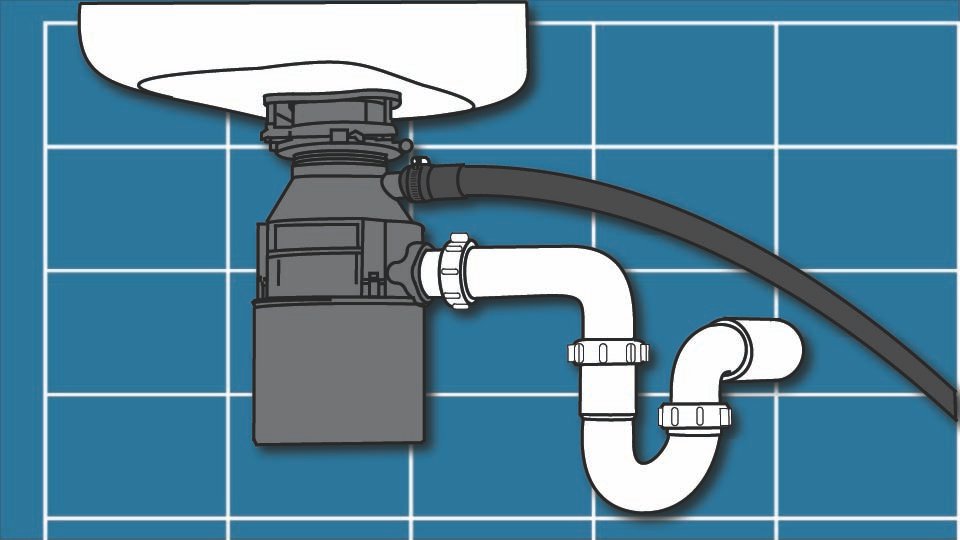
A kitchen sink actually has three separate drainage paths feeding into the same place: the main sink drain, the garbage disposal (if there is one, sitting between the sink and the trap), and the dishwasher drain, a hose connecting into the sink’s plumbing.
All three converge at the P-trap and travel together from there. That shared real estate is exactly why a slow sink can make the dishwasher gurgle — they’re not separate problems, they’re the same problem showing up in two places.
🥣 The Main Sink Drain
Water enters through the drain opening, and the strainer basket (that small screen sitting in the opening) catches roughly 80 percent of kitchen clogs before they ever become a pipe’s problem — food scraps, mystery chunks, the occasional dropped ring.
A full basket that’s draining slowly isn’t a slow drain. It’s a full basket. Empty it before it overflows, not after, and a genuine amount of kitchen sink trouble simply never happens.
🗑️ The Garbage Disposal
A disposal mounts directly under the sink drain and grinds food scraps small enough to travel through the plumbing without clogging it — but it doesn’t make food disappear, it just makes it smaller, and those ground particles can absolutely still clog something further downstream.
If the disposal won’t turn on, check that it’s plugged in, check the breaker, and look for the reset button on the unit’s underside.
If it’s jammed, turn it off completely, remove any obstruction with tongs — never a hand — and use an Allen wrench in the hex socket on the bottom to manually free the grinding plate.
Never put a hand in a garbage disposal. This is not a suggestion.
🍴 The Dishwasher Drain
Most dishwashers drain through a flexible hose into the sink’s plumbing, ideally through an air gap — a small cylindrical fitting on the countertop that physically prevents sink water from siphoning back into the dishwasher.
Some installations skip the air gap and connect the hose straight into the drain instead, which works fine until the sink backs up, at which point dirty sink water can flow directly into the dishwasher — exactly as pleasant as it sounds.
If the dishwasher’s draining slowly, the actual problem is almost always downstream in the sink plumbing, not the dishwasher itself; it’s just the one reporting the bad news first.
🔧 The P-Trap: Where Everything Meets
The curved pipe under the sink is where all three systems converge before heading to the main drain line.
It does two jobs at once: a small standing pool of water blocks sewer gas from rising back up, and the bend catches debris — coins, bottle caps, food particles — before it reaches the main line, which is also why things dropped down the drain are often still recoverable.
For a slow drain, cleaning the trap should be the first move, not chemicals and not a plumber call: place a bucket underneath, loosen the slip nuts by hand or with pliers, remove the trap, dump and rinse it, reinstall, and run water to check for leaks at the connections.
It takes about ten minutes, costs nothing, and is genuinely satisfying in a way house plumbing rarely is.
📐 The Slope Rule
Drain pipes need roughly 1/4 inch of downward slope per foot to keep water moving instead of pooling.
Too level, and water sits instead of flowing — leading to slow drains, standing water that smells, and debris settling instead of washing through.
A dishwasher hose that’s too level lets water pool and develop a smell of its own; a sink drain installed level or slightly uphill invites the same problem; and older sagging PVC can develop low spots over time even in a pipe that was sloped correctly to begin with.
If the trap’s clean and the drain is still slow, slope is worth suspecting next.
🔍 Reading the Symptoms
- A slow sink usually means a clogged strainer, a clogged trap, a disposal not grinding effectively, or genuinely wrong pipe slope — check in that order.
- Water backing into the dishwasher points to a clogged air gap or a backed-up sink drain that needs clearing first.
- A sewer smell means the trap is dry or clogged, or its seal has failed outright.
- And water leaking under the sink usually traces to a loose trap connection, a failed seal, or a leaking disposal gasket.
🧹 Keeping It Flowing
- Weekly, empty the strainer before it overflows and run hot water down the drain after using the disposal.
- Monthly, flush the drain with hot water and clean the air gap if there is one.
- Every three to six months, remove and clean the P-trap, and run the disposal with hot water and a cup of ice cubes, which scrubs the grinding chamber without any chemicals involved.
📞 When to Call a Plumber
Water backing up despite a clean trap and strainer, a sewer smell that running water doesn’t fix, a leak that won’t stop with tightening, a disposal motor that’s genuinely failed, or pipes that look incorrectly sloped are all past the DIY line.
Main line work beyond the trap, electrical work on the disposal, and anything requiring opening a wall belong to a professional, not a Saturday afternoon.
🛒 Gear Worth Having
Hand-Crank Plumbing Snake — For the clog hot water and a clean trap didn’t solve — reaches further into the line than either one can manage alone.
P-Trap Replacement Kit — A straightforward swap when a trap corrodes or a seal fails beyond what tightening the slip nuts can fix.
Rechargeable Headlamp Flashlight — Frees both hands for the actual work — the cabinet under a kitchen sink is darker than it has any right to be.
As an Amazon affiliate, I earn from qualifying purchases. Thank you for supporting SkippityWhistles.
📖 Related Reads
SkippityWhistles is part of the WhistleBump group – find the rest of the family at WhistleBump.com.
3024
©2026 John D Reinhart/Skippitywhistles.com — All rights reserved