
Ron’s water heater lasted almost exactly ten years before it started leaking rusty water from the base, and the plumber who came to replace it mentioned, almost in passing, that a thirty-dollar part called an anode rod probably would have kept the tank going another five years if anyone had ever swapped it out. Nobody had. Nobody had ever heard of it. Ron bought a whole new water heater instead of a thirty-dollar rod, which is a genuinely expensive way to learn a part exists.
A water heater looks intimidating sitting in the corner of a basement or garage, covered in pipes and a mystery valve on top. It’s actually simple once you know what each connection is doing — and one of those parts is quietly working the entire time, right up until it isn’t.
🎯 Three Connections, One Job
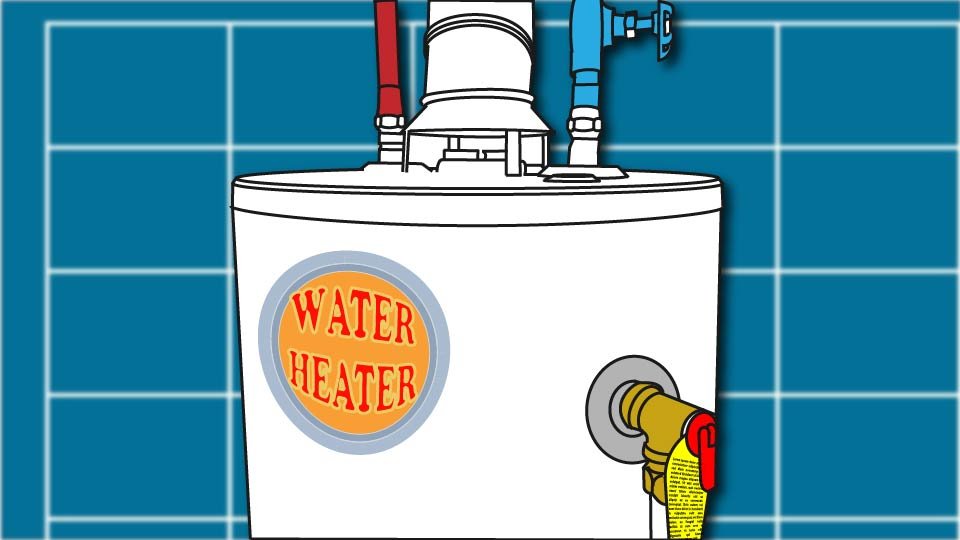
Every water heater boils down to three essential connections: a cold water inlet where water enters, a hot water outlet where it leaves, and a drain valve for emptying the tank when needed.
Everything else — safety devices, support piping — exists to serve those three. That’s the entire mental model worth keeping in mind.
🔵 The Cold Water Inlet and the Dip Tube Nobody Sees
Cold water enters here, usually through a 1/2-inch pipe connected at the top of the tank.
The water travels down the dip tube, a plastic pipe that carries it from the inlet at the top to the bottom of the tank.
If hard-water sediment builds up in the cold-water inlet, the flow of water into the tank can get restricted. Separately, over years the dip tube’s plastic can crack or degrade on its own — from heat cycling or just age — letting cold water release near the top of the tank instead of the bottom. The result is lukewarm water running from the hot water taps.
The cold water inlet has a valve on it, so that you can turn off the water supply to the water heater.
🔴 The Hot Water Outlet
The cold water flows into the tank through the dip tube, releasing near the bottom.
A heating element (electric) or a burner (gas), controlled by a thermostat, heats the water in the tank to a preset temperature.
When you open a tap in the house, hot water leaves through a connection at the top of the tank, typically the same 1/2-inch sizing as the inlet.
🚰 The Drain Valve
The drain valve is a small faucet-like valve at the tank’s base lets it drain completely — for replacement, sediment removal, or general maintenance.
Turn it counterclockwise and water flows out through a connected hose.
Opening it slightly once a year to release a bit of water is a genuinely underused habit that clears settled sediment and keeps the tank running efficiently.
But be careful – the water in the tank is hot!
🛡️ The T&P Relief Valve: The Safety Guard
The Temperature and Pressure (T&P) Relief Valve is a small valve with a lever on high up on the side of the tank. The T&P relief valve exists for one serious reason: water doesn’t compress, and as it heats inside a sealed tank, pressure builds right along with it.
If pressure climbs past roughly 150 PSI, or temperature past around 210°F, this valve opens automatically and releases water to bring both back down to within the proper limits.
The T&P relief valve is the entire reason a water heater doesn’t become a genuine hazard.
- Occasional slow dripping from its discharge pipe is usually normal pressure relief.
- Constant draining points to a real problem worth a plumber’s attention.
- Hard water leaves behind lime — a chalky mineral deposit — anywhere water sits or flows repeatedly, and the T&P valve is exactly that kind of spot. Over time, lime can coat the valve’s internal seat, the same way a showerhead gets crusty in a hard-water area. A valve fighting through mineral buildup may not open fully when a real pressure spike actually calls for it — the one moment this whole valve exists for.
- Checking it is simple: lift the small test lever on top of the valve briefly. Water should flow out immediately, then stop cleanly once you release the lever. If nothing comes out, or it keeps dripping afterward instead of shutting off, that’s the valve telling you it’s not sealing or opening the way it should — worth a call to a plumber rather than waiting to find out during an actual emergency.
🔩 The Anode Rod: The Invisible Protector
Inside the tank sits a sacrificial metal rod, usually magnesium or aluminum, whose entire job is to corrode instead of the tank itself. Over three to five years it slowly dissolves, and once it’s fully spent, the steel tank starts rusting in its place — which is exactly what happened to Ron’s.
If a water heater is eight to ten years old and otherwise running fine, replacing this one cheap, mostly unknown part can genuinely extend its life another five years or more.
Most people never learn it exists until after the tank’s already failed, at which point the only remaining option is the expensive one.
🔥⚡ Gas vs. Electric, Briefly
Gas water heaters add a gas line and a vent pipe carrying combustion exhaust up to the roof or chimney — gas connections are strictly a professional’s job, since a gas leak is a serious hazard, not a DIY judgment call.
Electric water heaters run on a 240-volt circuit powering heating elements inside the tank, and that electrical work belongs to a licensed professional too, for the same reason.
🔍 Reading the Symptoms
- No hot water at all points to a closed inlet valve, a failed dip tube, or a dead heating element or burner.
- Lukewarm water suggests a thermostat set too low, a broken dip tube mixing cold in, or sediment buildup reducing efficiency.
- Water dripping from the drain valve is often normal pressure relief, but constant draining signals a failing valve.
- Rumbling or popping sounds mean sediment settled at the bottom — a flush usually clears it.
- Rusty or discolored water is the anode rod’s warning sign, exactly the one Ron missed for a decade.
📞 When to Call a Professional
- Any actively leaking connection
- a T&P valve that won’t stop draining or won’t operate at all
- the smell of gas
- persistent lukewarm water after checking the obvious
- rusty water
Are all past the DIY line. Gas lines, electrical work, and anything inside the tank itself belong to a licensed professional every time — no exceptions worth the risk.
🛒 Gear Worth Having
Magnesium Anode Rod Replacement — The thirty-dollar part that could have saved Ron’s tank five extra years — check compatibility with your specific model before buying.
Temperature and Pressure Relief Valve Replacement — A critical safety component worth replacing the moment it’s failing or won’t operate — not a part to leave in question.
Strap Wrench (Rubber or Rope-Style) — Grips smooth, hard-to-reach fittings without marking them up, in the tight clearance around a water heater where a standard wrench often can’t get proper leverage.
As an Amazon affiliate, I earn from qualifying purchases. Thank you for supporting SkippityWhistles.
📖 Related Reads
SkippityWhistles is part of the WhistleBump group – find the rest of the family at WhistleBump.com.
3025
©2026 John D Reinhart/Skippitywhistles.com — All rights reserved