Ron watched his water bill creep upward for three straight months and quietly blamed the utility company for raising rates again. It wasn’t the rates. A toilet fill valve had been running low and steady the entire time, quietly wasting water around the clock, and the answer had been sitting right there on his water meter the whole time — he’d just never learned that the meter could tell him anything beyond how much to pay.
The water supply system looks like it’s just pipes and pressure, but a few specific components are doing real, active work — and knowing what they are turns a mysterious bill or a weak shower into something you can actually diagnose.
🚰 The Service Line: Where Your Responsibility Begins
The city taps its main water line with a smaller pipe, called a service line, usually buried 3 to 4 feet deep to stay below the frost line to your property.
Once that service line crosses your property line, it becomes your responsibility, not the utility’s — if it leaks or freezes, that’s a homeowner repair, not a city one.
That’s a detail worth knowing.
Another detail: if your home is older, your service line might be made of lead, as they sometimes were until the 1970’s. A lead service line is a genuine health hazard. If you think that could be a possibility in your house, it might be worth having a plumber confirm it.
🎛️ The Pressure-Reducing Valve: The Quiet Protector
City water pressure genuinely varies, sometimes swinging between 50 and 100-plus PSI depending on the day. A pressure-reducing valve (PRV — a small, brass, bulb-shaped device usually found near the main shutoff or water meter) steps that down to a safe, consistent 50 to 60 PSI before it reaches your fixtures.
Without it, pipes, seals, and appliances take on more pressure than they’re rated for, which shows up eventually as leaking connections, shortened fixture life, or water hammer (a banging sound from pressure surges in the pipes). Most homes have one. Most homeowners never notice it’s there, quietly doing its job.
📊 The Water Meter: A Leak Detector You Already Own
The water meter tracks exactly how much water enters the house, and it’s usually sitting right where the service line comes in — a pit near the street, or inside a basement.
Checking it is simple: write down the reading, make sure nothing’s using water for a few hours, and check it again.
Any movement at all means something’s using water somewhere, even if nothing’s visibly running — which is exactly the kind of slow, invisible leak that quietly inflated Ron’s bill for three months before he ever thought to look.
🔀 Cold and Hot Lines: Why They Stay Separate
Cold water travels straight from the main line to fixtures with no detour. Hot water takes a longer route — into the water heater, warmed, then out through its own dedicated pipes.
They stay separate because hot water expands as it heats, and running both through shared piping would create mixing and pressure problems neither system was built to handle.
That delay before hot water reaches the tap is simply the time it takes to warm the water already sitting in that pipe — the longer the run from heater to fixture, the longer the wait.
🔧 Shut-Off Valve Types
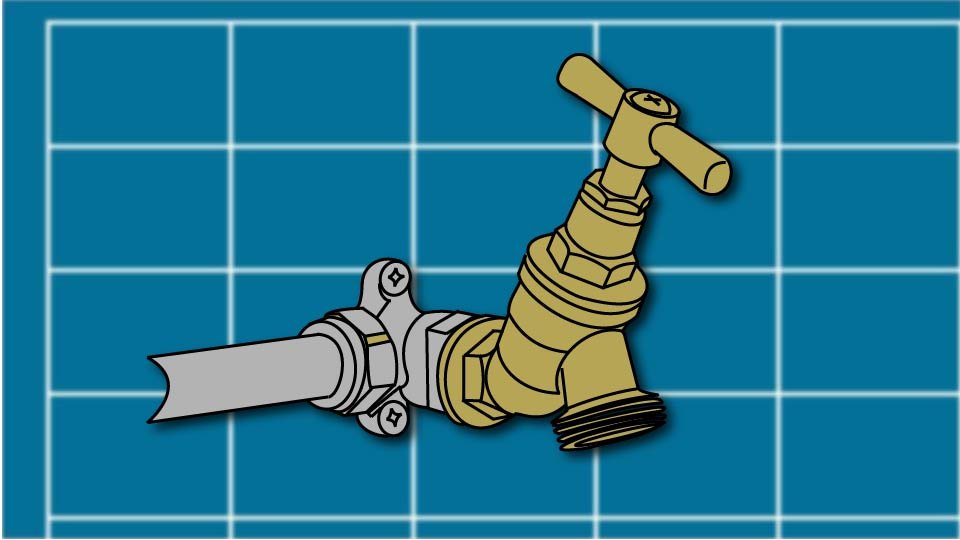
- A ball valve (lever handle, quarter-turn on or off) is the modern standard and the most reliable of the three.
- A gate valve (wheel handle, several full turns to open or close) is older and prone to sticking or failing after years of little use.
- A compression valve (a screw-down handle) is oldest of all and the most prone to leaking over time.
If any fixture in the house lacks its own shut-off valve, adding one is a small cost that prevents a much bigger problem the day that fixture needs a repair.
📈 Reading Your Own Pressure
- Below 30 PSI shows up as a weak shower, a slow-filling toilet, or an appliance that seems to take forever — usually pointing to a leak, a blocked line, or a failing PRV.
- Above 80 PSI shows up as banging pipes, leaking connections, or fixtures wearing out faster than they should — usually a faulty PRV or naturally high local pressure.
- 50 to 60 PSI is the healthy range, and a simple gauge that screws onto an outdoor spigot confirms exactly where a home actually sits, rather than guessing from symptoms alone.
🔍 Common Problems, Decoded
- No water at all points first to the main shutoff — check whether it’s accidentally closed before assuming a bigger issue.
- Low pressure everywhere suggests a leak, a blocked line, or a failing PRV.
- Low pressure at just one fixture is almost always a clogged aerator, the small screen at the faucet tip — remove and rinse it.
- Banging pipes point to pressure surges or a failing PRV. A leak at a connection is usually a worn washer or seal, fixable by shutting off that fixture’s valve and tightening or replacing the part.
- Discolored water that clears after running for a few minutes was just sediment; water that stays discolored is worth a plumber’s look.
🛒 Gear Worth Having
Water Pressure Gauge (Spigot-Mount) — A cheap, direct reading instead of guessing from symptoms — screws onto any outdoor faucet in seconds.
Ball Valve Shut-Off Kit — Individual, reliable shutoffs for any fixture that’s missing one — a small fix that prevents a much bigger emergency later.
Pipe Insulation Wrap — Prevents freezing on exposed lines in cold weather and cuts heat loss on hot water runs the rest of the year.
As an Amazon affiliate, I earn from qualifying purchases. Thank you for supporting SkippityWhistles.
📖 Related Reads
SkippityWhistles is part of the WhistleBump group – find the rest of the family at WhistleBump.com.
3020
©2026 John D Reinhart/Skippitywhistles.com — All rights reserved