
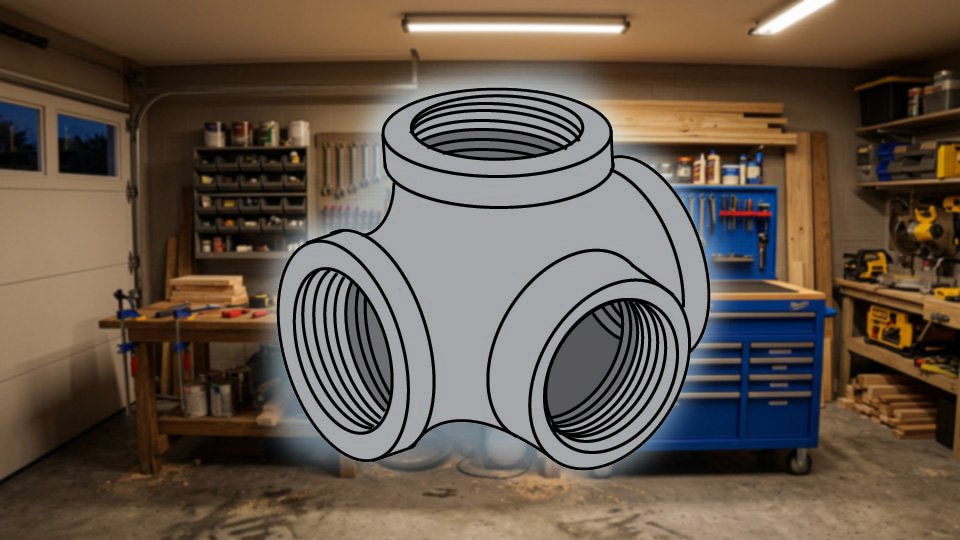
You’re standing in the plumbing aisle. There’s copper pipe. There’s white plastic pipe. There’s cream-colored plastic pipe that’s apparently different from the white plastic pipe. There are fittings shaped like elbows, T’s, and something having what can only be described as an identity crisis. And there’s nobody around to explain any of it.
Here’s the thing the aisle doesn’t tell you: these are not interchangeable. A copper fitting doesn’t work on plastic pipe. A PVC fitting doesn’t work on CPVC pipe even though they look identical. Use the wrong combination and your plumbing leaks, corrodes, or fails at the worst possible moment, which in plumbing is always.
The one principle that unlocks everything: pipe material determines fitting type. Full stop. Once you know what kind of pipe you’re working with, every other decision follows from that.
🔵 Copper: The Gold Standard (That Costs Like Gold)
Copper pipe is reddish-orange metal tubing. It’s been the premium choice in residential plumbing for decades and it earns that reputation — hot or cold water, underground or above ground, it lasts 50 years without complaint.
Why it’s great: Durable, reliable, and the fittings are soldered on, which creates a permanent seal that doesn’t leak, loosen, or degrade. Copper also has natural antimicrobial properties, which is a bonus nobody advertises.
Why it’s not always the answer: Soldering requires skill, heat, and flux. If you’re not comfortable with a torch, this is a call-a-plumber situation. It’s also expensive — the most expensive option in the aisle by a significant margin.
Type L is the common residential choice — medium thickness, good balance of cost and durability. Type K is thicker for main water lines. Type M is thinner and cheaper for lower-pressure applications.
⚪ PVC: The Budget-Friendly One With a Critical Limitation
PVC is white plastic pipe. It’s cheap, lightweight, easy to cut, and glues together with cement that chemically bonds the pipe and fitting into a permanent connection. No heat, no tools beyond a hacksaw and a can of cement.
Why it’s great: Drainage lines, vent lines, cold water supply. Affordable and genuinely reliable for what it’s designed to do.
The critical limitation: PVC is not rated for hot water. Heat softens it. Use PVC for hot water lines and you will eventually have a problem that is wet and expensive. This is the most common PVC mistake.
Schedule 40 is standard thickness for most applications. Schedule 80 is thicker for high-pressure or underground situations.
🟡 CPVC: PVC’s More Heat-Tolerant Cousin
CPVC is cream or tan colored — that’s how you tell it from PVC. Chlorinated PVC handles temperatures up to 200°F, which makes it suitable for hot water supply lines where regular PVC would eventually fail.
The trap everyone falls into: CPVC fittings and PVC fittings look almost identical. They are not compatible. CPVC cement and PVC cement are different products. Use PVC fittings on CPVC pipe and it will leak. Use PVC cement on CPVC and the bond fails. The color coding exists for a reason — pay attention to it.
🟥🟦 PEX: The Flexible Modern Choice
PEX is color-coded flexible plastic tubing — red for hot, blue for cold — that coils like a garden hose. It’s newer than the other options and increasingly popular because it’s flexible enough to run through walls and around obstacles without requiring as many fittings.
Why it’s gaining market share: No soldering, no glue, connects with crimp rings and a crimping tool. Flexible enough to navigate tight spaces. Handles both hot and cold water. Freeze-resistant compared to copper.
The limitation: UV degrades it, so it’s not for outdoor or exposed applications. Some older municipalities haven’t adopted it yet — worth checking local codes before using it for main supply lines.
⚫ Galvanized Steel: The One You’re Replacing, Not Installing
Dull gray metal pipe, usually crusty, found in houses built before 1960. It was coated in zinc for corrosion resistance and it worked — for a while. The problem is it corrodes from the inside out. Water pressure drops as the interior narrows. Eventually it needs replacing.
If you see galvanized pipe, you’re looking at history. It’s not a choice for new work — it’s a project waiting to happen. When you join new pipe to old galvanized, use transition fittings. Different metals corrode each other when in direct contact. The fitting bridges the gap safely.
🔧 The Fittings: What Each Shape Does
Once you know your pipe type, the fittings make sense quickly:
- Elbows — change direction. 90 degrees or 45 degrees. When the pipe needs to turn, you need an elbow.
- Tees — shaped like the letter T. One pipe branches into two, or two lines meet one. Required whenever you’re splitting a line.
- Couplings — join two pipes end to end in a straight line. Simple sleeve, slides over both ends.
- Reducers — like a coupling but one end is larger than the other. For connecting pipes of different diameters.
- Unions — connect two pipes but can be unscrewed later. Use these anywhere you might need to disconnect for future repairs or fixture replacement. Use a regular coupling and you’re cutting pipe later.
- Transition fittings — one end is one material, the other end is another. Copper to PVC, PVC to galvanized. When you’re joining different pipe materials, this is the fitting. Don’t improvise.
❌ The Mistakes Worth Avoiding
- PVC on hot water lines. It softens. It fails. Use CPVC or copper.
- PVC fittings on CPVC pipe. They almost fit. They don’t seal. The color difference is the warning.
- Skipping thread sealant on threaded connections. Threads alone don’t seal. Plumber’s tape or pipe dope on every threaded joint, every time.
- Copper against galvanized without a transition fitting. Dissimilar metals corrode each other at the joint. The fitting exists specifically for this situation.
- Over-tightening. Tight enough is enough. Tighter cracks fittings and strips threads. The goal is a seal, not a record.
🛒 The Stuff Worth Having
- Plumber’s tape (PTFE thread seal tape) — Every threaded connection needs it. Cheap, essential, buy it in bulk. The single most useful thing in the plumbing aisle.
- PVC cement and CPVC cement — Different cements for different pipes. Having both means you’re never tempted to use the wrong one.
- PEX crimping tool — If you’re working with PEX, this tool is non-negotiable. Creates the crimp connection that holds everything together. Not a job for improvised tools.
- Pipe wrench set — For threaded connections. The adjustable grip does the work without rounding off fittings. Two wrenches — one to hold, one to turn — is the correct approach.
As an Amazon affiliate, I earn from each qualifying purchase. Thank you for supporting Skippity Whistles.
✨ The Short Version
Copper lasts forever and requires soldering. PVC is cheap and easy but cold water only. CPVC handles hot water and is not PVC. PEX is flexible and modern and color-coded for a reason. Galvanized is old and on its way out.
Match fittings to pipe type. Use transition fittings when materials change. Thread sealant on every threaded joint. Know where the main shutoff is before you start anything.
The plumbing aisle is not complicated. It just looks that way until someone explains the rules. Now you have the rules.
📚 Related Reads
- How Your Home’s Plumbing System Actually Works
- How P-Traps and S-Traps Work
- Water Supply 101: From Main to Tap
SkippityWhistles is part of the WhistleBump group – find the rest of the family at WhistleBump.com.
3026
©2026 John D Reinhart/Skippitywhistles.com — All rights reserved