
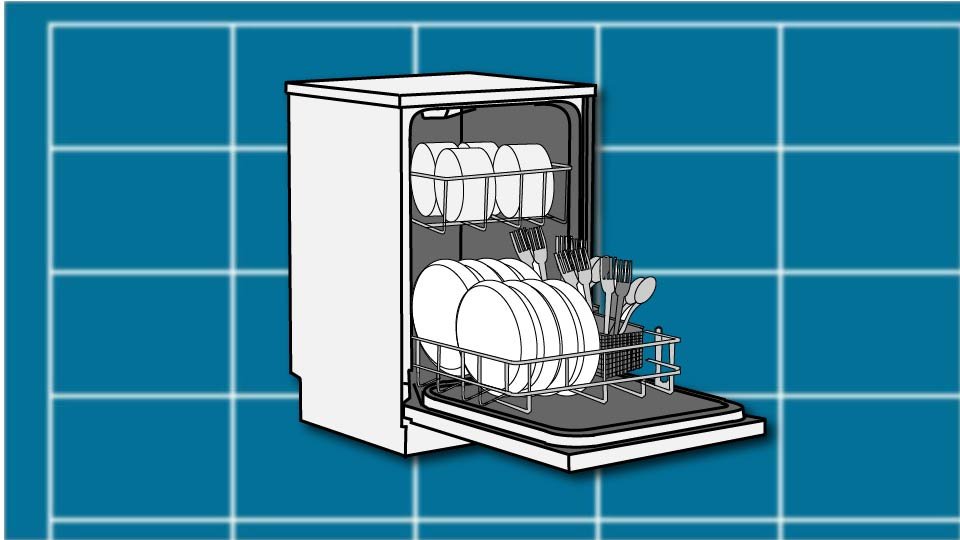
Ron’s dishwasher kept leaving a puddle of standing water in the bottom of the tub after every cycle, along with a faint smell he genuinely blamed on the machine getting old. He almost called for service before a friend crouched down, looked at the drain hose running along the cabinet floor, and pointed out that it never rose above the level of the sink drain it connected to — which meant water had nowhere to go but sit there. Ron’s dishwasher wasn’t old or broken. Its hose was just installed wrong from day one. Oops. Did you install that yourself, Ron?
A dishwasher is really a small, self-contained plumbing system tucked into a cabinet — it fills, sprays, drains, and repeats, and most of what goes wrong with it traces back to one of those four steps rather than the machine itself.
💧 The Basic Concept
Water enters through an inlet, gets pushed through spray arms by a pump, and eventually drains back out through a separate pump and hose — fill, spray, drain, repeat, on a timed cycle.
Understanding those four stages is most of what’s needed to diagnose almost anything that goes wrong.
🔥 Hot Water In
A dishwasher connects specifically to the hot water line, not cold — hot water dissolves detergent more effectively and cleans better across the board.
A flexible supply line runs to an inlet valve that opens and closes to control flow, releasing water into the bottom of the tub.
- If the dishwasher won’t fill, the inlet valve is usually stuck or the supply line is kinked
- a slow fill often means sediment clogging the valve’s screen
- lukewarm results usually trace back to the water heater itself not running hot enough, or a supply line long enough that water cools before arriving.
💦 Getting Water to the Dishes
A lower spray arm rotates near the bottom of the tub, and an upper arm covers the top rack — both powered purely by water pressure forcing them to spin as it sprays through their holes.
Clogged holes from food particles or mineral deposits, a cracked arm, or debris jamming the rotation are the most common reasons dishes come out less than clean.
Checking the spray arms first, before anything else, catches the majority of “my dishes aren’t getting clean” complaints.
Soaking a removed arm in hot water with vinegar dissolves mineral buildup, and a toothpick clears individual clogged holes — a genuinely free fix in most cases.
🌡️ Temperature and Detergent
Many dishwashers heat water internally during the cycle to reach an optimal cleaning temperature, typically 140 to 150°F. This means the water heater itself doesn’t need to run scalding hot — the dishwasher does additional heating on its own.
Detergent releases at specific points in the cycle through a spring-loaded dispenser cup.
If it’s not dissolving properly, low water temperature is the more likely culprit than the detergent itself.
⬆️ The Drain System, and the Rule That Trips Everyone Up
A drain pump creates suction at the end of the cycle, pulling dirty water out through a flexible hose running to the kitchen drain. Sometimes the water will be run through an air gap – a small cylinder, usually on the countertop, that prevents dirty sink water from siphoning back into the dishwasher.
The detail almost nobody knows going in: a dishwasher drain hose cannot drain uphill. If the hose runs up and then back down to reach the kitchen drain, that high point has to actually be the highest point in the run — a proper loop, well above the water level, before descending to the drain.
Without that loop, or if there’s a low spot anywhere along the hose where water can pull, the result is exactly what happened to Ron: standing water in the tub, a slow drain, and a smell that has nothing to do with the machine’s age.
🧽 The Filter: Catching What Shouldn’t Go Down
Most modern dishwashers have a filter at the tub’s bottom, catching food particles before they can clog the drain pump or get stuck in the spray arms.
A dirty filter is genuinely the single most common cause of dishwasher performance complaints.
Rinsing it under hot water and scrubbing lightly with an old toothbrush every one to two weeks (more often with heavy use) is a thirty-second habit that prevents a real share of service calls.
💧 Diagnosing a Leak by Where It Shows Up
- Water leaking during the cycle itself usually points to the door seal or, less commonly, a crack in the tub.
- Water under the dishwasher points to a supply or drain hose connection worth tightening by hand first.
- Water around the door specifically points to a worn or dirty door seal. Most door seals pull free by hand along the track they’re seated in, without tools. Run a finger along the gasket to find the edge, then peel it out gently before. Soaking it in hot water with vinegar sometimes restores a seal that’s just built up detergent residue rather than genuinely failed.
🧹 Keeping It Running
- Clean the filter monthly at minimum.
- Run it with genuinely hot water rather than lukewarm, since cold water hurts both cleaning and drainage.
- Use the correct amount of detergent — too much causes oversudsing, too little leaves residue.
- Confirm the drain hose is properly looped, not flat or kinked.
- And don’t let a small leak sit — a slow drip today is water damage under the cabinet tomorrow.
📞 When to Call a Professional
These items are all well past the DIY line:
- grinding motor noises
- any sign of electrical trouble like sparking or a burning smell
- a cracked tub
- or genuine uncertainty about a repair .
Electrical components, the heating element, and internal sensors or timers are worth leaving to someone qualified — knowing where that line sits is good judgment, not a failure to fix it yourself.
🛒 Gear Worth Having
Dishwasher Filter Replacement — Cheap insurance against the single most common cause of dishwasher performance complaints — worth keeping a spare on hand.
Dishwasher Drain Hose Kit — For routing a proper high loop the way Ron’s never had — straightforward to install and solves standing water at the source.
Dishwasher Door Seal/Gasket Replacement — The most common leak source on any dishwasher — confirm the model number before ordering, since seals are model-specific.
As an Amazon affiliate, I earn from qualifying purchases. Thank you for supporting SkippityWhistles.
📖 Related Reads
SkippityWhistles is part of the WhistleBump group – find the rest of the family at WhistleBump.com.
3030
©2026 John D Reinhart/Skippitywhistles.com — All rights reserved