Ron’s kitchen faucet developed a drip a few years back, and his solution was to crank the handle a little harder every time he shut it off — reasoning, more or less, that if a little pressure stopped ninety percent of the drip, a lot of pressure should stop all of it. It didn’t. It just wore out the handle faster and left him twisting it like Godzilla twice a day.
A faucet looks like one lever controlling water, but underneath the handle is a specific valve mechanism doing the actual work — and which mechanism you’ve got determines both why it eventually drips and what fixing it actually involves.
🔀 Four Valve Types, One Job
Nearly every residential faucet uses one of four internal valve types.
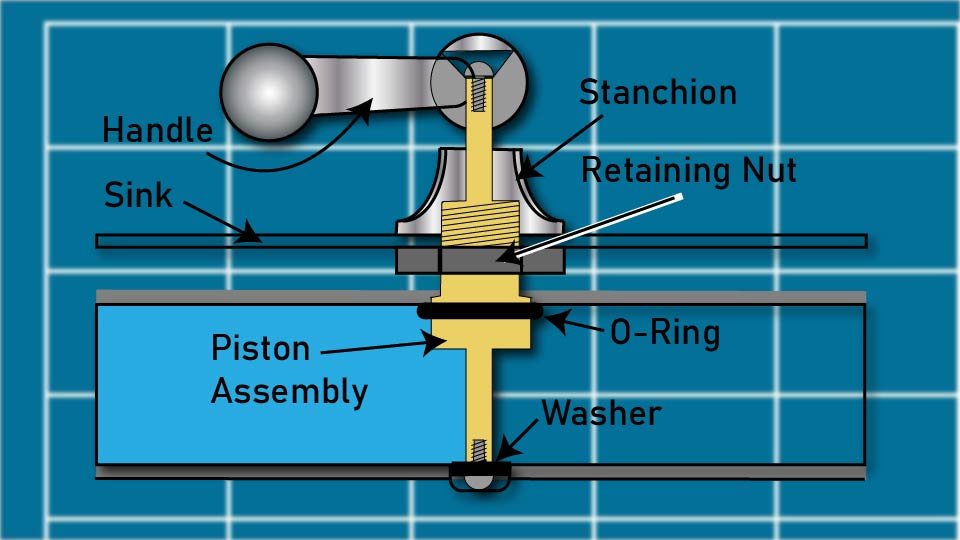
- A compression valve (the oldest style, using a rubber washer that compresses against a valve seat to stop flow) is common in older two-handle faucets and is the type most prone to dripping, since the washer wears with every use.
- A cartridge valve uses a replaceable cartridge (a self-contained unit that controls both flow and temperature) that slides or turns to open and close — common in modern single-handle faucets.
- A ball valve uses a slotted metal or plastic ball that rotates to align with inlet ports, common in older single-handle kitchen faucets.
- A ceramic disc valve uses two closely fitted ceramic discs that slide across each other to control flow, found in many higher-end modern faucets, and tends to be the most drip-resistant of the four because ceramic doesn’t wear the way rubber does.
💧 Why Faucets Actually Drip
- A compression faucet drips because the washer has worn down and no longer seals fully against the valve seat (the fixed surface inside the faucet body that the washer presses against to stop water flow) — the fix is a new washer, and sometimes a resurfaced or replaced seat if it’s become pitted.
- A cartridge faucet drips when the O-rings (small rubber rings that seal around the cartridge to prevent leaks) inside or around the cartridge harden and lose their seal, or when the cartridge itself wears out internally — the fix is usually a full cartridge swap rather than an individual seal, since cartridges are sold and serviced as one unit.
- Ball and ceramic disc valves drip less often, but when they do, it’s typically worn internal seals or springs, and again the repair path is usually a manufacturer-specific replacement part rather than something generic.
🌬️ The Aerator: A Different Kind of Problem
An aerator (the small mesh screen screwed onto the tip of a faucet spout that mixes air into the water stream) doesn’t cause drips, but it’s the most common reason for reduced water pressure or a sputtering stream. Mineral deposits build up in the screen over time, especially in hard-water areas, and clog the small openings. Unscrewing and rinsing or replacing the aerator solves a shockingly large share of “my faucet feels weak” complaints that have nothing to do with the valve at all.
🔧 One Handle vs. Two: Why It Changes the Repair
A two-handle faucet almost always uses compression valves — one per handle, one controlling hot, one controlling cold — which means each side can fail independently and each has its own washer and seat. A single-handle faucet uses one of the other three valve types, controlling both temperature and flow through a single mechanism, which means there’s exactly one part doing all the work, and exactly one part to replace when it fails.
🤔 Repair or Replace: Reading the Signs
A dripping faucet with a sound body and finish is almost always worth repairing — replacement parts for all four valve types are inexpensive and widely available, and the labor is usually shorter than a trip to the hardware store to buy the part. Replacement becomes the better call when the faucet body itself is corroded, when the specific cartridge or valve for an older or discontinued model is no longer available, or when a persistent leak has already caused damage to the surrounding fixture. As with most fixture repairs, matching the specific cartridge or valve model to your exact faucet brand is the detail that makes or breaks the fix — and it’s a detail worth confirming visually against your own faucet before buying anything, since even faucets from the same manufacturer often use several different cartridge designs across their product lines.
You can find a ton of YouTube videos showing you how to make the repairs we’ve discussed here, and how to make the replacement when things get drastic.
🛒 Gear Worth Having
Moen 1225 Cartridge Replacement — One of the most common single-handle cartridges in circulation, worth checking against your own faucet before assuming you need something more exotic.
Danco Faucet Repair O-Ring Assortment — Covers the range of O-ring sizes across most compression and cartridge faucets, so one kit answers most “which size do I even need” moments.
American Standard Water-Saving Aerator — A five-minute swap for a spout that’s been sputtering or running weak, and cheaper than assuming the whole faucet needs replacing over a clogged screen.
As an Amazon affiliate, I earn from qualifying purchases. Thank you for supporting SkippityWhistles.
📖 Related Reads
- Seals, Gaskets, and Thread Tape: Why They Matter
- Understanding P-Traps and S-Traps
- Tools for Working With Plumbing Systems
SkippityWhistles is part of the WhistleBump group – find the rest of the family at WhistleBump.com.
3015
©2026 John D Reinhart/Skippitywhistles.com — All rights reserved