Ron came inside on a 95-degree afternoon and cranked the thermostat down to 60, reasoning that a lower number would cool the house faster — more cold, sooner. It didn’t work that way. The compressor ran at exactly the same rate it would have at 72, and all Ron actually did was guarantee the AC kept running long after the house was already comfortable, chasing a number it was never going to need to hit.
Air conditioning doesn’t make cold air. It moves heat — takes it from inside the house and dumps it outside, leaving cooler air behind as the result. Once that clicks, the whole system, including exactly why Ron’s thermostat trick never works, makes sense.
🪣 Two Buckets, Not Magic
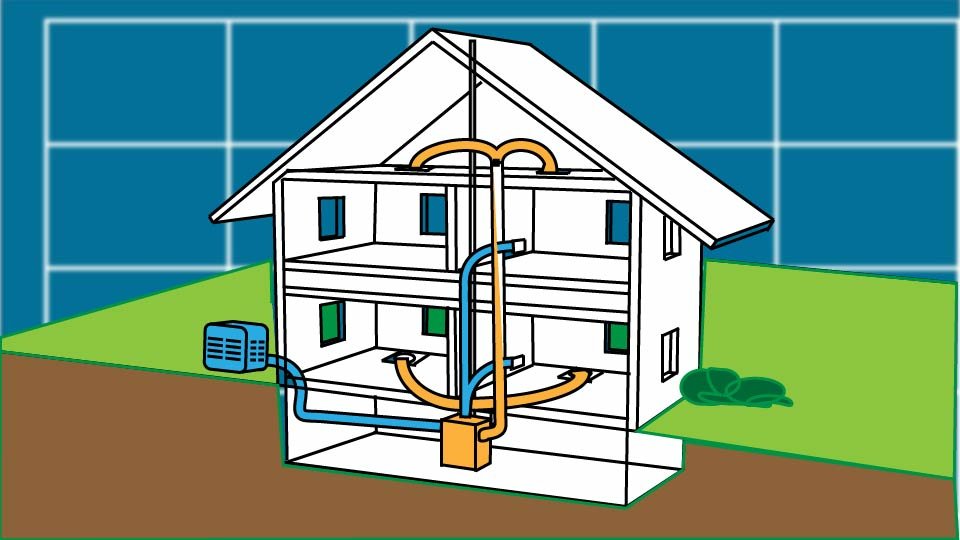
Bucket 1 is the refrigerant cycle, mostly happening in the outside unit — this is the actual engine doing the work.
Bucket 2 is your house air, the beneficiary riding along on whatever Bucket 1 accomplishes.
Bucket 1 runs the same way regardless of what’s happening in Bucket 2; it doesn’t work harder because the house feels warmer, it just runs until the thermostat tells it to stop.
🔧 Bucket 1: The Refrigerant Cycle
- Compression happens first: the compressor squeezes refrigerant into a smaller space, and pressure and temperature both spike, often to 120 to 150°F depending on how hard the compressor has to work against the outside temperature.
- Condensation follows: outside air blows across the condenser coil, the hot refrigerant releases that heat outward, and it cools back into a liquid, down around 40 to 50°F.
- Expansion comes next: the liquid refrigerant passes through a tiny valve, pressure drops suddenly, and temperature plunges into the 30s — this sudden cold is what makes the next step possible.
- Evaporation happens inside: that very cold refrigerant flows through the evaporator coil, house air blows across it, and heat transfers from your air into the refrigerant, cooling the air and warming the refrigerant slightly before it heads back to the compressor to start over.
The whole loop is closed — refrigerant doesn’t get “used up” the way gas does in a car. If a system needs a refill, that’s a leak, not depletion.
🏠 Bucket 2: Your House Air
- The evaporator coil sits directly in your home’s airflow
- A blower pushes house air across it, then out through the ducts into every room.
Your air never actually touches the refrigerant directly — the cold coil is the go-between, absorbing heat from the air on one side and handing it to the refrigerant on the other. Bucket 2 doesn’t control any of this. It just gets cooled as a byproduct of Bucket 1 doing its job.
🌡️ The Thermostat: A Switch, Not a Dial
This is exactly where Ron went wrong.
A thermostat doesn’t tell the compressor to work harder or cool more aggressively — it simply monitors house temperature and switches the whole system on or off.
Hit the set point, and it shuts the compressor down. The house naturally warms a degree or two, and the thermostat switches it back on.
Setting a lower number doesn’t make the compressor run harder or the air any colder — it just keeps the system running longer, chasing a temperature that was never actually necessary to reach in the first place.
The only real control a thermostat gives you is when the system runs, never how intensely.
📦 Why Both Units Matter Equally
The outside unit houses the compressor and condenser coil — genuinely the heavy lifting, and where most of the electricity gets spent.
The inside unit is quieter specifically because it isn’t compressing anything or dumping heat anywhere; it’s just delivering the result.
Neither one does anything useful without the other — an outside unit running with no inside unit just wastes energy dumping heat nobody benefits from, and an inside unit with no working outside unit has nothing cold to work with at all.
🚫 Common Misconceptions Worth Retiring
- Air conditioning doesn’t create cold air — it moves heat, and the cold you feel is really the absence of heat that just got relocated outside.
- The thermostat doesn’t control cooling intensity, only whether the system runs.
- Refrigerant doesn’t deplete on a schedule the way fuel does; needing a refill always means a leak, which is a real problem worth a professional’s attention, not routine maintenance.
- And a system running continuously, all day without cycling off, usually points to an undersized system or a thermostat set unrealistically low — not to a healthy AC working exactly as intended.
💰 Why It Genuinely Costs Money to Run
Moving heat against its natural direction — from cool space to hot outside air — takes real energy, and the compressor alone can account for 30 to 50 percent of a summer electric bill.
The bigger the gap between inside and outside temperature, the harder the whole system works: 72°F inside against a 95°F day costs meaningfully more to maintain than 78°F inside on the same day.
A few degrees of thermostat difference in summer can genuinely mean $20 to $30 a month, without changing comfort nearly as much as it changes the bill.
🔍 Reading the Symptoms
- Running but not cooling well usually means a dirty filter, a refrigerant leak, or a blocked outside unit — something interfering with heat transfer rather than the system itself failing outright.
- Constant cycling without ever shutting off points to a thermostat set too low or a system undersized for the house.
- A frozen-over inside unit usually means restricted airflow, often a dirty filter, or refrigerant pressure running low.
- No air from the vents despite the system running suggests a blower motor failure or blocked ducts.
- And most AC complaints, genuinely, trace back to a dirty filter or debris blocking the outside unit — a $15 filter solves a real share of these before they ever need a service call.
🛒 Gear Worth Having
HVAC Air Filter Multi-Pack — Confirm your system’s exact size, then replace monthly through cooling season — the single highest-value habit on this whole list.
Condenser Fin Comb — Straightens the thin aluminum fins on the outside unit that debris and time tend to bend flat, restoring the airflow the whole system depends on.
WiFi-Enabled Smart Thermostat — Scheduling and remote access save real money over a season, even though it still only controls when the system runs, not how hard.
As an Amazon affiliate, I earn from qualifying purchases. Thank you for supporting SkippityWhistles.
📖 Related Reads
SkippityWhistles is part of the WhistleBump group – find the rest of the family at WhistleBump.com.
3031
©2026 John D Reinhart/Skippitywhistles.com — All rights reserved