Ron noticed his shower draining a little slower than usual the same week his toilet started gurgling whenever the washing machine emptied out. He treated them as two separate problems — bought a drain cleaner for the shower, shrugged at the toilet — because a slow shower and a gurgling toilet don’t look like they have anything to do with each other. They did. Both were symptoms of the exact same downstream problem, and treating them separately meant Ron fixed neither.
You flush a toilet, water disappears. You pull a drain plug, water vanishes. This feels like the bare minimum a house should do — until one day it doesn’t disappear quite as fast, then slower still, then not at all. Most people call a plumber at that point with no idea what they’ll find. Drain problems almost always come down to the same handful of causes, and once the system makes sense, those causes stop being mysterious.
⬇️ The Fundamental Principle: Gravity Does Everything
The water supply system works because of pressure, pushing water to your fixtures. The drainage system works on the opposite principle entirely: gravity.
There are no pumps in a residential drain system — water flows downhill through pipes deliberately angled to keep it moving. Too steep, and water rushes through faster than it can carry solid waste, leaving debris behind. Too shallow, and water crawls, letting solids settle out before they reach the main line.
The correct slope is about 1/4 inch of drop per foot — barely visible to the eye, but exactly enough to keep everything moving. A slow drain with no obvious clog often traces back to incorrect slope.
🔄 The Journey from Fixture to Sewer
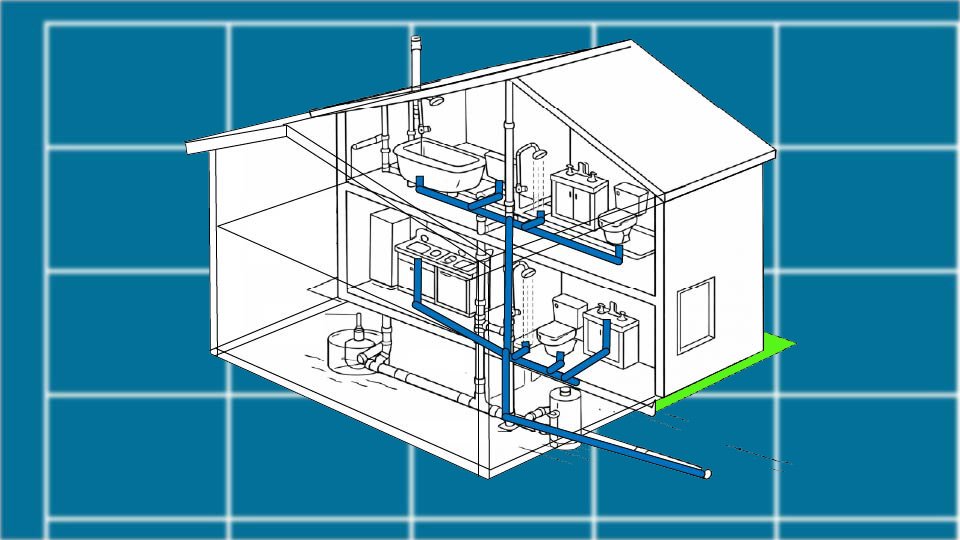
Water leaving a sink, shower, or toilet enters a small drain pipe, typically 1.5 to 2 inches wide, and reaches the first key component: the P-trap (also called a U-bend — the curved section of pipe under every sink that dips down and back up before continuing to the wall).
That water sitting in the trap holds a seal that keeps sewer gases from traveling back up into the house — the entire reason plumbing doesn’t smell like what it’s actually connected to.
From there, water flows into a branch drain, joins other branch drains into the main drain line, and exits through the foundation to the sewer or septic system.
Fixture drain to P-trap to branch drain to main line to sewer — gravity-powered the whole way.
💨 The Vent System: The Invisible Part That Makes Everything Work
A network of vent pipes runs from the drain lines up through the house and out through the roof — the pipes visible poking through the shingles.
As water flows down a drain, it pushes air ahead of it, and without somewhere for that air to escape, pressure changes build up inside the pipe. Those changes make drains gurgle, can siphon water straight out of P-traps, and slow the whole system down.
Vent pipes connect the drain system to outside air, equalizing that pressure so water can flow smoothly and sewer gases can escape outward instead of into the house.
When a vent gets blocked — ice, leaves, a bird’s nest — the symptoms are distinctive: gurgling drains, multiple fixtures slowing down at once, and P-traps siphoned dry enough to let sewer smells through.
Clearing a blocked vent usually means getting on the roof, which is worth handing to a professional.
🔍 Reading the Symptoms
- A slow drain at just one fixture is almost always a partial clog right there — hair, soap scum, debris — and it’s the most common, most fixable drain problem in any home.
- Multiple drains slowing down at the same time, the way Ron’s shower and toilet did together, points downstream of any single fixture: a main line blockage or a blocked vent, not something a single drain cleaner will touch.
- Gurgling is the sound of air fighting its way through water in a trap because the vent can’t supply air fast enough — usually a partially blocked vent.
- A sewer smell means a P-trap has lost its seal, either from drying out in a rarely-used drain (pour water down it — problem solved) or from being siphoned dry by a vent issue (if the smell returns within days, that’s the more likely cause).
- Water backing up out of a drain means a main line blockage, and that’s a call to a plumber immediately — not a DIY project, since a backup can introduce sewage into living space.
🛡️ What Actually Keeps Drains Running
- Hair and soap buildup cause the vast majority of slow drains — a simple drain screen at every shower and tub catches hair before it combines with soap residue into a growing blockage; emptying it takes ten seconds, snaking a clogged drain takes considerably longer.
- Keep grease out of kitchen drains entirely, since it solidifies as it cools and accumulates into a real blockage over time — wipe greasy pans before washing rather than rinsing grease straight down.
- Running hot water down a drain occasionally helps keep soap residue moving instead of building up on the pipe walls — maintenance, not a cure for an existing clog.
- And know where the cleanout -a capped pipe – is located, today. It’s usually in the basement, crawlspace, or near the foundation outside, giving direct access to the main drain line before an emergency makes finding it urgent.
🛒 Gear Worth Having
TubShroom Revolutionary Tub Drain Hair Catcher — Sits inside the drain and catches hair around the stem while water flows freely past — pull it out, wipe it off, done. The best few dollars spent on preventing a clog before it starts.
25-Foot Drum Drain Snake Auger — For the clog the hair catcher didn’t prevent and the plunger didn’t clear — twenty-five feet of cable that handles most household drain clogs without a service call.
Neiko 4-Piece Plunger Set (Cup and Flange) — A flat cup plunger for sinks and tubs, a flanged one that seats into a toilet bowl properly — the right shape for each job clears most partial clogs in thirty seconds.
As an Amazon affiliate, I earn from qualifying purchases. Thank you for supporting SkippityWhistles.
📖 Related Reads
SkippityWhistles is part of the WhistleBump group – find the rest of the family at WhistleBump.com.
3021
©2026 John D Reinhart/Skippitywhistles.com — All rights reserved