
Ron’s bathroom sink has gurgled softly for as long as he’s lived in the house, and for just as long, he’s filed it under “personality quirks of an old house,” somewhere between the creaky third stair and the light switch that does nothing. It’s not a personality quirk. It’s a blocked or undersized vent, quietly failing to do a job Ron never knew existed — because nobody ever explained that plumbing has a third system, and it’s the one making all the noise.
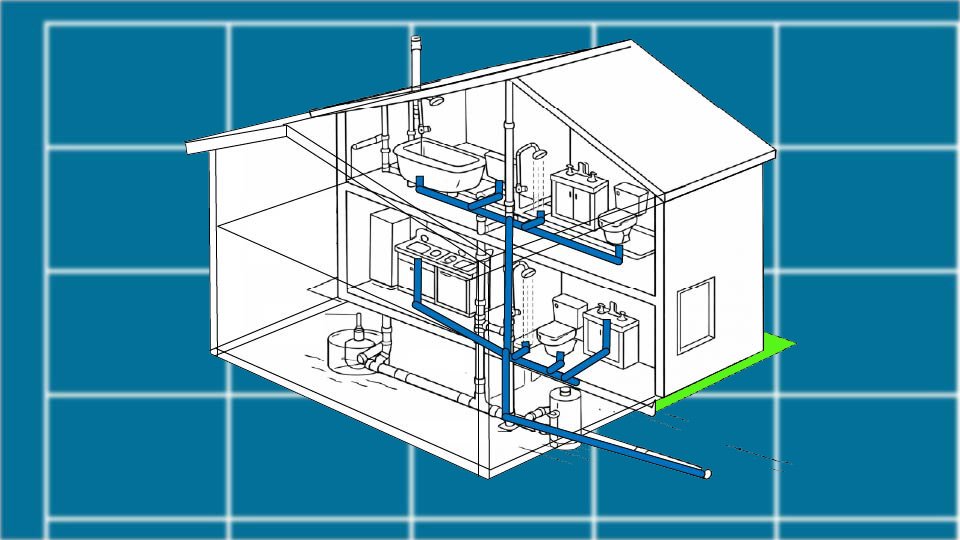
Turn on a faucet, water flows. Flush a toilet, water disappears. It looks simple because the actual system is hidden entirely inside your walls — but it’s really three separate systems working together, and once you know what each one does, a gurgle, a smell, or a slow drain all stop being mysteries.
💧 Three Systems, One Job
The water supply system uses pressure to push water in. The drain-waste system uses gravity to pull water back out. The vent system, the quiet one nobody thinks about, keeps air balanced so the other two can actually do their jobs without fighting each other. Understand those three, and the whole house makes sense.
⬆️ Supply: Pressure Brings It In
Water enters through a main supply line, usually buried underground, arriving under real pressure — typically around 50 PSI from the city main.
Inside the house, a main shutoff valve controls all of it, and the line splits into cold (straight to the fixtures) and hot (routed through the water heater first).
That pressure is doing more work than it gets credit for: it’s what makes a shower feel strong, what fills a washing machine, what refills a toilet tank after a flush.
A sudden drop in pressure anywhere in the house is the supply system’s way of reporting a leak, a partially closed valve, or a real supply problem.
⬇️ Drain-Waste: Gravity Takes It Out
Once water leaves a faucet and enters a drain, pressure stops mattering entirely and gravity takes over completely.
Drain pipes slope downward at a deliberate, specific angle — about 1/4 inch per foot — carrying water from fixture drains into branch drains, into the main drain line, and finally out to the sewer or septic system.
Too steep a slope and water rushes past solids, leaving them behind to clog later. Too shallow and water crawls, letting solids settle where they sit. That narrow correct range is exactly why a plumber’s first move on a slow drain is often checking slope, not reaching for a snake.
Under every sink sits a P-trap (a curved section of pipe shaped like a P or U), holding a small standing pool of water that seals the drain against sewer gases rising back up into the house. If a drain smells like sewage, the trap is either dry — pour water down it — or it’s failed outright, which is a call to a plumber.
🌬️ Vent: The Silent System Nobody Thinks About
Vent pipes connect the drain system to open air, usually exiting through the roof.
As water rushes down a drain, it creates pressure changes inside the pipe — without somewhere for air to enter and equalize that change, drains gurgle, traps can get siphoned dry, and the whole system starts misbehaving in small, confusing ways.
A blocked vent — ice, leaves, even a bird’s nest — is exactly what turns into Ron’s “quirky” gurgling sink, a slow toilet, or an unexplained sewer smell. It’s invisible right up until it fails, and then it explains almost everything at once.
🔄 The Whole Sequence, In Order
Washing your hands runs through all three systems in seconds: pressurized water travels through the supply line and reaches the faucet. You use it, then release it down the drain, where gravity takes over. It passes through the P-trap, which stays filled and sealed behind it. It flows along the sloped drain line toward the main.
Air enters through the vent system the entire time, equalizing pressure so nothing gurgles or siphons. And the wastewater finally reaches the sewer or septic system, job complete, without you ever thinking about any of it.
🔍 Common Symptoms, Decoded
- A slow drain usually means improper slope, a partial clog, or a blocked vent — gravity can’t do its job if the path is obstructed.
- Gurgling sounds mean a blocked vent, air escaping the only way it can, through water.
- A sewer smell means a dry or failed P-trap, the seal no longer sealing.
- A weak faucet or shower points to the supply side — a partially closed valve, a leak, or a genuine pressure problem somewhere upstream.
- A sudden backup across multiple fixtures at once points to the main line itself, and that one’s a call to a plumber, not a DIY afternoon.
🛒 Gear Worth Having
Plunger Set, Cup and Flange — A flat cup plunger for sinks and tubs, a flanged one for toilets — the two shapes solve two genuinely different sealing problems.
P-Trap Replacement Kit — A quick, inexpensive fix the moment a trap fails — cheaper than a plumber call for a problem this straightforward.
Rechargeable Headlamp Flashlight — Frees both hands for the actual work, which matters most in the dark cramped cabinet under a sink where most of this happens.
As an Amazon affiliate, I earn from qualifying purchases. Thank you for supporting SkippityWhistles.
📖 Related Reads
- How to Shut Off the Water to Your House
- How Your Sewer Line Works
- Tools for Working With Plumbing Systems
SkippityWhistles is part of the WhistleBump group – find the rest of the family at WhistleBump.com.
3019
©2026 John D Reinhart/Skippitywhistles.com — All rights reserved