
Ron’s guest bathroom sat mostly unused for a few months, and one day it started smelling faintly of sewer gas for no obvious reason. He checked for a leak, sniffed around the toilet, and came up with nothing — because the actual problem wasn’t a leak at all. It was the opposite: nothing had been leaking, running, or flushing in that bathroom long enough for the water sitting in the drain to simply evaporate away.
That curved pipe under every sink isn’t decorative. It’s a trap, and the water sitting inside it is doing genuinely critical work every hour of every day — right up until it isn’t there anymore.
🔑 The Core Principle: Water Is the Barrier
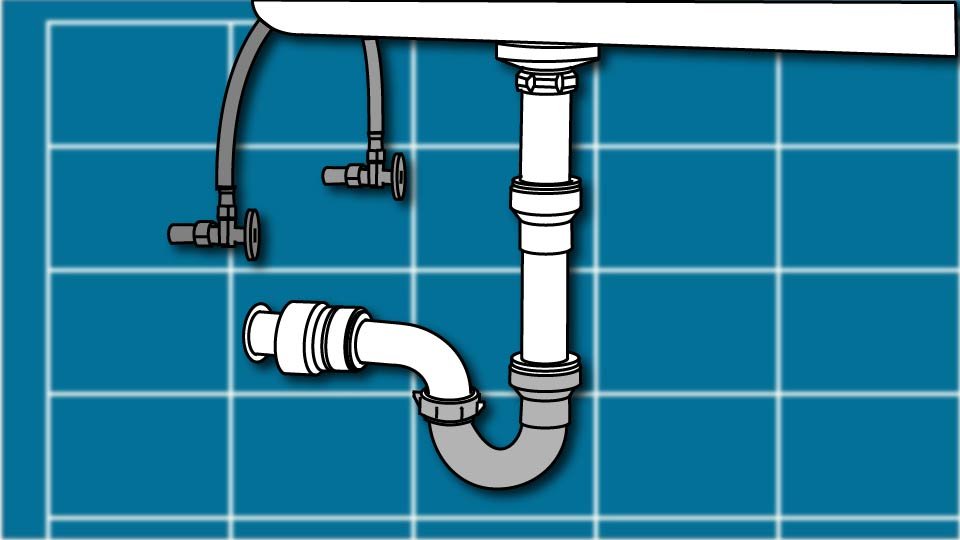
Every drain in a house — sink, toilet, shower, laundry — has a trap, a U-shaped or S-shaped bend in the pipe that holds a small standing pool of water.
That water creates a seal, and sewer gas simply cannot pass through standing water.
No water, no seal, no barrier — that’s the entire mechanism, simple enough to state in one sentence and important enough to build a whole plumbing code around.
Every time a sink gets used, the old trap water gets pushed out and replaced with fresh water, quietly resetting the seal without anyone thinking about it.
🔤 P-Trap vs. S-Trap
A P-trap is shaped like the letter P from the side, with one vertical and one horizontal section. It’s the modern standard, sitting under most current sinks. Its horizontal section includes a cleanout — a fitting that unscrews for clearing clogs without replacing the whole assembly.
An S-trap is the older version. Shaped like an S with two vertical curves, it was common in pre-1960s construction, and comes with a real design flaw: it’s fast. The quickly-draining water can create a siphon effect strong enough to pull the trap’s own water seal out along with it, leaving the trap dry and the seal gone.
Modern plumbing code actually prohibits new S-trap installations for exactly this reason — if a home still has one, replacing it with a P-trap is a genuine reliability upgrade, not just a cosmetic one.
🏜️ Why Traps Actually Dry Out
- An unused fixture is the most common cause — a guest bathroom nobody visits for weeks lets the trap’s water slowly evaporate away with nothing to refill it, exactly what happened to Ron.
- An S-trap can siphon itself dry during a single fast, heavy drain, no waiting required.
- And a slow leak near a fixture can mean the trap never gets enough fresh water to maintain a proper seal in the first place.
All three point to the same fix in the simplest case: run water down the drain, and a genuinely dry trap refills and reseals within seconds.
🚫 The Mistakes Worth Avoiding
- Removing a trap to “speed up drainage” trades a barely-noticeable slowdown for an open connection straight to the sewer — never worth it.
- Installing a sink without a trap violates both code and basic sense. Leaving an old S-trap in place after learning what it is just invites a repeat of the same siphon problem.
- Pouring something other than water down a drain and not following it with a water rinse leaves that substance sitting in the trap instead of flushing through — it settles, dries, and starts producing its own smell independent of the sewer gas question entirely.
- And reaching for harsh chemical drain cleaners before trying a plunger or a mechanical snake risks damaging the trap material itself for a problem gentler tools usually solve just fine.
🔧 The Cleanout: Where Clogs Actually Get Cleared
Most P-traps have a cleanout at the bottom — a nut that unscrews by hand, giving direct access to clear whatever’s stuck inside without disassembling the whole trap. Knowing exactly where it is before a clog happens turns a frustrating afternoon into a five-minute fix. If a bathroom ever starts smelling like sewer gas with no obvious cause, running water in that fixture for a minute solves it immediately if a dry trap was the culprit — and if the smell comes back within days, that’s usually a sign of an S-trap’s siphon effect rather than simple evaporation.
🛒 Gear Worth Having
P-Trap Replacement Kit (Standard 1.5-Inch) — Everything needed to swap out a damaged trap or finally retire an old S-trap for a modern, reliable one.
DrainX 25-Foot Drum Drain Snake Auger — For the clog a plunger alone won’t clear, without reaching for harsh chemicals that can damage trap material.
Enzymatic Drain Cleaner, Non-Caustic — Breaks down organic buildup gently, without the pipe and trap damage risk that comes with harsher chemical cleaners.
As an Amazon affiliate, I earn from qualifying purchases. Thank you for supporting SkippityWhistles.
📖 Related Reads
SkippityWhistles is part of the WhistleBump group – find the rest of the family at WhistleBump.com.
3022
©2026 John D Reinhart/Skippitywhistles.com — All rights reserved