
Halfway through a project, you reach for a drill bit. It’s not quite the right size, but close enough — except it isn’t, and the hole comes out wrong. Or it is the right size, but the bit is the cheap one, and it snaps in the chuck like a tiny piece of chalk. Or the right bit exists somewhere in the garage, loose, in a coffee can with seventeen other bits of unknown size, none of them labeled, several of them dull.
A good drill bit set solves all three problems at once: the right sizes available, organized and labeled, made from material that actually cuts rather than breaks. A bad drill bit set — or no set at all — means buying individual bits at $2.99 each every time a project needs one, which is both expensive and slow.
Here’s how to pick a set that matches the work you actually do.
🔴 Start with the Material — This Is the First Decision
Different materials require different drill bits, and the wrong bit for the wrong material either won’t cut effectively or will break. This isn’t a preference — it’s how drill bit metallurgy works.
HSS (High-Speed Steel) bits — the standard, most common type — handle wood, plastic, and soft metals without difficulty. If the work involves hanging shelves, assembling furniture, drilling through wood framing, or occasional light metalwork, an HSS set covers the job. They’re affordable and widely available.
Titanium-coated bits are HSS bits with a thin titanium nitride coating applied to the surface. The coating reduces friction, dissipates heat more effectively, and extends the working life of the bit compared to uncoated HSS. They cost slightly more but last meaningfully longer, especially when drilling into metal. For most home toolboxes where wood and light metal are the primary materials, titanium-coated HSS is the practical sweet spot — better than plain HSS without the premium price of cobalt.
Cobalt – the bits are made from a high-speed steel alloy with cobalt content, which makes them significantly harder and more heat-resistant than standard HSS or titanium-coated bits. They’re the right tool for drilling into stainless steel, hardened steel, cast iron, and other tough metals that quickly dull regular bits. If drilling into metal is a regular part of the work, cobalt is worth the investment. For occasional metalwork, titanium-coated HSS is usually sufficient.
Carbide-tipped masonry bits are for concrete, brick, stone, and tile — materials that would destroy HSS or cobalt bits almost immediately. The carbide tip is harder than the masonry material and grinds through it rather than cutting. Masonry bits require either a hammer drill (a drill with a hammering action that chips the material as the bit rotates) or a rotary hammer for serious work. If the project involves anchoring into concrete or drilling through brick, these are non-negotiable.
🔢 How Many Bits Do You Actually Need?
Drill bit sets range from compact 15-piece kits to sprawling 200-piece collections. More pieces is not automatically better — what matters is having the right sizes for the work, in a case organized well enough to find them quickly.
For most home projects, a set covering 1/16 inch through 1/2 inch in the common fractional increments (1/16, 3/32, 1/8, 5/32, 3/16, 7/32, 1/4, and so on) handles the majority of situations. That range covers pilot holes (holes you drill to make it easier to drive in a screw) for most screw sizes, holes for drywall anchors and toggle bolts, and clearance holes for bolts and lag screws. A 21 to 29 piece set typically covers this range well.
The temptation of a 100-piece or 200-piece set is understandable — it feels like comprehensive preparation. The reality is that many of those extra pieces are rarely-used sizes, and the quality of individual bits in a very large set is often lower because the manufacturer is spreading budget across more pieces. A solid 21-piece set from a reputable brand outperforms a 100-piece set from a budget manufacturer in practice. Quality beats quantity every time.
One specific note on small bits: in any set, the smallest bits — 1/16 and 3/32 inch — are the ones that snap most often, because they’re narrow enough to flex under side load. Cheap small bits break frustratingly quickly. A quality set uses the same material standards for the small bits as the large ones, which is where the difference between a mid-range and budget set is most obvious.
📦 The Case Matters More Than Most People Think
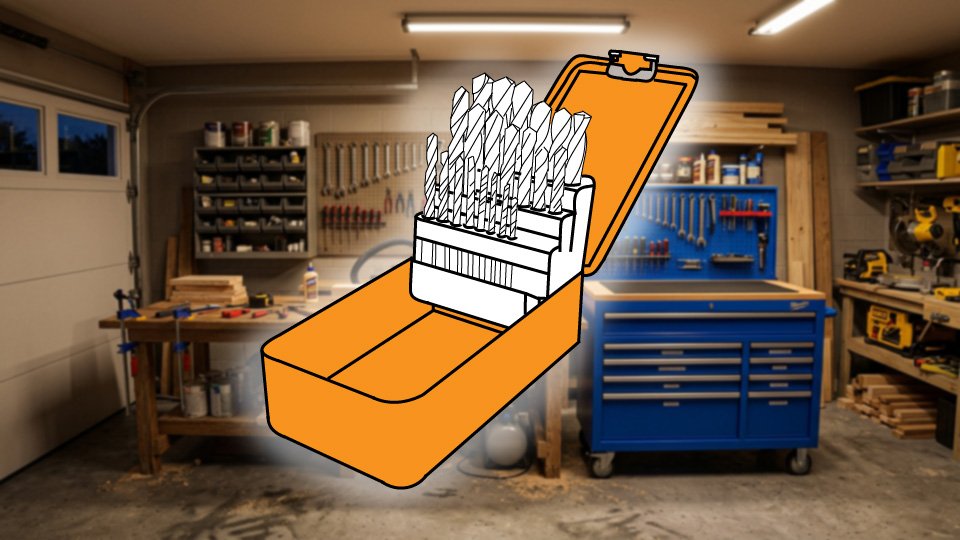
A drill bit set without organized storage is a drill bit collection waiting to become a problem. Bits that roll loose in a toolbox drawer dull against each other. Bits dumped in a coffee can require handling every bit to find the right size. Bits in an unmarked case require guessing.
The right case has labeled individual slots — each bit has a home, and the label tells you which size goes where. When a bit is missing from the case, you know immediately which size you need to replace. When you need a specific size mid-project, you can find it in seconds without handling every other bit in the collection.
A case with a clear lid is also useful — a quick visual confirms what you have before opening anything. This sounds minor until the third time you’ve opened a case looking for a bit that turns out not to be there.
If a set comes in a flimsy plastic tray that flexes when handled, the bits will eventually escape their slots. Look for a case with a positive latch, rigid construction, and slots that actually hold the bits securely. The case is part of the tool.
🔍 The One Thing That Identifies a Quality Bit on Sight
Examine the tip of a drill bit before buying. A quality bit has what’s called a split point — the very tip of the bit is ground to a sharp point that starts cutting immediately on contact, without requiring pressure to keep it centered. A cheap bit has a rounded or blunt tip that tends to “walk” across the surface before it starts cutting, producing a hole in a slightly different location than intended.
On titanium-coated bits, look for even, consistent coloring across the bit. Uneven coating or bits that look more yellow than gold-colored are usually thinner, lower-quality coatings that wear off quickly.
On cobalt bits, the bit should be uniformly silver-gray throughout — cobalt alloy steel doesn’t have a coating, it’s the material itself. A “cobalt” bit with a colored coating is probably a coated HSS bit being marketed misleadingly.
💰 The False Economy of Cheap Bits
The $9.99 drill bit set at the checkout aisle of the hardware store is one of the most consistent disappointments in DIY. The small bits snap under minimal pressure. The larger bits go dull after a few holes. The case falls apart. Within a few months, the useful bits have been replaced individually and the original set is mostly sorted into a coffee can of questionable history.
The math on replacement bits: a good individual 1/4-inch titanium bit costs $3 to $5. A good 21-piece titanium set costs $25 to $35. Buy the set and have the right size every time. Buy three or four individual replacement bits and you’ve spent the same money with far less coverage.
The right price range for a capable general-purpose set is $25 to $45. Above $60 for a general set is diminishing returns unless the work regularly involves hard metals or specialty materials. Below $15 for a set covering the full fractional range is almost certainly compromised quality somewhere — usually in the coating, the steel alloy, or the small bit sizes.
🛒 Gear Worth Having
DEWALT 21-Piece Titanium Nitride Pilot Point Drill Bit Set with Case (DW1361) — The benchmark general-purpose set. Titanium nitride coating over HSS steel, pilot point tips that start on contact without walking, 21 bits from 1/16 to 1/2 inch in the common fractional sizes. Labeled case with individual slots and clear lid. DEWALT is the number one selling set in Amazon’s Jobber Drill Bits category and has earned it — these bits cut cleanly in wood, plastic, and light metal, and hold their edge through years of regular use. The right starting point for any toolbox.
DEWALT 14-Piece Cobalt Alloy Steel Pilot Point Drill Bit Set (DWA1240) — For work that involves metal regularly — stainless steel, angle iron, hardened fasteners, metal cabinets. Industrial-grade cobalt alloy steel holds its edge significantly longer than titanium-coated HSS in hard metals. Pilot point tips eliminate bit walking even on curved metal surfaces. 14 bits from 1/16 to 5/16 inch covering the sizes most commonly needed in metalwork, in DEWALT’s ToughCase+ system. Buy this alongside the titanium set and have the right bit for every material.
Bosch 7-Piece Carbide-Tipped Masonry Drill Bit Set (BC007) — For concrete, brick, block, and stone. Carbide-tipped bits that grind through masonry rather than cutting it. Seven bits from 3/16 to 1/2 inch covering the common anchor and bolt hole sizes. Requires a hammer drill (a standard drill with a hammering function, typically marked on the drill’s mode selector) for best results in concrete. Keep these separate from the general set — masonry bits look similar to HSS bits but are not interchangeable with them.
As an Amazon affiliate, I earn from qualifying purchases. Thank you for supporting SkippityWhistles.
📖 Related Reads
The right drill bit set is the one that has the right size for the job, made from material that matches the material being drilled, organized well enough to find quickly. Buy that set once and stop thinking about drill bits for the next several years. Buy the wrong one and spend the next several years thinking about drill bits constantly.
SkippityWhistles is part of the WhistleBump group – find the rest of the family at WhistleBump.com.
7049
©2026 John D Reinhart/Skippitywhistles.com — All rights reserved