Every adhesive on the shelf says something about strength. “Industrial strength.” “Maximum bond.” “Bonds everything.” And they’re not lying, exactly — they do bond things strongly. The problem is that “strongly” is relative, and the wrong adhesive for the wrong job produces a joint that fails in ways the right adhesive never would.
Super glue on a structural wood joint. Wood glue on a PVC pipe. Construction adhesive on a ceramic figurine. All of these create a bond. None of them hold.
The right adhesive isn’t the strongest one on the shelf — it’s the one whose chemistry matches the materials being joined, whose working time matches the complexity of the job, and whose cured properties match what the joint needs to do. Once those three things align, the adhesive does its job and disappears. Here’s how to get there.
❓ The Four Questions That Choose Your Adhesive
Before reaching for any glue, answer these four questions. The right product becomes obvious.
What materials are being bonded? Wood to wood, metal to metal, plastic to plastic, ceramic to ceramic — different surfaces require different chemistry. Adhesives work through chemical compatibility, and some won’t bond certain surfaces at all. This is the first filter.
Is this a structural joint or a cosmetic one? A joint carrying weight, resisting stress, or doing mechanical work needs structural adhesive — epoxy or construction adhesive. A joint that just needs to hold something together for appearance needs much less. The right answer for a decorative ceramic repair is completely wrong for a furniture joint under load.
What environment will the joint live in? Outdoors, in a wet area, exposed to heat, or subject to vibration — all of these affect which adhesive holds long-term. Standard wood glue fails outdoors. PVC cement is useless on wood. Regular super glue fails in wet conditions. Environment is not an afterthought.
How much working time is needed? Some adhesives set in seconds. Others allow hours of adjustment. That’s not a quality difference — it’s a design difference. A complex assembly with many pieces needs working time. A simple chip repair needs to set fast before the piece shifts. Match the working time to the job.
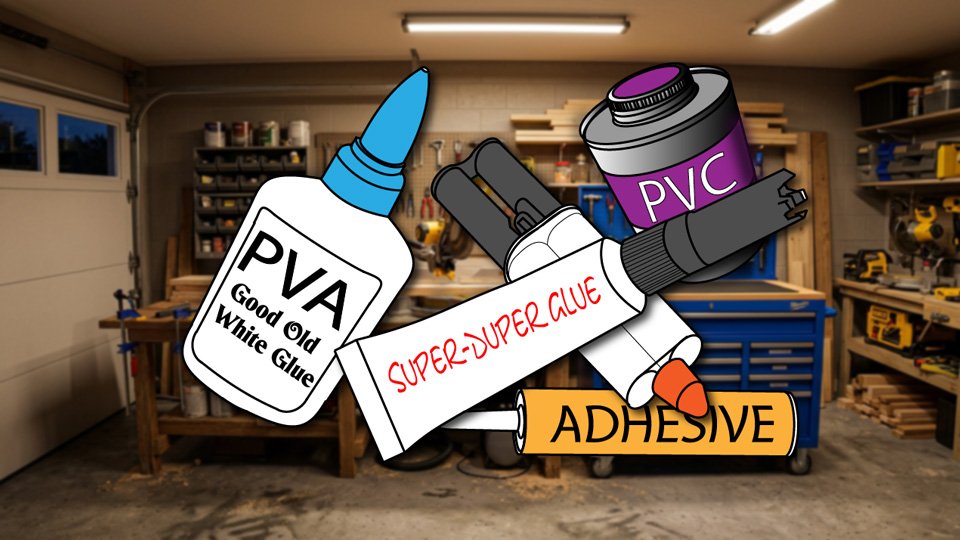
🔵 Cyanoacrylate (Super Glue) — Fast, Precise, and Not What You Think
Super glue — technically cyanoacrylate (CA glue) — sets in seconds by reacting with trace moisture on the surfaces being bonded. The result is a hard, rigid bond that’s surprisingly strong on small, tight-fitting surfaces. It’s the right tool for quick repairs on non-porous materials: ceramic chips, small plastic breaks, metal-to-metal repairs where the fit is tight and the load is light.
What super glue is not: a gap-filler. It requires close-fitting surfaces to work properly. A gap between the pieces means no bond. It’s also brittle — it resists pulling forces well but fails under impact or stress. And it bonds skin instantly using the same moisture-reaction that bonds everything else, which is why gloves are worth keeping nearby.
The gel formula is better for most repair work than the liquid: thicker, less likely to run onto surfaces where it doesn’t belong, slightly more working time before the bond sets. For anything requiring precision — fitting a ceramic handle, reattaching a small decorative piece — gel is the right choice.
🟡 Two-Part Epoxy — The Structural Answer
Two-part epoxy comes in two containers — a resin and a hardener — that are mixed together immediately before use. The chemical reaction between them produces a rigid, extremely strong bond that fills gaps, works on almost any surface, and often ends up stronger than the materials being bonded.
Epoxy is the answer for structural repairs: metal brackets, furniture joints under load, ceramic or porcelain repairs where the piece will actually be used, bonding dissimilar materials that nothing else will stick to. It’s also the right choice when there’s a gap between surfaces — unlike super glue, epoxy fills the gap as it cures.
The working time varies by formula. Five-minute epoxy (the most common) gives roughly five minutes of working time before it begins to set, which is enough for straightforward assembly. Thirty-minute epoxy allows more complex positioning. The tradeoff: faster-setting epoxy is slightly less strong at full cure than slower-setting formulas. For most home repairs, five-minute is entirely adequate.
Mix only as much as the job requires. Epoxy can’t be stored once the two parts are combined — whatever is mixed needs to be used before it sets. Small syringe dispensers that meter equal amounts of resin and hardener automatically are the most convenient format for home use.
🟤 Wood Glue (PVA) — The Right Tool for Wood
PVA wood glue — polyvinyl acetate (PVA) — is specifically designed for wood-to-wood joints, and it performs them better than anything else. It penetrates wood grain, cures hard, and creates a joint that is often stronger than the wood itself. When a wood joint fails under load, the wood typically breaks before the glue does.
The critical requirement is clamping. Wood glue needs pressure applied during the curing process to draw the joint tight and ensure full contact between the surfaces. The clamp time is usually 20 to 30 minutes. Full cure takes 24 hours — the joint feels solid after a few hours, but full strength doesn’t develop until the next day. Don’t stress-test a glued wood joint before it’s fully cured.
Wood glue cleans up with water before it cures and can be sanded and painted after curing. It’s the right choice for furniture repair, cabinet assembly, shelf construction, and any wood-to-wood joint that will be finished. It is not the right choice for outdoor projects exposed to standing water or repeated wetting — use a waterproof-rated wood glue (look for Type I water resistance rating on the label) for those applications.
🔴 PVC Cement — Not Actually a Glue
PVC cement doesn’t bond two pieces of PVC pipe the way an adhesive bonds two surfaces. It dissolves the plastic surface of both pieces slightly, then fuses them together at a molecular level as the solvent evaporates. The result isn’t two pieces stuck together — it’s one piece of plastic where a joint used to be.
This is why PVC connections are permanent and essentially impossible to undo, and why using the wrong cement on the wrong plastic is a serious problem. PVC cement works on PVC. ABS cement works on ABS (the black drain pipe used in older homes). CPVC cement works on CPVC (the hot water supply pipe). These are not interchangeable — using PVC cement on CPVC can actually damage the pipe rather than bonding it. The label specifies which plastic the cement is rated for. Read it before applying.
Most residential PVC plumbing work also requires primer before cement — a purple chemical that prepares the plastic surface for bonding. Some cements include primer in the formula; most don’t. The primer step is not optional for pressure-rated plumbing work.
⚫ Construction Adhesive — For Heavy Materials Under Stress
Construction adhesive is for bonding large building materials: subfloor panels to joists, drywall to framing, underlayment to subfloor. It comes in cartridges that fit a caulk gun (the same tool used for caulking, applied in a similar bead pattern).
What makes it different from other adhesives is flexibility. Where super glue and epoxy cure rigid, construction adhesive cures with some flexibility, which allows it to absorb vibration and movement. This is why it’s ideal for subfloors — applied under the panels before screwing them down, it fills the minor gaps between the panel and the joist, eliminating the movement that causes floor squeaks. A subfloor fastened with screws alone squeaks when the wood moves slightly. Add construction adhesive and the movement disappears.
It’s overkill for small repairs and awkward for precise work. It’s the right tool when large surfaces need to be bonded under building conditions.
🛒 Gear Worth Having
Gorilla Wood Glue — 8 oz., Water Resistant PVA, Natural Color, Paintable & Sandable — The benchmark PVA wood glue. Cross-linking formula creates a bond stronger than the wood around it. Twenty to thirty minutes of clamp time, fully cured in 24 hours. Dries a natural translucent tan with no foaming, paintable and sandable for a clean finish. Water resistant (ANSI/HPVA Type II rated) for indoor or outdoor projects. The reliable answer for any wood-to-wood joint from furniture repair to cabinet assembly.
Gorilla Super Glue Gel XL — 25g, Clear, Anti-Clog Cap — The gel formula for precision repair work. Thicker than liquid super glue so it doesn’t run onto adjacent surfaces, dries completely clear, sets in 10 to 45 seconds, full cure in 24 hours. The anti-clog cap keeps the bottle usable months after opening. The right tool for ceramic chips, small plastic repairs, and any close-fitting surface that needs a fast, invisible bond.
J-B Weld ClearWeld 5-Minute Epoxy Syringe — 25ml, Clear — Two-part epoxy in a syringe that dispenses equal amounts of resin and hardener automatically — no measuring, no guessing the ratio. Sets in five minutes, cures to full strength in one hour, dries completely clear. 3,900 PSI tensile strength — stronger than most of the materials it bonds. The structural repair answer for metal, ceramic, glass, and bonding dissimilar materials that nothing else will hold.
As an Amazon affiliate, I earn from qualifying purchases. Thank you for supporting SkippityWhistles.
📖 Related Reads
- How to Repair Broken Porcelain and Pottery
- How to Choose the Right Caulk for Your Home
- Seals, Gaskets, and Plumber’s Tape
The right adhesive is patient. It does its job and disappears into the joint. The wrong adhesive announces itself eventually — usually at the worst possible moment, usually in the most inconvenient location. Ask the four questions, match the chemistry to the materials, and the joint holds. That’s the whole deal.
SkippityWhistles is part of the WhistleBump group – find the rest of the family at WhistleBump.com.
2010
©2026 John D Reinhart/Skippitywhistles.com — All rights reserved