
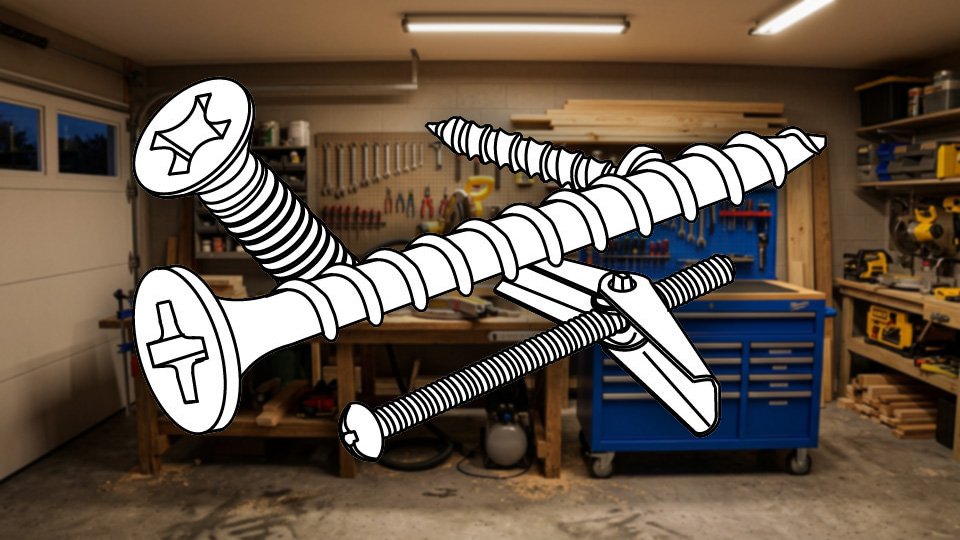
Ron keeps a coffee can of assorted screws on the workbench and, historically, has grabbed from it the same way he’d grab a snack — whatever’s closest, whatever looks about the right size. This worked fine right up until the deck board he was fastening split down the middle, because the screw closest to the top of the can was meant for drywall, not for anything outdoors, and definitely not for anything under load.
A fastener isn’t one decision. It’s three or four smaller decisions stacked together — material, load, drive type, length — and getting even one of them wrong is how a five-minute job turns into a return trip to the hardware store.
🪵 Start With What You’re Fastening Into
Wood generally wants wood screws — deep, widely spaced threads designed to bite into a soft, fibrous material. Drywall wants drywall screws, which have a sharper point and finer thread built for a thin, brittle material that doesn’t take a wood screw’s aggressive thread well. Concrete and masonry need a fastener rated for masonry, usually installed into a pre-drilled hole with a matching anchor, since nothing simply threads directly into cured concrete. Metal-to-metal work needs self-tapping screws (screws with a sharp point and thread specifically designed to cut their own threads into metal as they’re driven, rather than needing a pre-cut thread already in place).
Mismatching this first decision is the single most common fastener failure — not weak material, not the wrong tool, just the wrong screw for what’s actually on the other side of it.
⚖️ Load Changes Everything
A picture frame and a deck railing are not the same fastening problem, even if the screw in the hardware bin looks identical for both. Anything load-bearing or structural — railings, shelving holding real weight, framing connections — calls for a fastener rated for that use, often a structural screw or a bolt with a nut rather than a general-purpose wood screw. Cosmetic or light-duty fastening, like hanging a picture or securing trim, has much more forgiving requirements. When in doubt about how much weight or stress a connection needs to hold, sizing up in both fastener strength and quantity costs very little and fails far less often than guessing light.
🔧 Drive Type Is Not Just Preference
The drive type (the shape of the recess in a screw head that a driver bit fits into — Phillips, Torx, square, slotted) determines how well a driver bit grips under pressure. Phillips heads are the most common but the driver can slip out (“cam out”) under high torque. Torx and square drive resist cam-out much better, which is why more structural and outdoor screws have moved toward those drive types. If a project involves driving a lot of screws or driving into dense material, a Torx or square-drive screw will save real frustration over a Phillips equivalent.
📏 Gauge, Length, and the Pilot Hole Question
Gauge (a number describing a screw’s shaft diameter — higher gauge numbers mean a thicker screw) needs to match the job’s demands: thin trim work uses a lower gauge, structural framing uses a higher one. Length should generally let the screw penetrate at least half its length into the base material beneath whatever’s being fastened, not just through the top piece. A pilot hole (a small hole drilled before driving a screw, sized slightly smaller than the screw itself) prevents splitting in hardwood or near the edge of a board, and is close to mandatory for anything going into hardwood or near a board’s edge — skipping it is how Ron split that deck board in the first place.
🌦️ Indoors vs. Outdoors: Coating Matters
A screw with no corrosion-resistant coating will rust within a season outdoors, and rusted fasteners weaken and stain everything around them. Exterior work needs coated or stainless fasteners rated for outdoor or treated-lumber use specifically — treated lumber’s chemical preservatives corrode standard screw coatings faster than plain weather exposure alone. If a project is going outside or into treated wood, checking the box for an exterior or treated-lumber rating is a five-second step that prevents a much bigger problem eighteen months from now.
📖 When the Fastener Itself Is the Whole Project
Some fastening situations are specific enough to deserve their own deeper dive rather than a paragraph here — hanging something heavy on drywall with no stud behind it, working with actual nuts and bolts and their sizing conventions, or driving anything into cured concrete each have their own decision points worth walking through properly. Those are covered in full in the Related Reads below.
🛒 Gear Worth Having
Wensilon Multi-Material Screw Assortment Kit — Covers wood, deck, and general construction screws with a T-Star drive that resists cam-out, in a size range wide enough to replace most of the mismatched coffee-can situation at once.
DEWALT Titanium Drill and Drive Bit Set — Pairs pilot-hole drill bits with matching driver bits in one case, which solves the actual problem of never having the right pilot bit on hand when the screw calls for one.
Divanc Stainless Steel Exterior Screw Assortment — Rated for treated lumber and outdoor exposure, so the deck or fence project doesn’t come back to haunt you with rust streaks two summers from now.
As an Amazon affiliate, I earn from qualifying purchases. Thank you for supporting SkippityWhistles.
📖 Related Reads
SkippityWhistles is part of the WhistleBump group – find the rest of the family at WhistleBump.com.
2001
©2026 John D Reinhart/Skippitywhistles.com — All rights reserved