Ron’s approach to any plumbing fitting has historically been the same pair of channel-lock pliers he uses for everything else in the garage — right up until he rounded the corners off a brass fitting badly enough that it needed replacing instead of just loosening. Pliers grip. They don’t grip a hex-shaped pipe fitting the way a tool actually built for the job would.
Plumbing has its own small, specific toolkit, and most of it exists to solve one problem: pipe fittings and drain lines have shapes and spaces that general-purpose tools weren’t built for.
🔧 The Pipe Wrench
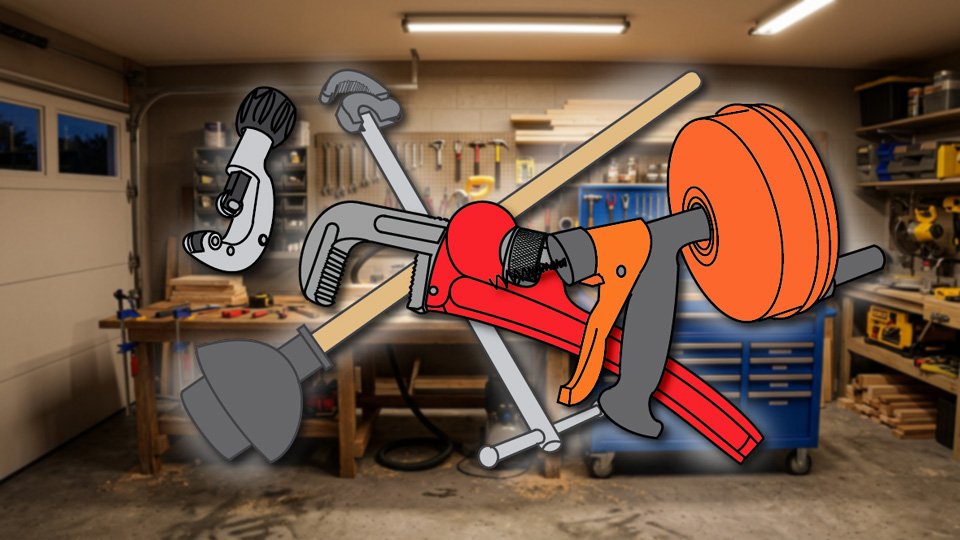
A pipe wrench (a wrench with self-tightening, serrated jaws that bite harder into round pipe the more force you apply) is built specifically for round pipe and rounded fittings, which a standard wrench’s flat jaws tend to slip on. The serrated jaws leave marks, which is exactly why pipe wrenches are for rough, functional pipe — not for polished chrome fixtures where the finish matters. Two pipe wrenches used against each other, one holding and one turning, is the standard technique for loosening a threaded pipe joint without twisting the whole line.
🔩 The Basin Wrench
A basin wrench (a long-handled tool with a pivoting, spring-loaded jaw at the end, designed to reach up into the tight space behind a sink) solves a problem no other tool handles well: the mounting nuts holding a faucet in place sit in a cramped gap behind the sink basin, often too tight for a hand or a standard wrench to reach. The basin wrench’s long shaft and pivoting head reach up into that gap and grip the nut from an angle nothing else can manage.
✂️ The Tubing Cutter
A tubing cutter (a small tool with a sharp cutting wheel that rotates around a pipe, tightening gradually to slice through it cleanly) makes a square, clean cut on copper or thin-wall pipe — the kind of cut a hacksaw can approximate but rarely matches. A clean, square cut matters more than it seems: a ragged or angled cut makes a proper watertight fitting connection much harder to achieve later.
🪠 The Plunger — And Why There Are Two Kinds
A standard cup plunger has a simple rubber dome and works fine on flat surfaces like a shower or floor drain. A flange plunger (also called a funnel-cup plunger, with an extra fold of rubber that unfolds down into a toilet’s drain opening) seals against a toilet’s curved opening far better than a standard cup, which is why a flat-bottomed plunger so often underperforms on a toilet specifically — it’s the wrong shape for that one job, not a weaker tool overall.
🌀 The Drain Auger
A drain auger, or hand-crank drain snake (a flexible steel cable on a hand-cranked reel, fed into a drain to break up or hook a clog), reaches well past where a plunger’s suction can do anything useful — often several feet into a drain line. It’s the right tool for a single stubborn fixture clog. A whole-house backup involving multiple fixtures at once calls for something with far more reach and power than a hand-crank auger provides — that’s motorized drum auger territory, covered in the sewer line post below.
🧵 The One Tool That’s Really a Material
Thread seal tape and pipe dope don’t get their own tool category here because they already have a full post dedicated to exactly what they do and why — see Related Reads. Worth mentioning only because no plumbing toolkit is complete without one of the two on hand.
🛒 Gear Worth Having
RIDGID 10-Inch Straight Pipe Wrench — Sized right for most household supply and drain pipe without being too bulky to fit under a sink or behind a toilet.
Superior Tool Telescoping Basin Wrench — The telescoping handle reaches the deep, awkward gap behind a sink without needing to contort an arm into the cabinet first.
IMPERIAL Tube Cutter for Copper and Thin-Wall Pipe — A clean, square cut every time, which matters more once you’re trying to get a fitting to seal properly afterward.
As an Amazon affiliate, I earn from qualifying purchases. Thank you for supporting SkippityWhistles.
📖 Related Reads
- Seals, Gaskets, and Thread Tape: Why They Matter
- Pipes and Fittings: What’s What
- How Your Sewer Line Works
SkippityWhistles is part of the WhistleBump group – find the rest of the family at WhistleBump.com.
3027
©2026 John D Reinhart/Skippitywhistles.com — All rights reserved