
You’re tightening a bolt. It feels snug. You give it one more turn because snug feels like not quite enough. Then another, because the second turn felt like the first one — still not tight enough. Then something either strips, cracks, or gives way, and now a simple job has become a more complicated one.
This is the problem that torque wrenches solve. Not every bolt needs one — most household fasteners are fine with a regular wrench and reasonable judgment. But for bolts that hold structural things together, bolts that go into softer materials like aluminum, or bolts where the manufacturer has specified an exact tightening value — a torque wrench takes “how tight is tight enough” out of the equation entirely.
It’s also a significantly simpler tool than most people assume. Here’s what it does and how to use it.
⚙️ What a Torque Wrench Actually Does
A torque wrench measures rotational force — called torque — as you tighten a fastener. Torque is measured in foot-pounds (ft-lbs), inch-pounds (in-lbs), or Newton-meters (Nm), depending on the application and which measurement system the spec was written in.
The tool lets you set a target value before you start tightening. When you reach that value — when you’ve applied exactly the amount of rotational force the fastener requires — the wrench signals you to stop. On the most common type (the click-type torque wrench), that signal is a distinct click you can both hear and feel. On a beam-type wrench, it’s a pointer reaching a mark on a visible scale. Either way, the message is the same: you’re done. Stop tightening.
The reason this matters is that different fasteners in different materials have very specific tightening requirements. A deck ledger bolt connecting your deck to the house framing needs a precise amount of torque — too loose and the connection fails structurally, too tight and you can damage the threads or the wood. A bolt going into aluminum needs less torque than the same bolt going into steel, because aluminum strips more easily. The torque specification exists to get the fastener to exactly the right tightness for its application, and the torque wrench is the tool that gets you there.
🔧 The Click-Type Wrench — This Is the One to Buy
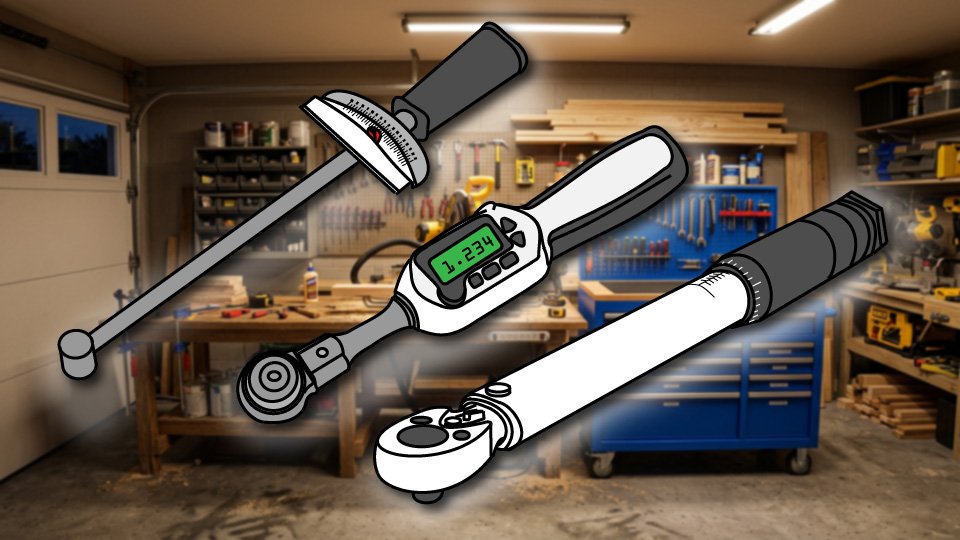
There are three types of torque wrenches: click-type, beam-type, and digital. For home DIY use, the click-type is the right choice. It’s reliable, affordable, requires no batteries, and is easy to use without a learning curve.
A click-type torque wrench looks like a long-handled ratchet wrench. The handle is hollow, and inside it is a calibrated spring mechanism. You set your target torque value by gripping the handle and rotating the adjustment knob at the bottom — this compresses the spring to a specific tension. When you tighten a fastener and the applied force reaches the preset value, the spring releases with a distinctive click. The click is unmistakable. You stop, the bolt is torqued correctly, and you move on.
The beam-type wrench uses a visible pointer on a scale — you watch it while you tighten and stop when the pointer reaches your target. It’s accurate and requires no calibration, but it requires you to watch the scale while tightening, which can be awkward in tight spaces. The digital type has an electronic display and beeps at the target value — accurate and convenient, but more expensive and battery-dependent.
For most people buying their first torque wrench: click-type, 3/8-inch drive (the square post size that connects to sockets — the same standard 3/8-inch drive used by most socket sets), range of 10 to 80 foot-pounds. That covers the majority of home DIY applications: automotive work, deck construction, furniture assembly with specified torque, and general structural fasteners.
📋 Finding the Torque Specification
Before using a torque wrench, you need to know what value you’re tightening to. This is not a number you guess — it comes from the manufacturer or from a standard reference.
For furniture and equipment assembly, the manual specifies torque values for critical fasteners. For automotive work — lug nuts, spark plugs, oil drain plugs — the vehicle’s service manual specifies the values, and they’re also widely available online by searching the vehicle year, make, model, and the specific component. For structural fasteners like deck ledger bolts, the building code or the fastener manufacturer’s documentation specifies the values.
As a general reference for hardware that doesn’t come with specifications: small bolts (1/4 inch diameter) typically land in the 5 to 15 foot-pound range; medium bolts (3/8 inch) in the 20 to 40 foot-pound range; larger bolts (1/2 inch) at 50 foot-pounds and up. But these are starting points, not substitutes for the actual spec. When a spec exists, use it.
📐 How to Set and Use the Wrench
Look up the torque specification for your fastener and write it down. Misremembering a number mid-job is more common than it should be.
Select a socket that fits the bolt head precisely — no wobble, no play. A socket that’s even slightly loose on the fastener will give an inaccurate reading and can round off the fastener head. On click-type wrenches, the drive size needs to match your socket set — 3/8-inch drive wrench with 3/8-inch drive sockets.
Set the torque value on the wrench. On most click-type wrenches, hold the handle firmly with one hand and rotate the knurled adjustment knob at the bottom of the handle with the other. The scale on the handle shows your current setting. Turn until the indicator line aligns with your target value. Check it again before you start — a misread of even five foot-pounds can matter on critical fasteners.
Thread the bolt in by hand until it’s snug against the surface. Hand-tightening first ensures the threads are properly engaged before any torque is applied, and prevents cross-threading — the frustrating situation where the bolt goes in at a slight angle and damages both the bolt threads and the receiving threads.
Attach the torque wrench and begin tightening with slow, steady pressure. Don’t jerk or apply sudden force. The click mechanism needs consistent pressure to trigger accurately — rapid or jerky tightening can cause the wrench to click early or late. When you hear and feel the click, stop immediately. The bolt is torqued to specification. Tightening further past the click does not improve the connection — it just adds force beyond the rated value, which can strip threads or damage the fastener.
🔄 One Important Storage Rule
When you’re done using a click-type torque wrench, turn the adjustment knob back to its lowest setting before putting it away. The spring inside the wrench that creates the click mechanism can take a permanent set — weaken slightly — if stored under compression at a high torque setting. Over time, a wrench stored at maximum torque loses calibration accuracy. Back it off to the minimum after every use. It takes ten seconds and it keeps the wrench accurate for years.
Store the wrench in its case rather than loose in a toolbox. Torque wrenches are precision tools — the calibration can be affected by a sharp impact. A drop onto a concrete floor is worth getting the wrench recalibrated before trusting it on critical fasteners again. Professional calibration runs about twenty to fifty dollars and is worth it for anything structural.
🛒 Gear Worth Having
TEKTON 3/8 Inch Drive Micrometer Torque Wrench (10-100 ft.-lb.) | 24330 — The 3/8-inch drive click-type wrench that handles the majority of home DIY torque work: automotive fasteners, deck construction, structural hardware, furniture with specified torque values. Calibrated to ±4% accuracy out of the box. All-steel construction with no plastic parts. Dual-range scale in both foot-pounds and Newton-meters. Ships in a storage case. TEKTON is the respected mid-range brand that professional mechanics and serious DIYers reach for when they want accuracy without a professional price point.
TEKTON 1/4 Inch Drive Click Torque Wrench (20-200 in.-lb.) | 24320 — The smaller companion to the 3/8-inch wrench, for lighter fasteners measured in inch-pounds (in-lbs) rather than foot-pounds. Spark plugs, small engine components, bicycle fasteners, and precision assembly work all typically call for inch-pound torque values. Same TEKTON build quality, same ±4% calibration accuracy, same all-steel construction. If the 3/8-inch wrench is for the deck and the car, the 1/4-inch is for everything smaller.
SUERCUP Torque Wrench Set — 1/4″, 3/8″ & 1/2″ Drive, 3-Piece with Case — For the toolbox that wants all three drive sizes in one purchase. The 1/4-inch handles small precision work, the 3/8-inch covers most DIY applications, and the 1/2-inch handles heavy-duty automotive and structural work. Chrome vanadium steel throughout, calibrated to ±4%, organized storage case keeps all three accessible. The complete answer if you want to buy torque wrenches once and have what you need for any job.
As an Amazon affiliate, I earn from qualifying purchases. Thank you for supporting SkippityWhistles.
📖 Related Reads
The torque wrench isn’t the tool for every bolt — most household fasteners are perfectly fine tightened by feel with a regular wrench. But for the ones that matter, for the structural connections and the precision assemblies and the fasteners where the manufacturer took the time to specify an exact value, the torque wrench is the tool that gets it right the first time. The click is the sound of a fastener done correctly. It’s a satisfying sound.
SkippityWhistles is part of the WhistleBump group – find the rest of the family at WhistleBump.com.
7053
©2026 John D Reinhart/Skippitywhistles.com — All rights reserved