Ron was halfway through a curve, running a little behind schedule, and decided the saw could probably keep up if he just pushed a bit harder through the tight part. It could not. There was a small, distinct ping, and the blade — which had been doing exactly what it was designed to do right up until that moment — was now in two pieces instead of one. The jigsaw hadn’t failed. It had simply reached the end of what “a bit harder” was willing to tolerate.
A jigsaw isn’t a power tool in the aggressive, brute-force sense. It’s a controlled, patient tool that cuts curves other saws simply can’t manage — and the entire skill is guiding it smoothly along a line rather than trying to hurry it toward the finish.
⚙️ The Core Idea: Controlled Vibration, Not Power
The blade moves up and down — oscillates — hundreds of times a minute, cutting on the upstroke and resetting on the downstroke. You’re not forcing material through the blade. You’re guiding the tool along a line while the blade does its own small, repetitive work. Push it faster than that rhythm wants to go, and the blade either binds, tears the material, or, as Ron discovered, simply breaks.
🔩 The Parts You’re Holding
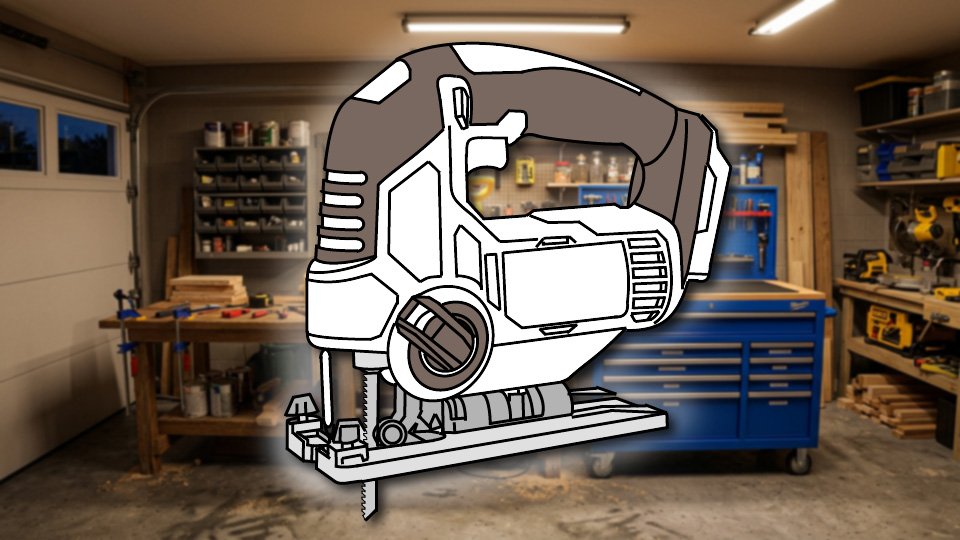
The motor drives the blade’s up-and-down motion, and many modern jigsaws offer variable speed — slower for delicate work, faster for aggressive cutting. An older, fixed-speed model, the kind that tends to get inherited rather than bought, just means you control the pace with how fast you feed the saw instead of a dial.
The blade itself comes in several types: coarse wood-cutting blades for fast cuts, fine metal-cutting blades for slower and cleaner work, and fine scroll blades for genuinely intricate curves.
The base plate rests flat against the material and keeps the blade perpendicular — a bent or worn plate throws off every cut that follows.
Some jigsaws include an adjustable shoe for bevel cuts, though square (90 degrees) covers the overwhelming majority of everyday use.
🛠️ Using It, Step by Step
- Secure the material firmly — a piece that shifts mid-cut ruins the line and announces itself with a distinctive, unmistakable bucka-bucka-bucka that everyone in the house will hear and correctly interpret.
- Mark the cut line clearly; freehanding a curve with no line to follow isn’t really a technique, it’s a guess.
- Match the blade to the material — running a wood blade against thin metal sounds uncannily like a baseball card caught in bicycle spokes, and does about as much good. Insert the blade fully into the quick-change chuck and confirm it’s seated tight, since a loose blade breaks, falls out, or both.
- Position yourself to the side of the saw in a stable, comfortable stance, since curve-cutting takes patience and fine control over a longer stretch than a quick straight cut.
- Turn it on and let the blade reach full speed before it touches anything.
- Guide it along the line with light, steady pressure, letting the blade’s own rhythm do the actual cutting — rushing it is exactly how Ron ended up with two shorter blades instead of one working one.
- Follow the line smoothly without jerking to correct direction. Once through, lift the saw clear, release the trigger, and let it coast to a stop rather than forcing it still.
🕳️ Plunge Cuts: Starting in the Middle
Cutting a hole in the middle of material, rather than starting from an edge, calls for a plunge cut. Drill a small starter hole slightly larger than the blade, tilt the saw so the front of the base plate touches the material with the blade held above it, start the saw and let it reach full speed, then lower the blade slowly and steadily into the starter hole. Once the base plate sits flat, begin guiding the cut normally. This is a genuinely advanced technique — worth trying only once ordinary edge cuts feel comfortable and predictable.
🚫 The Mistakes Worth Avoiding
- Forcing the saw through a cut is the direct cause of binding, tearing, and the specific ping that ended Ron’s afternoon early.
- A dull blade demands more force and fails faster than a sharp one. Unsecured material moves mid-cut and ruins the line.
- Jerking the saw to correct direction mid-curve is a reliable way to snap a blade.
- Plunging too fast binds or breaks the blade before it’s even fully seated.
- Rushing along the line produces a torn, ragged edge instead of a clean one.
- Using the wrong blade for the material wastes both the blade and the material.
- And a blade vibrating or sounding strange is a warning worth stopping for immediately, not a background noise to push through.
🛒 Gear Worth Having
Variable Speed Corded Jigsaw — Genuine speed control for matching the cut to the material, instead of managing pace entirely through feed rate on a fixed-speed model.
Jigsaw Blade Assortment (Wood, Metal, Scroll) — Covers the actual range of materials and curve tightness a jigsaw gets asked to handle, so the wrong blade never has to fake its way through a cut.
3M Impact-Resistant Safety Glasses — Cheap protection against flying sawdust and splinters on every single cut, not just the ones that feel risky.
As an Amazon affiliate, I earn from qualifying purchases. Thank you for supporting SkippityWhistles.
📖 Related Reads
SkippityWhistles is part of the WhistleBump group – find the rest of the family at WhistleBump.com.
7057
©2026 John D Reinhart/Skippitywhistles.com — All rights reserved