
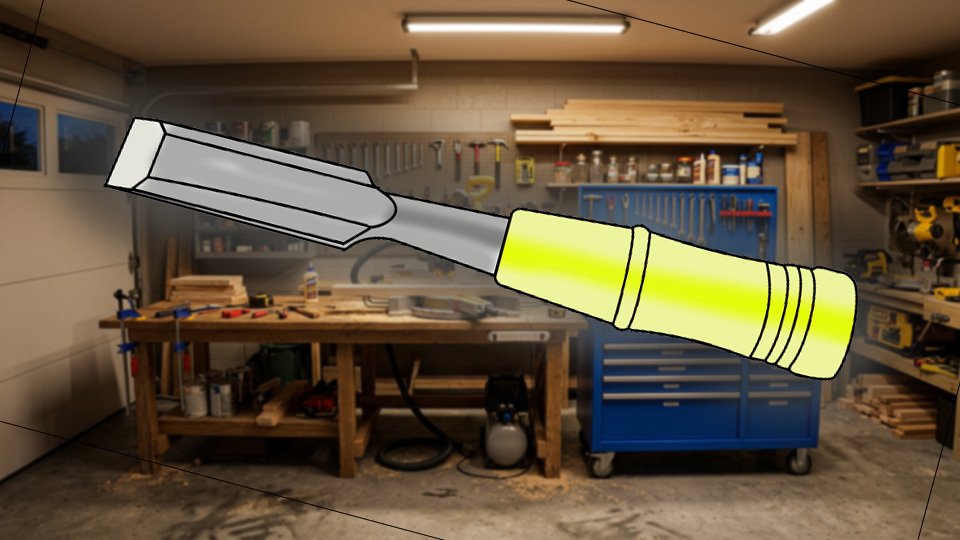
Ron grabbed the closest hammer to drive his chisel through a stubborn knot, because, well, a hammer is a hammer, and force is force, right? The metal hammer head chipped a small crescent out of the chisel’s wooden handle on the very first strike. Nice going, Ron.
A chisel looks like a simple wedge on a stick because that’s exactly what it is. The skill isn’t really in the tool — it’s in a few decisions you make before the blade ever touches the wood.
🪓 What’s Actually Happening When You Cut
A chisel’s blade is ground into a wedge shape. One side is flat. The other side is angled, and that angled side is called the bevel.
The wedge doesn’t just cut wood. It splits it, along whatever line you position the blade on. That’s why direction matters so much more with a chisel than it does with, say, a saw.
✋ Two Techniques: Hand Pressure and Mallet
For light work — shaving off a high spot, fine shaping, careful trimming — use hand pressure alone. Grip the handle with one hand. Rest your other forefinger on top of the blade, just behind the cutting edge. Push slowly and let that front hand guide the blade’s path.
For deeper cuts, use a mallet instead. Hold the chisel upright with one hand. Hold the mallet in your other, dominant hand. Tap the handle — don’t swing at it. Let the tool do the cutting instead of trying to force it through in one blow.
Never substitute a metal hammer for a mallet. A chisel handle is shaped to absorb a mallet’s softer strike, not a hammer’s hard one, and a hammer will chip or split it.
🎯 Bevel Direction: The One Decision That Changes Everything
Before every cut, you’re choosing which way the bevel faces. That one choice determines what happens next.
Face the bevel away from the waste — the part of the wood you’re cutting off — when you want a clean, straight line. The flat side does the cutting in this position, and it tracks straight.
Face the bevel into the waste when you want to remove material with more control over depth. The angled side rides up and out as you push, lifting waste away instead of digging straight down.
Get this backwards and the cut still happens. It just doesn’t happen the way you meant it to and you start using words that could embarrass your parents.
🌾 Reading the Grain Before You Cut
Wood fibers all run in one direction — that’s the grain. A chisel moving with the grain lifts wood cleanly. A chisel moving against the grain fights the fibers, takes more force, and tends to tear or splinter instead of cutting.
Watch the wood as you make your first light cut. If it lifts smoothly, you’re working with the grain. Keep going.
If it tears, catches, or feels like it’s fighting back, stop. Turn around and cut from the opposite direction instead.
🔪 Why a Sharp Chisel Matters More Than a Strong Arm
A dull chisel doesn’t cut cleanly no matter how hard you push it. It crushes and tears wood fibers instead of slicing them, which is both a worse result and a real safety risk — a dull edge slips sideways more easily than a sharp one bites in.
Sharpen the chisel before starting any real project, and again the moment it stops slicing cleanly through a light test cut. A basic sharpening stone handles this in a few minutes and works on kitchen knives and hatchets too, so it’s not a single-purpose expense.
🚫 The Mistakes Worth Avoiding
- Using a metal hammer instead of a mallet.
- Twisting the blade mid-cut instead of pulling straight back and repositioning.
- Skipping sharpening until the chisel is genuinely struggling.
- Trying to remove too much material in one pass instead of working in light, controlled cuts.
- And cutting toward your own body or hand instead of always working away from yourself.
🛒 Gear Worth Having
Bevel-Edge Wood Chisel Set — A range of widths in one set, so the right size is on hand instead of forcing one chisel to do every job.
Wooden Woodworking Mallet — Built specifically to strike a chisel handle without chipping it — the actual right tool, not a stand-in hammer.
Combination Sharpening Stone — Medium and fine grit in one stone, enough to keep a chisel edge — and most other blades in the house — genuinely sharp.
As an Amazon affiliate, I earn from qualifying purchases. Thank you for supporting SkippityWhistles.
📖 Related Reads
SkippityWhistles is part of the WhistleBump group – find the rest of the family at WhistleBump.com.
7016
©2026 John D Reinhart/Skippitywhistles.com — All rights reserved