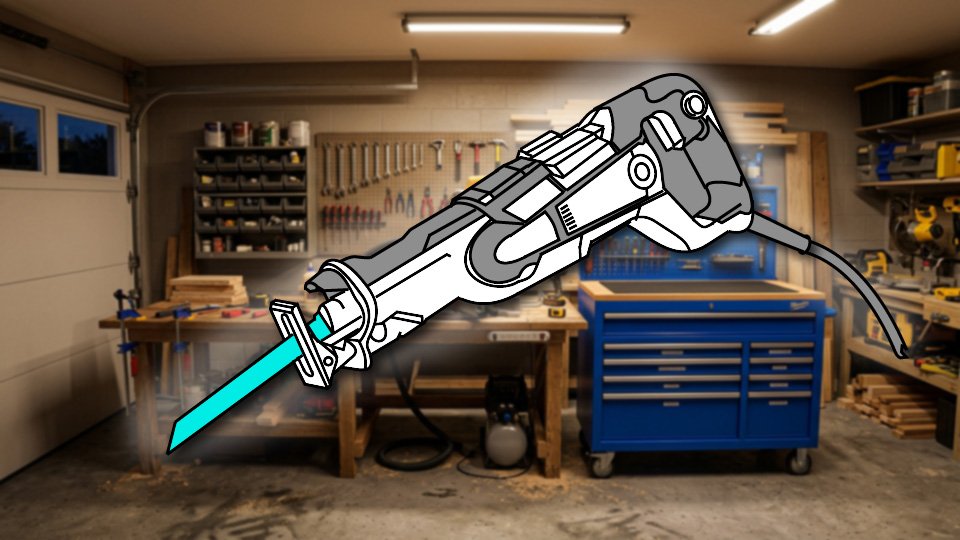
Ron gripped his reciprocating saw with just his his hand wrapped around the trigger, figuring the front of the tool was just there to point the blade. The blade caught on a hidden nail mid-cut, and the whole tool twisted hard and fast, nearly wrenching out of his grip entirely. Nothing was wrong with the saw. Ron just hadn’t put his other hand where it actually needed to be — on the front handle, holding on like the tool meant it, because it did. What did you think that grip on the front was for, eh Ronnie?
A reciprocating saw isn’t a precision tool. It’s controlled aggression — a blade moving back and forth hundreds of times a second, built for rough cuts and demolition. Respected properly, it tears through wood, metal, and even nails with real speed. Held wrong, it’s a tool that genuinely tries to twist itself loose the moment it meets real resistance.
⚠️ The Core Principle
The back-and-forth blade motion creates real torque, especially the instant the blade catches on something solid. That torque tries to twist the saw out of your hands or twist your wrist along with it. Your job isn’t to fight the tool’s cutting power — let it cut aggressively, that’s what it’s for. Your job is to make sure it can’t do to your hands what it wants to do the moment it catches.
🔩 The Parts You’re Holding
The blade moves back and forth thousands of strokes per minute, and different blades suit different materials —
- wood blades with larger teeth cut fast through lumber
- metal blades with finer teeth handle pipe and studs
- demolition blades are built for rough, aggressive cutting through mixed material including embedded nails.
Stroke length — how far the blade travels on each cycle, typically 3/4 to 1 1/4 inch depending on the saw — is a fixed spec of the tool itself, not something you adjust; a longer-stroke saw cuts more aggressively and demands more experience to control.
Variable speed, where available, adjusts how fast the blade cycles, but speed is never a substitute for proper grip.
🖐️ The Grip: Two Hands, Straight Wrist, Non-Negotiable
- Your dominant hand, on the trigger handle, is the main control point — grip firmly, all fingers and thumb locked underneath, without crushing the handle.
- Your other hand belongs on the front handle, and this is the grip that actually matters most: it’s what prevents the saw from twisting out of your hands the instant the blade catches on something.
- Grip it like it’s trying to get away, because it genuinely is.
- Keep your wrist straight rather than bent — a bent wrist acts like a lever, rotating your hand instead of resisting the twist, while a straight wrist actually holds firm against it.
- Stand with feet shoulder-width apart, leaning slightly into the tool, positioned so that if it does slip, it slides away from your body rather than toward it.
🛠️ Using It: Secure, Position, Cut
- Secure whatever you’re cutting first — clamps, bracing, or gravity, but it needs to be stable. Material that shifts mid-cut is one of the most common causes of the tool binding and twisting unexpectedly.
- Position the blade against the material before starting; plunge cuts, starting mid-material with the saw already running, are an advanced technique worth learning after edge cuts feel comfortable.
- Let the blade reach full speed before pushing into the cut — starting already embedded in material invites binding immediately.
- Push forward and slightly downward, guiding rather than forcing; pressing hard doesn’t cut faster, it just works the tool harder and makes a twist more likely.
- Follow your cut line steadily, and don’t expect precision — the blade wanders a little, and that’s normal for a demolition tool.
- Once through, pull the saw away from the material rather than leaving a running blade sitting in the cut.
🚫 The Mistakes Worth Never Making
- Gripping with only one hand removes the exact control that stops the tool from twisting loose.
- A bent wrist turns into a lever instead of resistance. Pressing too hard works the saw harder without cutting any faster.
- Unsecured material shifts mid-cut and causes binding.
- A dull blade demands more force and binds more easily than a sharp one.
- Starting before the blade reaches full speed causes it to bind on first contact.
- Leaving a running blade in the material creates unnecessary wear and risk.
- And reaching any part of your body near a running blade is exactly as dangerous as it sounds — just never do it.
🎯 When to Reach for It (and When Not To)
Reach for it for demolition, cutting through nails or metal, rough and fast cuts, salvaging material from something being torn out, or cutting in spots a circular saw can’t reach.
Reach for something else — a circular saw or miter saw — when the job needs precision, a genuinely clean final cut, or speed on a long straight run, since a reciprocating saw simply isn’t built to deliver any of those three.
🛒 Gear Worth Having
Cordless Reciprocating Saw — Genuine freedom of movement for demolition work, without a cord getting caught in exactly the debris you’re trying to cut through.
Demolition Blade Assortment (Wood, Metal, Nail-Embedded) — Covers the mixed, unpredictable material demolition work actually throws at a blade, including the nails a wood blade alone won’t survive.
Bessey Bar Clamp Set — Keeps material from shifting mid-cut, which is one of the most common ways this saw ends up binding and twisting unexpectedly.
As an Amazon affiliate, I earn from qualifying purchases. Thank you for supporting SkippityWhistles.
📖 Related Reads
SkippityWhistles is part of the WhistleBump group – find the rest of the family at WhistleBump.com.
7054
©2026 John D Reinhart/Skippitywhistles.com — All rights reserved