Rhonda leaned into her belt sander like it owed her rent, figuring more pressure meant a faster finish on the tabletop she was smoothing. Thirty seconds later, the tabletop had a dip in it deep enough to serve soup out of. The sander hadn’t malfunctioned. It had done exactly what Rhonda told it to do, which was the actual problem.
A power sander removes material through motion and friction, not through how hard you lean on it. Understanding that one idea prevents almost every disaster a power sander is capable of causing.
🌀 Three Sanders, Three Jobs
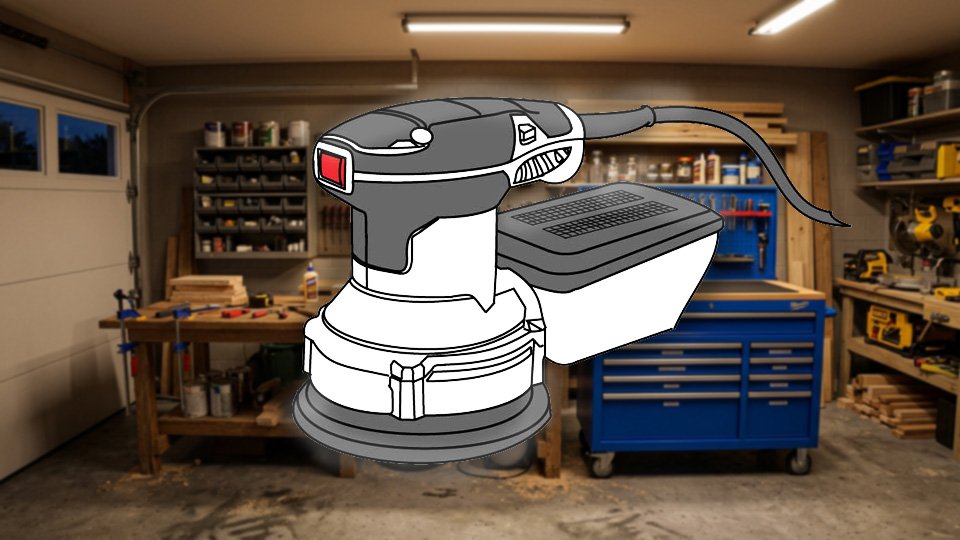
- A random orbital sander (a round pad that spins while also moving in small random circles) is the forgiving, do-almost-everything option — the randomness in its motion is specifically what prevents the circular swirl marks other sanders can leave behind.
- An orbital sander (a smaller square pad that moves in tight, consistent circles) produces an extremely smooth finish but works slower and is best saved for fine detail work.
- A belt sander (a continuous loop of sandpaper running fast around two rollers) removes material aggressively — genuinely fast — which makes it the right tool for stripping paint or flattening rough lumber and the wrong tool for anything needing a delicate touch.
For most household projects, a random orbital sander covers the job; the belt sander is a specialist brought in for rough, heavy removal only.
🔢 Grit: Start Rough, Work Up
Sandpaper grit is a number rating system defining how coarse or fine a sandpaper’s abrasive particles are.
Lower numbers are coarser and remove material fast, higher numbers are finer and smooth or polish without removing much at all. An 80-grit sheet cuts through old paint aggressively. A 320-grit sheet barely leaves a mark, which is exactly the point once you’re past removing anything and into finishing.
The rule that covers almost every situation: start coarse when you’re removing material, start fine when you’re finishing a surface that’s already close to done.
⚡ Starting, Floating, and Stopping
Turn the sander on before it touches the wood — starting it already pressed against the surface can dig a small gouge in the first instant of spin-up.
Once it’s running, let the tool’s own weight do the work; guide it with two hands rather than pressing down; a sander barely needs to touch the surface to be effective.
Keep it moving in slow, overlapping passes rather than lingering in one spot, the same way you’d mow a lawn — stopping in place for even a few extra seconds creates a shallow dip that’s far more work to sand back out than it would have been to avoid.
Lift the sander off the surface before switching it off, letting it wind down in the air rather than against your work.
🧹 Dust Isn’t Optional
Sanding dust does two things at once: it clogs the sandpaper, which makes it cut poorly and can actually scorch the surface, and it fills the air you’re breathing.
If the sander has a dust port, connect it to a shop vacuum or use the attached collection bag every time, not just when somebody’s looking.
A dust mask or respirator isn’t a suggestion for extended sanding sessions — fine wood dust is a genuine respiratory irritant, and the tool that makes a project faster shouldn’t make your lungs pay for it.
🛑 Knowing When to Stop
A surface is done when it feels smooth under bare fingertips (a better test than eyesight alone), looks even under raking light from the side, and shows a consistent scratch pattern with no remaining gouges or high spots.
More sanding past that point doesn’t improve anything — it just thins the material, softens edges that should stay crisp, and burns time you didn’t need to spend. Smooth is a finish line, not a direction to keep walking past.
🛒 Gear Worth Having
DEWALT 5-Inch Random Orbital Sander (DWE6423K) — The forgiving all-purpose sander that covers nearly every household job without the learning curve or the risk a belt sander carries.
Bosch Universal Vacuum Hose Adapter Kit — Connects most sanders to a standard shop vacuum, which keeps sandpaper cutting cleanly instead of clogging and scorching halfway through the job.
3M N95 Sanding and Dust Respirator, 5-Pack — Genuinely necessary for any extended sanding session — the dust is a real irritant, and this is the cheapest insurance in the whole project.
As an Amazon affiliate, I earn from qualifying purchases. Thank you for supporting SkippityWhistles.
📖 Related Reads
SkippityWhistles is part of the WhistleBump group – find the rest of the family at WhistleBump.com.
2016
©2026 John D Reinhart/Skippitywhistles.com — All rights reserved