Ron found a pair of sawhorses at a suspiciously good price, made of the kind of plastic that looks confident in the store and reconsiders that confidence the moment real weight shows up. They held a sheet of plywood for about ninety seconds before folding sideways like a lawn chair meeting its true purpose in life. He set them back up, tried again, and watched it happen a second time — because apparently once wasn’t a clear enough message.
A sawhorse looks like the simplest object in the entire garage. Four legs, a beam, nothing to think about. Right up until it’s under real weight and it turns out “simple” and “correctly rated for the job” are two very different things.
🐴 What a Sawhorse Actually Does
A sawhorse elevates and stabilizes a workpiece — no bending over, no material shifting mid-cut, and a pair of them with a sheet of plywood on top instantly becomes a workbench. It sounds unglamorous because it is. Unglamorous and reliable is exactly the goal here.
⚖️ Weight Capacity: Don’t Be Ron
Light-duty sawhorses, rated around 500 pounds per pair, are fine for small projects and light assembly — but a standard sheet of plywood already weighs around 55 pounds before you add a person leaning on it, which eats into that rating faster than it looks like it should. Medium-duty, in the 1,000 to 2,000 pound range, is the actual sweet spot for most home DIY work — stable, reasonably priced, and unlikely to stage a dramatic collapse mid-project. Heavy-duty, 2,500 pounds and up, is genuinely overkill unless renovation work is a regular occurrence rather than an occasional weekend.
🧱 Material: Plastic, Metal, or Homemade
- Plastic folds up small and travels light, which is exactly why it tempts people into a suspiciously good price — but it flexes under real load and the tops get slippery fast.
- Metal costs more and weighs more to move, but it’s the durable, stable upgrade that doesn’t fold sideways under a sheet of plywood the way Ron’s did.
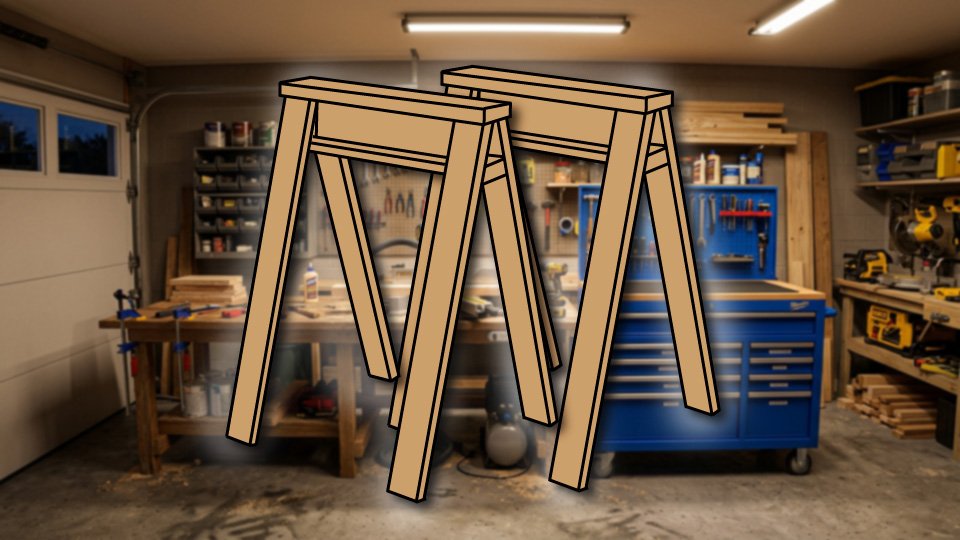
- Building your own from wood takes an afternoon and gives you exact control over height and grip, at the cost of portability and storage space. None of these is wrong.
Matching the material to the actual load is the part that matters.
🐎 Taming the Wobble
Always use them in pairs — a single sawhorse offers nothing but a false sense of accomplishment. Check the ground before loading anything on top; uneven concrete or a sloped driveway puts all the weight on one leg and turns a stable stand into a seesaw. A scrap of wood shimmed under a short leg fixes this in about ten seconds.
Spacing matters too — roughly 4 to 6 feet apart for lumber, closer at 3 to 4 feet for sheet goods, since anything wider needs the extra support to keep from sagging in the middle.
🎿 Stopping the Slide
A slick plastic top lets material slide the instant you press down with a saw, which turns a straight cut crooked fast. Non-slip grip tape on the top solves this in minutes for a few dollars. A sacrificial scrap board clamped across the top works just as well for free, and takes the cut damage instead of the sawhorse itself. For anything heavy or awkward, clamping the workpiece directly to the sawhorse removes the sliding problem entirely — worth the extra minute of setup on anything that actually matters.
🪑 Turning Two Sawhorses Into a Workbench
Two properly spaced sawhorses plus a sheet of plywood on top is an instant, adjustable, portable workbench — genuinely one of the better cheap upgrades in a home shop. When the plywood top gets chewed up from use, swap it for a fresh sheet instead of replacing the whole setup.
🚫 The Mistakes Worth Avoiding
- Standing on a sawhorse treats it like a ladder, which it was never built to be.
- Exceeding the weight rating is exactly how Ron’s plastic pair met their end, twice.
- Cutting directly into an unprotected top chews up the surface and leaves splinters behind.
- Using just one sawhorse for anything real is asking for trouble.
- And ignoring uneven ground is the fastest way to lose control of a workpiece mid-cut.
🛒 Gear Worth Having
WORX Medium-Duty Adjustable Sawhorses — The sweet-spot rating and adjustable height that covers the overwhelming majority of home DIY work without folding sideways under a sheet of plywood.
Non-Slip Grip Tape for Sawhorse Tops — A few dollars and a couple minutes to stop material from sliding mid-cut — one of the cheapest upgrades on this whole list.
Steel Heavy-Duty Folding Sawhorses — For anyone who’s already had the suspiciously-cheap-plastic experience and is ready to never have it again.
As an Amazon affiliate, I earn from qualifying purchases. Thank you for supporting SkippityWhistles.
📖 Related Reads
SkippityWhistles is part of the WhistleBump group – find the rest of the family at WhistleBump.com.
7035
©2026 John D Reinhart/Skippitywhistles.com — All rights reserved