
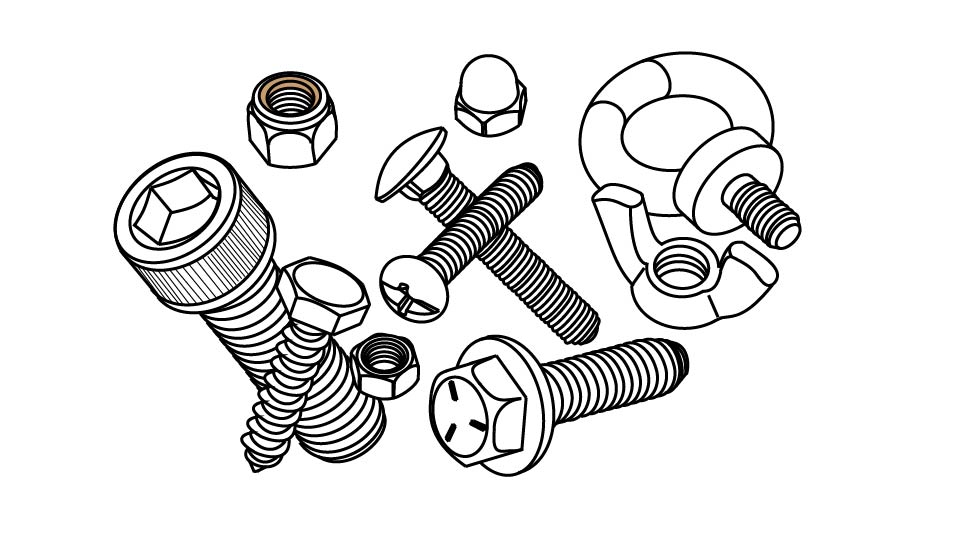
Or: The nuts and bolts of nuts and bolts.
If you spend any time fixing, assembling, reinforcing, or building, you eventually graduate from screws to bolts. Screws bite into material. Bolts clamp materials together. And when the joint matters — when strength, alignment, or disassembly are important — nuts and bolts are often the right answer.
For the DIYer, they can also be confusing. Hex bolts, carriage bolts, lag bolts (which aren’t technically bolts), cap nuts, lock nuts, washers, grades, thread sizes — the hardware aisle suddenly feels like a mechanical dictionary exploded.
This guide walks through what nuts and bolts are, how they work, and which ones you actually need to understand as a homeowner.
What Makes a Bolt Different from a Screw?
The simplest distinction:
- Screws cut or form threads into material.
- Bolts pass through material and are secured with a nut on the other side.
Bolted connections clamp materials together using tension. The bolt tightens, the nut resists, and the materials in between are compressed. That clamping force is what makes the joint strong.
If you can access both sides of the material, a bolt is often stronger and more reliable than a screw.
The Anatomy of a Bolt
Most bolts share the same basic parts:
- Head – The shaped top you turn with a wrench or socket.
- Shank – The smooth portion (if present) below the head.
- Threads – The ridged portion that engages the nut.
- Tip – Usually flat on machine bolts; sometimes tapered on specialty bolts.
Understanding this anatomy helps you choose the right length and type for the job.
Common Types of Bolts (What You’ll Actually Use)
Hex Bolts
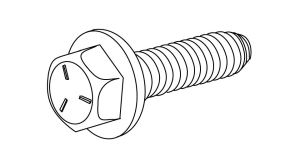
The standard bolt. Six-sided head. Used with a wrench or socket.
Best for:
- Structural framing
- Outdoor projects
- Heavy-duty fastening
If you’re building something that needs real strength, this is often the default choice.
Hex Bolts vs. Hex Cap Screws (Are They Different?)
If you’ve ever stood in the hardware aisle staring at labels that read hex bolt and hex cap screw, you’re not alone in wondering whether they’re actually different.
Technically, yes.
A hex cap screw is manufactured to tighter tolerances and is typically fully threaded, with a washer face built into the underside of the head. They’re designed for precise applications — machinery, engines, structural steel — where torque specifications matter.
A traditional hex bolt, by contrast, often has a partially threaded shank and slightly looser dimensional tolerances. It’s meant to be used with a nut and washer in general fastening applications.
In everyday DIY use, however, the terms are often used interchangeably — especially in big-box stores. For assembling workbenches, bolting together lumber, or securing brackets, either will usually perform the same job when properly sized and graded.
Where the distinction does matter is in high-load or precision applications. If torque ratings, shear strength, or exact fit are critical, check the labeling and grade markings carefully.
For most homeowners, though, the takeaway is simple:
Carriage Bolts
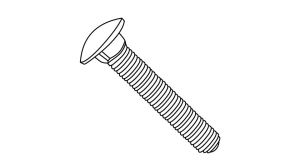
Rounded, domed head with a square section beneath it.
The square shoulder bites into wood and prevents spinning while you tighten the nut.
Best for:
- Decks
- Fences
- Outdoor furniture
- Wood-to-wood connections
They’re clean-looking and great when you don’t want exposed hex heads.
Lag Bolts (Lag Screws)
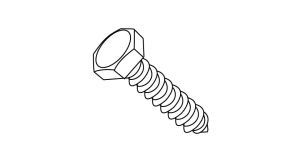
Technically, these are lag screws, because they thread directly into wood and do not use a nut.
They look like bolts but act like very large screws.
Best for:
- Ledger boards
- Structural wood connections
- Mounting heavy items into framing
They require a pilot hole and serious torque.
Eye Bolts / Ring Bolts
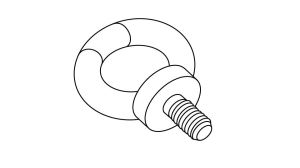
Bolts with a looped head.
Best for:
- Hanging items
- Securing cables
- Anchor points
Be mindful of load direction — many are not rated for side loading.
Stove Bolts (Machine Bolts)
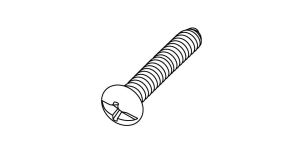
Small-diameter bolts with fully threaded shafts.
Best for:
- Light-duty metal connections
- Appliance repairs
- Hardware assemblies
Often used with small hex nuts and washers.
Hex Bolts vs. Hex Cap Screws (Are They Different?)
If you’ve ever stood in the hardware aisle staring at labels that read hex bolt and hex cap screw, you’re not alone in wondering whether they’re actually different.
Technically, yes.
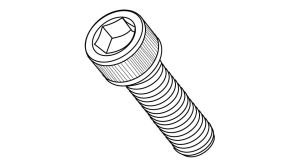
A hex cap screw is manufactured to tighter tolerances and is typically fully threaded, with a washer face built into the underside of the head. They’re designed for precise applications — machinery, engines, structural steel — where torque specifications matter.
A traditional hex bolt, by contrast, often has a partially threaded shank and slightly looser dimensional tolerances. It’s meant to be used with a nut and washer in general fastening applications.
In everyday DIY use, however, the terms are often used interchangeably — especially in big-box stores. For assembling workbenches, bolting together lumber, or securing brackets, either will usually perform the same job when properly sized and graded.
Where the distinction does matter is in high-load or precision applications. If torque ratings, shear strength, or exact fit are critical, check the labeling and grade markings carefully.
For most homeowners, though, the takeaway is simple:
If it has a six-sided head and tightens with a wrench, you’re in the right aisle — just make sure the size and strength rating match the job.
Understanding Nuts
A bolt is only half the story.
Hex Nuts
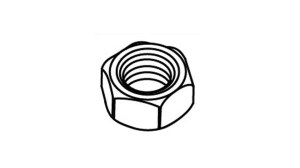
The standard nut. Six sides. Fits standard wrenches.
Use for:
- Most general-purpose bolted connections.
Cap Nuts (Acorn Nuts)
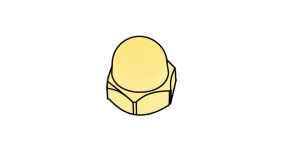
Closed at the top.
Use for:
- Decorative finishes
- Protecting exposed threads
- Preventing injury from sharp bolt ends
Lock Nuts (Nylon Insert Nuts)
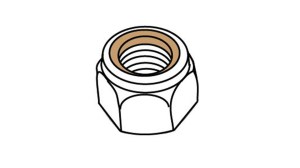
Contain a nylon ring that resists loosening from vibration.
Use for:
- Lawn equipment
- Appliances
- Anything that shakes
These are worth keeping on hand.
Wing Nuts
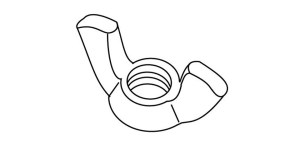
Designed to tighten by hand.
Use for:
- Temporary setups
- Adjustable assemblies
- Fixtures that need frequent removal
Not high-strength, but convenient.
Washers: The Overlooked Hero
Washers do three important things:
- Distribute load
- Protect surfaces
- Prevent loosening
A simple flat washer spreads pressure over a larger area. Lock washers add vibration resistance. Fender washers provide extra-wide coverage for softer materials.
Skipping washers is one of the most common DIY mistakes.
Bolt Grades (Briefly, and Without Engineering School)
You may see markings on bolt heads.
- No markings – Basic strength (light duty)
- Three radial lines – Grade 5 (stronger)
- Six radial lines – Grade 8 (very strong)
For most homeowner applications, Grade 5 is more than sufficient. Structural or load-bearing applications may require higher grades — check project requirements carefully.
Thread Size and Pitch (What Actually Matters)
Bolts are sized by:
- Diameter (e.g., 1/4″, 5/16″, 3/8″)
- Length (measured from under the head)
- Thread pitch (coarse or fine)
For most DIY wood and general-use applications:
- Coarse threads are standard.
- Fine threads are more common in machinery and automotive work.
When replacing a bolt, always bring the original to the hardware store.
When to Use Bolts Instead of Screws
Choose bolts when:
- You can access both sides of the material.
- Strength and clamping force matter.
- You may need to disassemble your construction later.
- The joint will experience vibration or movement.
Screws are convenient.
Bolts are dependable.
A Simple DIY Bolt Starter Kit
For most homeowners, a small assortment is sufficient:
- 1/4″ and 5/16″ hex bolts (various lengths)
- Matching hex nuts
- Lock nuts (nylon insert)
- Flat washers and lock washers
- A few carriage bolts
- A couple of eye bolts
Having these on hand saves a surprising number of trips to the hardware store.
This 2,251 Piece Hardware Assortment Kit is highly rated and will see you through years of DIY projects.
(As an Amazon affiliate, I earn from qualifying purchases)
Final Thoughts
Understanding nuts and bolts isn’t about memorizing every hardware variation on the shelf. It’s about recognizing how clamping force works, how materials behave under tension, and why certain connections hold while others fail.
Once you grasp that, the hardware aisle stops feeling overwhelming.
And that’s the goal: not just to fasten things — but to understand what’s holding them together.
Related Posts
DIY projects involve risk. Always follow manufacturer instructions and use appropriate safety precautions.
2017
 Skippity Whistles