
Ron climbed a ladder to clean a gutter, felt it wobble slightly on the uneven ground, and decided to just lean a little further instead of climbing down to reposition it. That lean is exactly how a six-foot ladder turns into a trip to urgent care — not because Ron was careless in general, just impatient for about four seconds at the wrong moment.
Almost every DIY injury traces back to that same root cause: someone in a hurry, skipping a step that would have taken less time than the injury will cost. Safety isn’t about being anxious. It’s a short list of habits and gear that turn a possible disaster into a non-event.
👁️ Eye Protection: The One Nobody Regrets Wearing
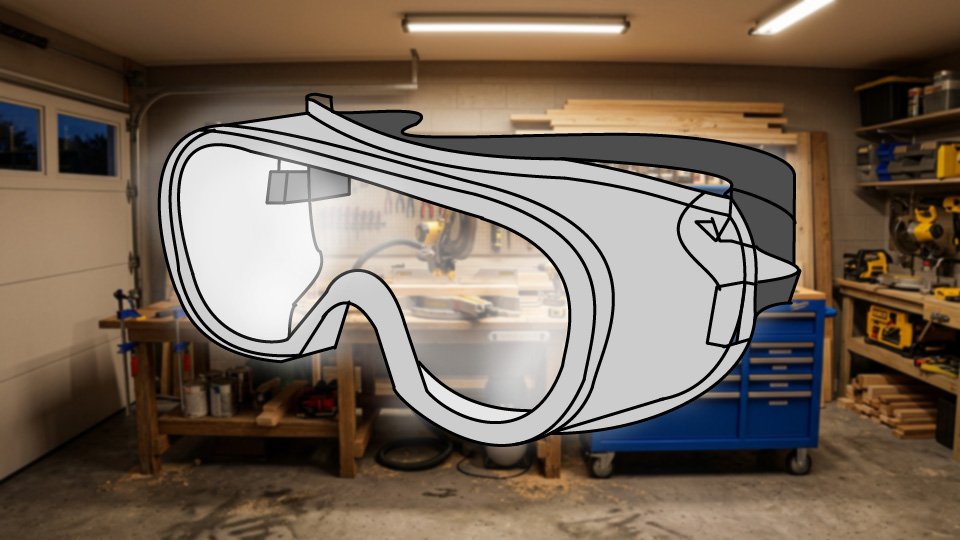
Eyes are genuinely easy to injure and impossible to replace. Debris from cutting, drilling, sanding, hammering, or anything with a chance of flying deserves eye protection every time, not just when a project feels risky. Impact-rated safety glasses with clear lenses are the standard — keep a pair at the workbench and another in a car or toolbox, since gear you actually have on hand gets worn far more often than gear buried in a drawer.
🧤 Hand Protection — and the One Real Danger
Gloves protect against splinters, sharp edges, and rough handling during general work, demolition, and material handling. Match the material to the job: canvas or leather for rough general work, nitrile for chemicals and adhesives, rubber for wet cleanup.
One rule overrides everything else: never wear gloves around spinning tools — a drill, a lathe, an angle grinder, anything with a fast-spinning bit or blade. A glove can catch on a spinning tool and pull a hand in before there’s any time to react. Bare hands, kept clear, are safer than gloved ones near anything that spins.
😷 Respiratory Protection: Don’t Breathe the Project
Fine dust from sanding, cutting drywall, or working with old materials floats in the air long after the work stops, and it settles in lungs the same way. A basic dust mask covers light work with minimal dust. An N95 respirator (rated to filter 95 percent of particles down to 0.3 microns) is the right minimum for any project generating visible dust — wood sanding, drywall cutting, general demolition. A reusable respirator with swappable cartridges steps up further for heavy, extended dust or chemical fumes, and needs the cartridge matched to the actual hazard, since a dust cartridge won’t filter fumes and vice versa.
👂 Hearing Protection: Damage That Doesn’t Heal
Power tools, mowers, and grinders run loud enough, long enough, to cause real hearing damage — and unlike most injuries on this list, hearing loss doesn’t come back once it’s gone. Foam earplugs handle general power tool work cheaply. Earmuffs suit longer sessions since they go on and off instantly with no insertion needed. For genuinely loud, extended work, both together isn’t overkill.
🪜 Ladder Safety: Preventing the Fall
The 4-to-1 rule keeps a ladder’s base positioned safely: for every 4 feet of height, the base sits 1 foot away from the wall — a 12-foot ladder needs its base 3 feet out. Keep three points of contact on the ladder at all times, meaning two hands and one foot, or two feet and one hand, never fewer. Never stand on the top rung, lean sideways past your hips, or work a ladder on uneven ground or in wind. If a ladder feels unstable even slightly, that feeling is correct — climb down and reposition rather than push through it, exactly the step Ron skipped.
⚡ Electrical Safety: Respect the Shock
Never touch electrical components without confirming power is off first, and never trust a circuit is dead just because it should be — verify it. A non-contact voltage tester (a tool that detects live current by holding it near a wire, no direct contact needed) is genuinely non-negotiable for any electrical work at all. A GFCI outlet (a ground-fault circuit interrupter, which cuts power automatically the instant it detects current leaking somewhere it shouldn’t) is required in bathrooms, kitchens, and outdoor circuits for good reason — it reacts faster than a person possibly could. Anything beyond simple, well-understood electrical work is worth a licensed electrician, every time, without exception.
🏋️ Lifting: Protect Your Back Before It Needs Protecting
Bend at the knees, not the waist, and keep the load close to your body — distance from your body multiplies the strain on your back dramatically. Lift with your legs doing the work, not your spine, and never twist while holding weight. As a rough guide, 50 pounds is reasonable for most people alone; past 75 pounds, or with anything heavy and awkward like a full sheet of plywood, get a second person or a hand truck involved rather than testing your luck.
🩹 First Aid: Ready for the Small Stuff
Most DIY injuries are minor — cuts, scrapes, splinters, pinched fingers — and a basic kit within arm’s reach handles the overwhelming majority of them. Bandages, gauze, antiseptic wipes, tweezers, and antibiotic ointment cover most workshop mishaps completely. Anything more serious — a deep cut that won’t stop bleeding, any eye injury, a suspected electrical burn, or real confusion about how bad it is — is a call to 911, not a wait-and-see.
🧠 The Actual Habit Worth Building
Nearly every injury on this list traces back to rushing — skipping the glasses “just this once,” not double-checking a circuit, leaning a little further instead of climbing down. The fifteen seconds it takes to put on safety glasses is nothing compared to the weeks an eye injury costs. That pause, right before the risky part of any task, is where safety actually lives — not in owning more gear, just in taking the four extra seconds to use what’s already sitting there.
🛒 Gear Worth Having
AXEMIS Half-Face Respirator Mask Combo Kit with Anti-Fog Safety Glasses & Earplugs — Covers eyes, lungs, and ears in one kit — the three protection categories that get skipped most often simply because they’re not already on hand.
Klein Tools NCVT-3 Non-Contact Voltage Tester — The one tool worth owning before any electrical work at all — confirms a wire is dead without ever needing to touch it.
Compact Workshop First Aid Kit — Covers the small cuts, splinters, and scrapes that make up most DIY injuries, kept close enough that reaching for it is never the hard part.
As an Amazon affiliate, I earn from qualifying purchases. Thank you for supporting SkippityWhistles.
📖 Related Reads
SkippityWhistles is part of the WhistleBump group – find the rest of the family at WhistleBump.com.
7025
©2026 John D Reinhart/Skippitywhistles.com — All rights reserved