
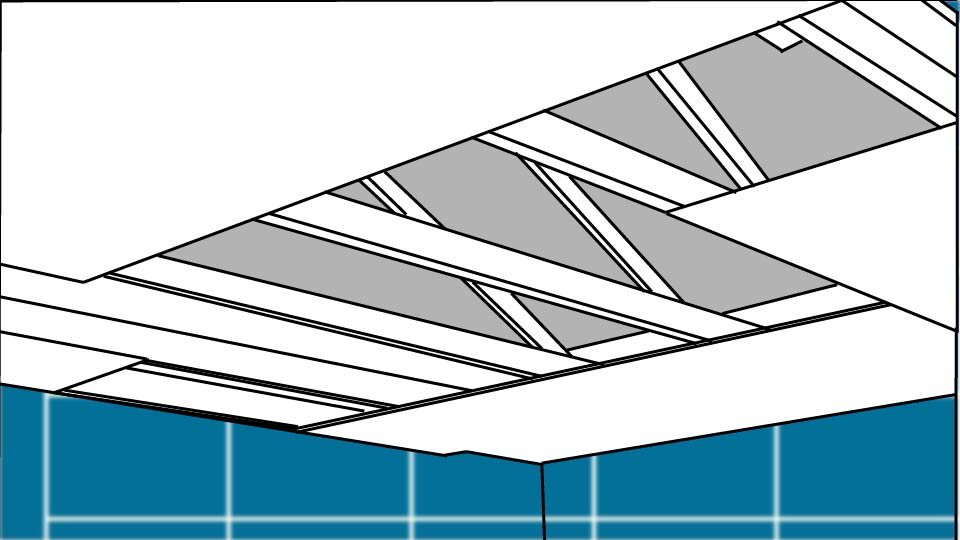
Ron owns a house full of drywall and has never once thought about what it actually is — right up until he put a doorknob straight through a bedroom wall and discovered the answer was “surprisingly little.” A wall that looks like solid plaster turned out to be a thin panel with a chalky white interior, and Ron’s working theory about walls being basically indestructible took a real hit that afternoon.
Drywall is the material behind almost every interior wall and ceiling in a modern home, and understanding what it actually is explains both why it’s so easy to damage and why it’s just as easy to bring back.
🪨 What’s Actually Inside the Panel
Drywall is gypsum (a soft, naturally occurring mineral that’s fire-resistant and easy to shape) pressed into a solid core and sandwiched between two layers of thick paper that hold it together and give the surface something smooth to finish. That’s the entire material — no wood, no plaster in the traditional sense, nothing structural on its own. It’s a skin, not a skeleton; the actual framing behind it is what the house depends on for strength.
Panels come in a few standard thicknesses for a reason: 1/2 inch is the standard for most interior walls, 5/8 inch shows up on ceilings and shared walls because the extra mass improves fire resistance and sound dampening, and 1/4 inch exists specifically as a thin overlay for resurfacing over existing damaged drywall rather than tearing it out.
💥 Why It Damages So Easily — and Why That’s Not a Flaw
A doorknob, a moving box corner, or a shelf bracket punches through drywall easily because the gypsum core has no give and the paper facing tears cleanly once the core cracks. That’s actually the tradeoff that makes drywall the standard material it is — a more impact-resistant wall material would also be heavier, harder to cut, and far more expensive to install across an entire house. Drywall trades some durability for being fast to install, inexpensive, and, just as importantly, fast and inexpensive to repair when something inevitably goes through it.
📌 Nail Pops: The Damage That Isn’t Really Damage
A nail pop (a small raised bump or crack where a fastener has worked its way slightly loose from the framing behind the drywall) isn’t the drywall failing — it’s the house settling, wood framing shrinking slightly as it dries over the seasons, and the fastener no longer sitting flush. It shows up as a small bump or hairline crack, usually in a fairly straight line along a stud. It looks alarming the first time you notice it and is almost always cosmetic rather than structural.
🩹 Seams, Tape, and Why Some Walls Are Invisible
Every seam between two sheets of drywall gets covered with joint compound (a plaster-like paste used to fill and smooth seams, dents, and screw holes) and drywall tape (a reinforcing strip — either paper or fiberglass mesh — embedded in the compound to keep the seam from cracking). A wall where you genuinely cannot find the seams is the result of feathering the compound out wide and thin over several coats, not a different material or some hidden trick. Fiberglass mesh tape is more forgiving for small patch jobs; paper tape is what most professional new-construction seams use because it resists cracking slightly better over the long run.
🤔 Patch, Repair, or Call Someone
Small holes, hairline cracks, and nail pops are genuinely reasonable to handle yourself — the material and process for that specific job are covered step by step in the dedicated patching post below, since that’s a hands-on task worth walking through properly rather than summarizing here. Larger jobs change the calculation fast: hanging full new sheets, water-damaged drywall that’s gone soft or moldy, or repairs near electrical boxes all bring in enough complexity, weight, or risk that a contractor’s quote is worth getting before committing a weekend to it. The material itself is forgiving. The scale and safety of the job is what should decide who’s holding the taping knife.
🛒 Gear Worth Having
3M Patch Plus Primer Self-Adhesive Drywall Patch — A metal mesh patch with primer built in, sized for the small-to-medium holes that make up most household drywall damage — no separate backing or tape needed.
USG Sheetrock Pre-Mixed All-Purpose Joint Compound — Ready to use straight from the bucket, which matters most on a first attempt when mixing your own powder compound is one more variable than you need.
3M Drywall Sanding Sponge, Fine/Medium Grit — Contours to the patch better than flat sandpaper, and the dual-grit sides mean one sponge handles both the rough smoothing and the final pass.
As an Amazon affiliate, I earn from qualifying purchases. Thank you for supporting SkippityWhistles.
📖 Related Reads
SkippityWhistles is part of the WhistleBump group – find the rest of the family at WhistleBump.com.
2002
©2026 John D Reinhart/Skippitywhistles.com — All rights reserved