
Ron’s fix for a torn window screen, for about three summers running, was a strip of packing tape pressed over the hole from the inside. It held, technically, in the sense that a bug now had to work slightly harder to get through. What Ron never quite figured out was that the screen wasn’t one thing that had failed — it was one of three specific parts, and knowing which one would have told him whether tape was even in the right neighborhood of a fix.
A window screen looks simple because it does one simple job. Understanding the three parts that do that job explains why screens fail the way they do, and which failures are worth your time to address.
🧩 Three Parts, One Job
Every window screen breaks down into a frame (the rigid border, usually aluminum, that holds everything else in shape), mesh (the woven material that blocks insects while letting air and light through), and a spline (a flexible rubber cord pressed into a groove around the inside of the frame, clamping the mesh in place). Nearly every screen problem traces back to a failure in exactly one of these three, which makes diagnosing the issue mostly a process of figuring out which one.
🖼️ The Frame: What Holds Everything
The frame’s only real feature that matters is the groove (a narrow channel running around the inside perimeter of the frame, where the spline sits) — without it, there’d be nothing to clamp the mesh against. Frames fail by bending (which throws the groove out of alignment so the spline can’t seat properly), corroding (aluminum weakens over years, especially near coastlines or in humid climates), or cracking (usually final — a cracked frame isn’t something to patch, it’s something to replace).
🕸️ The Mesh: What Actually Stops the Bugs
Fiberglass mesh is flexible and forgiving, which makes it the friendlier material to work with, though it sags a little more over time. Aluminum mesh holds its shape longer but is stiffer to install. Mesh fails through physical tears, UV-driven brittleness after years in the sun, or simple sagging when the spline behind it has lost its grip. The hole size in any mesh is a deliberate tradeoff — finer mesh blocks smaller insects but cuts down airflow slightly, which is why most residential screens land on a middle-ground size rather than the finest mesh available.
🧵 The Spline: The Part Nobody Notices Until It Fails
The spline is doing all the actual clamping — without it, mesh has nothing holding it against the frame at all. It fails the way most rubber does: UV exposure and years of temperature swings make it brittle and eventually crack, at which point it stops gripping and the mesh works itself loose. It’s also the part most commonly skipped during a repair, since reusing old spline looks like it saves a step. It rarely holds — spline that’s already brittle enough to fail once tends to fail again within months of being reinstalled.
🤔 Repair or Replace: Reading the Signs
A screen is generally worth repairing when the frame itself is straight and undamaged and the failure is limited to the mesh or spline — that’s a genuine fix, not a stopgap, provided both the mesh and spline get replaced together rather than just patched. A screen is generally worth replacing outright when the frame is bent, cracked, or corroded badly enough that the groove itself is compromised, since no amount of new mesh or spline fixes a frame that can’t hold either one properly. Given that a full replacement screen often costs less than an afternoon’s frustration, a compromised frame is rarely worth fighting for.
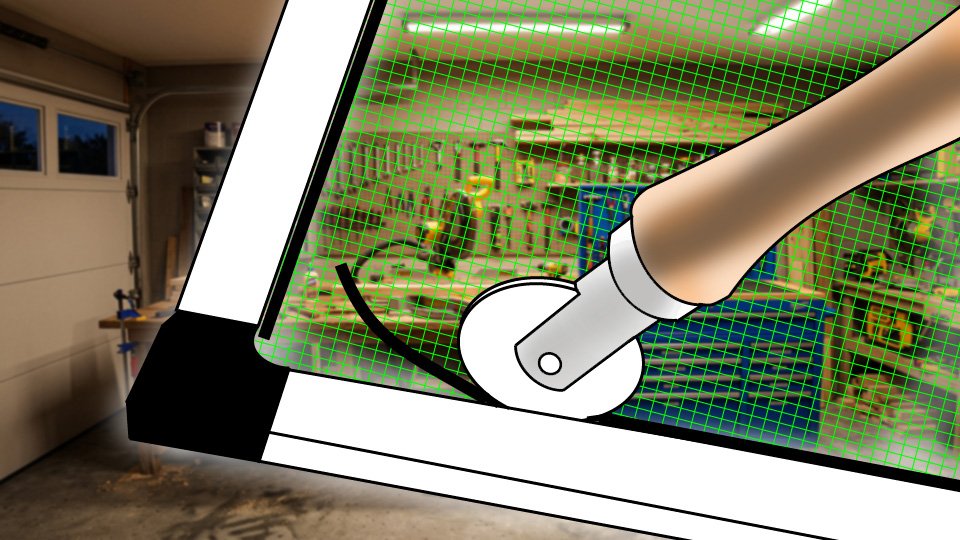
The actual mesh-and-spline installation — pressing new mesh into the groove and rolling the spline in tight and even all the way around — is a hands-on process that’s genuinely easier to follow by watching than reading. It’s worth a quick YouTube search once you’ve decided repair is the right call; watching someone’s hands roll a spline for thirty seconds will teach the technique faster than any amount of description here.
🛒 Gear Worth Having
Fiberglass Window Screen Repair Kit — Bundles fresh mesh with matching spline and a roller tool in one kit, so you’re not stuck reusing brittle old spline just because it was already in the drawer.
Prime-Line Screen Spline Roller Tool — The dual-wheel design seats spline evenly on the first pass instead of leaving loose spots that work themselves free within a season.
Metro Screenworks Custom-Cut Aluminum Window Screen — Built to your exact window dimensions when the frame itself is the problem — the right call the moment the groove is bent instead of the mesh.
As an Amazon affiliate, I earn from qualifying purchases. Thank you for supporting SkippityWhistles.
📖 Related Reads
- How to Choose the Right Fastener
- Seals, Gaskets, and Thread Tape: Why They Matter
- Working with Drywall
SkippityWhistles is part of the WhistleBump group – find the rest of the family at WhistleBump.com.
2020
©2026 John D Reinhart/Skippitywhistles.com — All rights reserved