
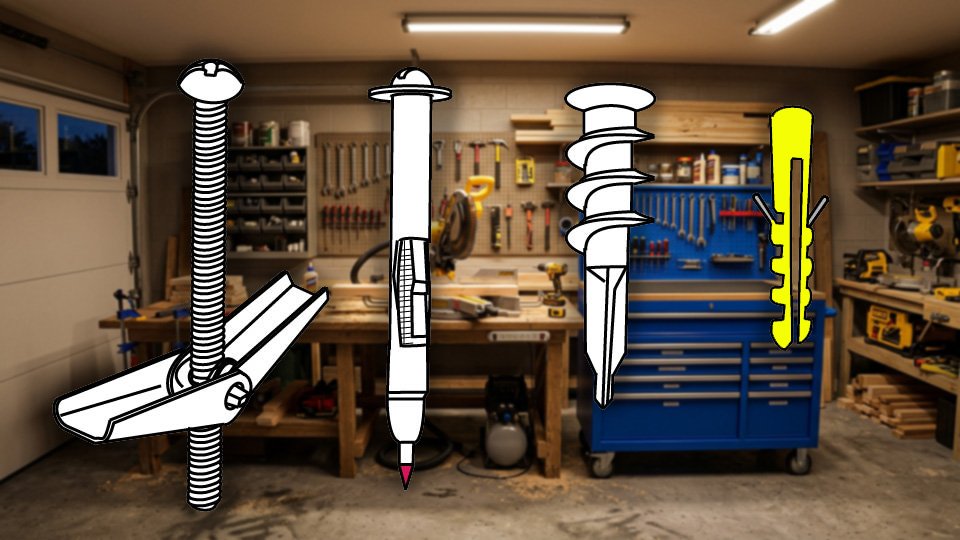
Ron drove a screw into what he was fairly confident was a stud, hung a shelf, and loaded it with exactly the kind of hardcover books that make a point about it later. The shelf held for four days. On the fifth, at roughly 3 AM, it introduced itself to the floor. Ron hadn’t found a stud. He’d found drywall that was very good at pretending, right up until it wasn’t.
A screw spinning uselessly in drywall isn’t a broken screw — it’s a screw with nothing to grip, because drywall’s powdery gypsum core has no fiber for threads to bite into the way solid wood does. That’s the entire reason anchors and toggle bolts exist: they give a fastener something real to hold onto, spreading the load out instead of asking one small point of drywall to carry all of it.
🧩 Four Anchors, Four Strength Levels
- A plastic expansion anchor (a ridged plastic sleeve that expands against the hole as a screw is driven into it) is the lightest option, good for roughly 5 to 10 pounds — pictures, small hooks, nothing you’d mourn if it failed.
- A self-drilling anchor (a sharp-tipped screw-style anchor that drills its own hole without a pilot) steps up to around 10 to 25 pounds and skips a step in installation, at the cost of leaving a bigger hole behind if it’s ever removed.
- A molly bolt (a metal sleeve that expands and locks behind the drywall as its screw is tightened) handles roughly 25 to 50 pounds and stays permanently anchored behind the wall even after the screw comes out.
- A toggle bolt (a machine screw paired with spring-loaded metal wings that fold flat for insertion and snap open behind the drywall) is the heavyweight option, often rated 50 to 100-plus pounds, because its wings lock flat against the back of the drywall and spread the load across the widest area of any anchor type.
The general rule: light and forgettable gets a plastic anchor, everyday household weight gets a self-drilling anchor or molly bolt, and anything you genuinely cannot afford to have fall — a heavy mirror, a loaded shelf, a TV mount — gets a toggle bolt, or better yet, an actual stud.
🛠️ Installing a Toggle Bolt, Step by Step
Mark the spot and commit — toggle bolts leave a dime-sized hole behind if the anchor’s ever removed, so measure with intention. Drill the hole to the exact size the package specifies; too small and the wings can’t open, too large and the whole anchor spins uselessly in the hole, which defeats the entire point. Thread the screw through whatever you’re hanging first, then thread it through the folded wings until the screw tip just peeks through — don’t tighten yet, just assemble. Fold the wings flat and push the assembly through the hole until you feel a distinct snap as the wings spring open on the other side of the drywall. Finally, tighten while gently pulling the screw back toward you, which keeps the wings flush against the back of the wall for maximum grip — stop at snug, not at Hulk-strength, since overtightening can crush the drywall from the inside and quietly weaken the very hold you’re trying to create.
🤔 The Three-Question Test
Before buying anything, answer three questions honestly.
- How heavy, really — not just the fixture’s weight, but the fixture plus whatever it’ll eventually hold, since a shelf that weighs two pounds empty might carry thirty pounds of books.
- What’s the wall made of — standard drywall works with any anchor type here, but solid masonry or concrete needs a completely different masonry anchor, a different category of hardware entirely.
- And how permanent — plastic anchors come out cleanly for something you’ll rearrange next year, while toggle bolts commit you to that exact spot on the wall for good.
🚫 The One Mistake That Beats Them All
Before reaching for any anchor, check for a stud (the wood or metal framing member inside the wall that a screw can bite into directly). A stud is stronger than every anchor on this list combined, and if one happens to be right where you need it, skip the anchor entirely and drive a wood screw straight into it. Anchors exist specifically for the in-between spots where no stud is available — they’re a very good solution to a problem you’d rather not have in the first place.
🛒 Gear Worth Having
TOGGLER SnapToggle Heavy-Duty Toggle Bolt Kit — Rated well past 100 pounds per anchor and reusable if the screw ever needs to come out — the toggle bolt that makes a heavy mirror a non-issue.
Self-Drilling Drywall Anchor Assortment — No pilot hole, no separate drill bit — for the everyday medium-weight jobs that don’t need the full toggle-bolt commitment.
Zircon MultiScanner Stud Finder — The tool that makes the whole anchor conversation unnecessary in the first place, whenever there’s a stud close enough to use instead.
As an Amazon affiliate, I earn from qualifying purchases. Thank you for supporting SkippityWhistles.
📖 Related Reads
SkippityWhistles is part of the WhistleBump group – find the rest of the family at WhistleBump.com.
2008
©2026 John D Reinhart/Skippitywhistles.com — All rights reserved