Ron crossed two wires and tried to twist them together, muttering in surprise when he cut them off. Come on, Ron! Look at the pliers! Right there, next to the pivot? Those are wire cutters, man!
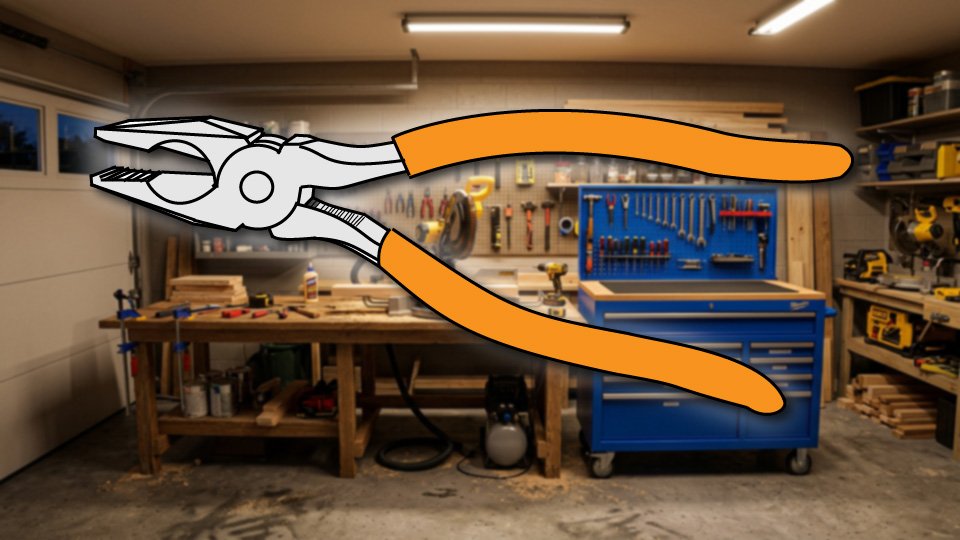
Linesman pliers look like a heavier, more serious version of the pliers in the kitchen drawer, and that’s basically accurate. They’re not the jack-of-all-trades pliers like the slip-joints – they’re built for a narrower set of jobs that they do very well.
🔌 What Makes Them Different
A linesman pliers has flat, straight gripping jaws instead of the curved jaws on a slip-joint pair. Built into the jaws, near the pivot, is a genuine cutting edge — not an add-on, but a real part of the tool’s design.
Unlike slip-joint pliers, the jaw opening on a linesman pliers doesn’t adjust. It makes up in strength and control what it gives up in flexibility, which is exactly why electricians reach for this pliers specifically, over and over.
✋ Gripping and Twisting
To join two wires together, cross them and grip both, holding them toward the back of the flat jaws, close to the cutting notch but not inside it. That spot gives you the most leverage for a tight, clean twist.
Twist steadily, like turning a key, rather than in short jerks — a steady twist keeps both wires locked together instead of slipping apart mid-turn.
✂️ Cutting Wire
The cutting notch sits right behind the flat jaws, near the pivot. It handles household electrical wire and small metal rods or nails cleanly. Ask Ron, he can show it to you.
Confirm the electrical circuit is off before cutting any wire, every single time, regardless of how minor the wire looks.
Wear eye protection. A cut wire end can flick unpredictably the instant it separates.
〰️ Pulling and Bending
The jaws pull small nails and bend light metal cleanly, using the same flat gripping surface as it does for general holding work.
Don’t force the tool against hard or oversized material. A linesman pliers that’s straining is a sign to switch tools, not a sign to push harder — forcing it risks damaging the pliers, the material, or both.
🛡️ Safety Basics
Wear safety glasses any time you’re cutting wire. Never use any pliers on a live electrical circuit — confirm power is off first, no exceptions for a job that looks small. And don’t use a linesman pliers as a makeshift hammer or wrench; it’s built specifically for gripping, twisting, and cutting, not striking or turning fasteners.
🛒 Gear Worth Having
Klein Tools Linesman Pliers — The standard, reliable choice most electricians already reach for — sturdy jaws and a genuine cutting edge built to last.
Klein Tools 1000V Insulated Linesman Pliers — Rated insulated handles for anyone doing real electrical work regularly, not just an occasional household fix.
IRWIN Wire Stripper and Cutter — The companion tool that strips insulation cleanly, so the linesman pliers can focus on cutting and twisting instead of double-duty stripping.
As an Amazon affiliate, I earn from qualifying purchases. Thank you for supporting SkippityWhistles.
📖 Related Reads
SkippityWhistles is part of the WhistleBump group – find the rest of the family at WhistleBump.com.
7023
©2026 John D Reinhart/Skippitywhistles.com — All rights reserved