Rhonda hung a shelf by eye, stepped back, and it looked perfectly level — right up until a coffee mug started a slow, deliberate migration toward the edge over the following week. Her eye hadn’t been careless. It had just done what eyes reliably do with anything you built yourself: rounded the tilt down to zero because you wanted it to be level.
A spirit level exists specifically to overrule that instinct. It’s a genuinely simple tool, and using it right is less about technique and more about trusting it over your own eye, every time, without negotiating.
🫧 How the Bubble Actually Works
Inside a spirit level sits a sealed, curved tube filled with liquid (traditionally alcohol — the “spirit”) and one air bubble.
Gravity pulls the liquid to the lowest point, which pushes the bubble to the highest point in the tube.
When the tube is perfectly level, the bubble centers itself exactly between two marked lines. Tilt the tube even slightly, and the bubble drifts toward the higher end.
That’s the entire mechanism — everything else about using a level is just reading that one honest signal correctly.
📏 Picking the Right Level for the Job
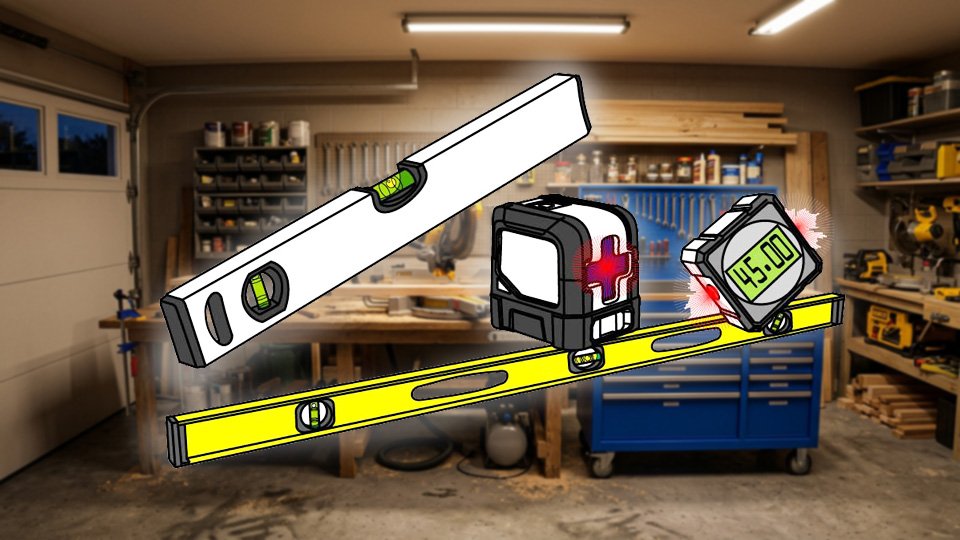
- A torpedo level (short, usually 9 to 24 inches, showing level, plumb, and often 45 degrees) covers the overwhelming majority of household jobs — shelves, picture frames, cabinets, fence posts — and is the level most people should own first.
- A box level (longer, 24 to 48 inches) gives a more accurate reading across longer spans, which matters for deck framing, drywall, or flooring where a short level’s reading in one spot can miss a slow sag across the whole surface.
- A laser level projects a level line across a whole wall or room, genuinely useful for big projects but unnecessary for a single shelf. The general rule: the longer the surface, the more a longer tool’s reading actually means something.
👀 Reading the Bubble Correctly
Centered – like dead center between the lines, means level. “Pretty-much centered” and “basically centered” are not things. The bubble must be between the lines. Off toward one end means the surface tilts in that direction, and the further off-center, the more pronounced the tilt.
- Horizontal (floors, tables, shelves, etc): Lay the level flat on the surface. Make sure there’s nothing under it that might throw it off. Rotate the level 90 degrees to make sure the item is flat in the other direction, too.
- Vertical (the sides of bookcases, door frames, etc): There’s a smaller “plumb” level to measure the up-and-down straightness of these things. Like measuring the horizontal, press the level against the item being measured, making sure there’s nothing under the level to throw it off.
Checking one direction only is the most common way a project ends up subtly wrong — a shelf can read perfectly level side-to-side and still slope front-to-back. Rotate the level ninety degrees and check the second direction before calling anything finished.
🚫 The Habits That Undo a Good Level
- Trusting your eye over the tool once the level has already told you otherwise defeats the entire purpose of owning one.
- Using a short level on a long surface can miss a gentle sag that only shows up across real distance.
- Skipping the second-direction check leaves half the problem invisible.
- And treating “pretty close” as good enough quietly reintroduces the exact tilt the level was there to catch — if it matters enough to check, it matters enough to actually center the bubble.
🧰 Keeping a Level Honest
Store it flat or standing upright, never propped at an angle, since angled storage stresses the tube’s seal over time.
A level that’s been dropped deserves a quick trust check: set it on a surface you’re confident is truly flat, like a countertop, and confirm the bubble still centers.
If it doesn’t, the level itself has gone out of true — and a level you can’t trust is worse than no level at all, since it hands you false confidence instead of an honest answer.
🛒 Gear Worth Having
Johnson Level 24-Inch Aluminum Torpedo Level — Accurate, compact, and the right first level for nearly every household project before anything longer is ever needed.
Empire 48-Inch Box Level — Spans real distance for framing, flooring, or anything a short torpedo level would only read a fraction of.
Huepar Self-Leveling Laser Level — Projects a full line across a wall instead of a single point, which earns its keep the moment a project gets bigger than one shelf.
As an Amazon affiliate, I earn from qualifying purchases. Thank you for supporting SkippityWhistles.
📖 Related Reads
SkippityWhistles is part of the WhistleBump group – find the rest of the family at WhistleBump.com.
2022
©2026 John D Reinhart/Skippitywhistles.com — All rights reserved