
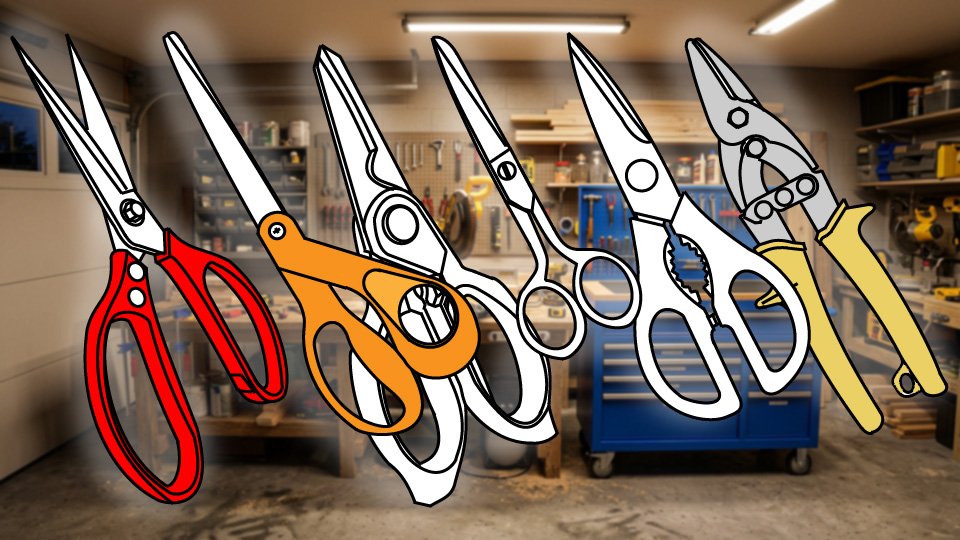
Ron needed to open a plastic clamshell package sealed with the aggressive confidence of a company that has never once considered the customer’s feelings, and the nearest sharp object happened to be a pair of fabric scissors from the sewing kit. They worked. They also came out of the encounter with a small nick in one blade, which is the exact kind of damage that turns a scissors built for silk into a scissors that now snags cotton. Fabric scissors have exactly one job, Ron. That wasn’t it.
Scissors and shears get almost no respect in a toolbox, right up until you’re holding the wrong pair for the job and suddenly they’re the only thing that matters. There are more kinds than you’d expect, and each one is quietly furious about being used for anything but its actual purpose.
✂️ Scissors vs. Shears: The Actual Difference
Scissors are typically smaller and lighter, built for precision and control on lighter material — paper, tape, light plastic. Shears are larger and heavier, with longer blades and stronger handles, built for tougher material and repeated use. The two words get used interchangeably in casual conversation, but the size and strength difference is real, and most well-stocked DIYers eventually own examples of both.
📦 Household Scissors: The Everyday Default
General-purpose household scissors handle paper, cardboard, packaging, tape, and twine — the stuff most people reach for scissors to cut in the first place. They dull quickly if pushed into thicker or more abrasive material than they’re built for, which is most of what sends people reaching for the wrong pair to begin with.
💪 Heavy-Duty Scissors: When Household Isn’t Enough
A step up in blade thickness and pivot strength, heavy-duty scissors handle thicker cardboard, plastic clamshell packaging (the exact villain from Ron’s story), and light rubber or foam without the hand fatigue a flimsier pair would cause. If you only buy one pair of scissors for a DIY toolkit, this is the one — stainless steel blades, a strong pivot screw, and enough muscle for the packaging aisle to stop winning.
🛠️ Aviation Snips: Metal Only
Technically shears, not scissors, aviation snips are built specifically for thin sheet metal, aluminum flashing, and HVAC ducting. Using them on anything else dulls them fast, and using scissors on metal instead of snips is an equally bad trade in the other direction. The full technique gets its own dedicated post — this is a specialist tool worth treating as one.
🧵 Fabric Scissors: The One Rule
Fabric scissors are ground to a finer, sharper edge specifically for clean cuts through cloth and upholstery material, and that edge dulls fast against anything with more resistance — cardboard, plastic, tape. The rule is short and absolute: never use fabric scissors on anything but fabric. Ever. Ron’s clamshell package incident is exhibit A for why this rule exists in the first place.
🍴 Kitchen Shears: The Sneaky DIY Helper
Kitchen shears turn up in DIY tasks more often than their name suggests — twine, rope, plastic packaging, light rubber and foam all fall well within their range. They often come with genuinely comfortable grips and strong leverage, since cutting through poultry bones demands real strength to begin with.
🔌 Electrician’s Scissors: The Hidden Gem
Short, tough blades built specifically for wire insulation, electrical tape, zip ties, and light cable work. These are genuinely underrated outside electrical circles — the short blade length gives excellent control in tight spaces, and they’re built to take abuse that would ruin a standard pair of scissors within a week.
🎯 What to Buy First
A heavy-duty utility shear covers the widest range of everyday DIY cutting and is the right first purchase for almost anyone. Add fabric scissors the moment any sewing or upholstery work enters the picture — and keep them physically separate from everything else, ideally in their own drawer, so nobody “just this once” borrows them for a clamshell package. Everything else on this list gets added exactly when a project specifically calls for it, not before.
🛡️ Safety Basics
Cut away from your body, always. Keep fingers clear of the blade path. Never use scissors as a pry tool — that’s a fast way to snap a blade or a pivot. Store them closed, not loose in a drawer with the blades exposed. And remember that dull scissors slip more than sharp ones, which is exactly backwards from what intuition suggests — sharp is the safer choice, not the riskier one.
🛒 Gear Worth Having
Heavy-Duty Utility Shears — The single best first purchase — stainless blades and a strong pivot that handle most everyday DIY cutting without complaint.
Fiskars Fabric Scissors — A dedicated pair that never has to touch cardboard again, which is the whole point of owning them separately.
Klein Tools Electrician’s Scissors — Short, tough, and genuinely handy well beyond electrical work — the hidden gem this list keeps mentioning.
As an Amazon affiliate, I earn from qualifying purchases. Thank you for supporting SkippityWhistles.
📖 Related Reads
SkippityWhistles is part of the WhistleBump group – find the rest of the family at WhistleBump.com.
7030
©2026 John D Reinhart/Skippitywhistles.com — All rights reserved