
(Or: How I abandoned the handle and learned to love the buttons)
So you moved into a house with a push-button toilet. You know the type: one button for a light flush (number one), two buttons for a heavy flush (number two).
You’ve dealt with toilets all your life. Just jiggle the handle, right? So, how do you jiggle the handle when all you have are push-buttons?
Luckily, it’s actually pretty simple. And knowing how it works can save you frustration — and maybe some money on the water bill.
The Basics: What Makes It Different
Traditional toilets have a lever connected to a flapper inside the tank. Push the handle that lifts the flapper so water rushes into the bowl and the flush happens. (See our post How Standard Toilets Flush for more details).
Push-button toilets use the same principle, but the mechanics are different:
- The button operates a plunger or a piston inside the tank.
- One press lifts a smaller flapper for a low-volume flush.
- Pushing the second button lifts the full flapper for something a little more robust.
- Some systems are dual-valve: one button opens a small valve, the other opens a larger valve.
Basically: one button = small flush, two button = big flush. Same result. Fewer moving parts in the visible tank area, and generally more water-efficient.
Why Push-Button Toilets Exist
- Water Efficiency
- Small flush uses less water.
- Helps reduce your monthly water bill.
- Clean Look & Modern Aesthetic
- Buttons on the tank or wall look sleek.
- No clunky handles sticking out.
- Dual-Flush Functionality
- Gives you control over the volume.
- Reduces unnecessary water usage for liquids.
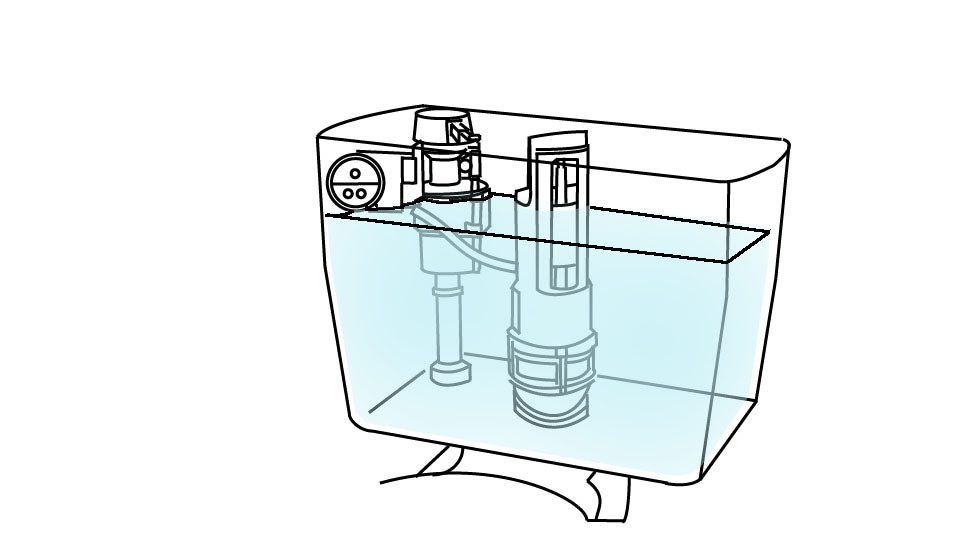
Inside the Tank
If you remove the lid (carefully!), you’ll usually see:
- Two buttons connected to rods or cables
- A piston or flapper mechanism
- A fill valve
- Overflow tube
When you push the button, it lifts the flapper or opens the valve. Water flows from the tank into the bowl — just like a regular toilet. The main difference is in how the button engages the flushing mechanism.
Common Push-Button Toilet Questions
Can You Flush With One Button Only?
Yes. Most toilets are dual-flush, meaning the smaller flush works independently. The larger flush uses either a second button or an extended press.
Do You Need to Press and Hold?
Usually not. A quick press triggers the mechanism. Some older models might require a half-second press to engage fully.
What About Repairs?
- Leaks under the button? Usually a gasket or valve seal issue.
- Button stuck? Clean around the button and lubricate if necessary.
- Flapper not sealing? Standard flapper replacements work with most systems.
Safety note: Don’t try to modify the internal mechanisms with plumbing glue or tape. Replacement parts are inexpensive and designed for your model.
Why This Matters for Homeowners
- Saves water – reducing water volume when it’s not necessary will certainly save on your water bill.
- Reduces accidental overflushes – pushing the button is a lot less user-involved than holding the handle to make sure the flush completes, reducing the chances of an inexperienced user making that happen.
- Makes troubleshooting easier – once you understand the mechanism, you can identify issues quickly.
Plus, knowing which button to push means less embarrassment when guests use your bathroom.
Final Thoughts
So, what did we learn today?
- One dot = small flush, two dots = big flush.
- Buttons lift a flapper or open a valve inside the tank.
- From there, it works on the same principle as a traditional lever-flush toilet.
- Water-efficient and modern.
- Replacement parts are cheap; repair is usually straightforward.
DIY projects involve risk. Always follow manufacturer instructions and use appropriate safety precautions.
3014
 Skippity Whistles