
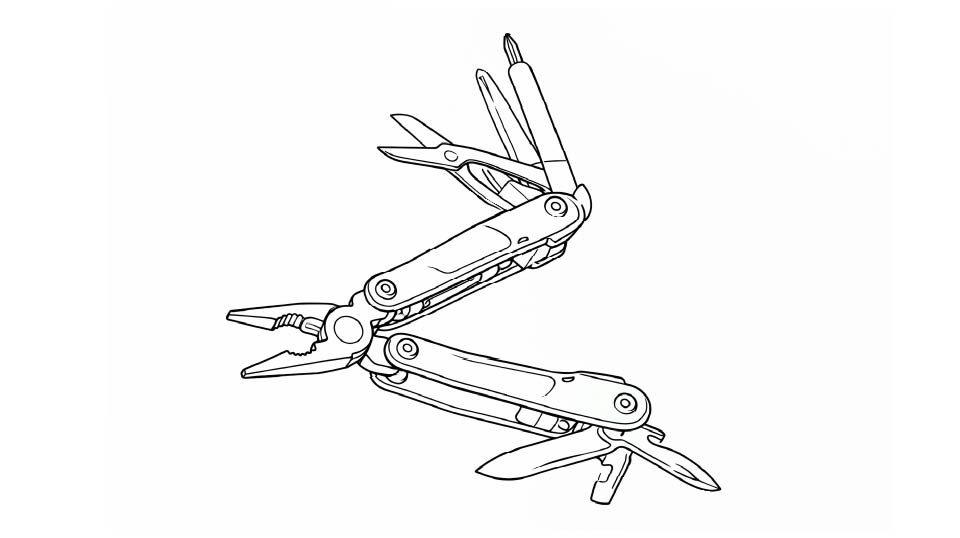
(Pick the right one and avoid using all those words)
If you’ve ever fumbled through a repair, a weekend project, or a camping trip wishing you had just one tool that did it all, you know the appeal of a good multi-tool.
But not all multi-tools are created equal. One might feel perfect in your hand, only to leave you struggling when you need a screwdriver, pliers, or wire cutter. Here’s how to make sure you pick a multi-tool that actually works for real-life DIYers.
Step 1: Decide Your Core Uses
A multi-tool isn’t just a shiny gadget. It’s a solution. Ask yourself:
- Am I mostly using it for home repairs?
- Will it see outdoor/camping use?
- Do I need it to handle emergencies or just light tasks?
Knowing your intended use narrows your options faster than any review page.
Step 2: Examine the Tools Included
Most multi-tools include:
- Pliers (needle-nose and standard)
- Wire cutters
- Screwdrivers (flathead, Phillips)
- Knife blades
- Scissors
- Saw or file
Some add specialty tools:
- Bottle opener / can opener
- Awl / punch
- Crimper or wire stripper
Rule of thumb:
- More tools does not always mean better. Fewer, high-quality tools you actually use beat a Swiss Army kitchen-drawer any day.
Step 3: Build Quality Matters
- Stainless steel vs. cheaper alloys results in better durability. What’s the point of carrying a broken multi-tool? A high-quality tool can last decades — literally a lifetime.
- Pivot points that feel solid result in less tool wobble under pressure.
- Locking mechanisms are mandatory for safety and precision. Just as important as the locking mechanism is an easy-to-use lock-release. A poorly made multi-tool can fold on you mid-use.
Step 4: Comfort and Ergonomics
- Handle shape matters more than most people think. Does the entire tool conform to your hand when any one of the tools is extended?
- Grip texture will help when your hands are wet or greasy.
- A heavy tool will be firm and sturdy in your hands, but difficult to carry in your pocket.
- A light tool will be much easier to carry, but may not be as robust as a heavy one.
Hold it, wiggle it, simulate your most common tasks. You’ll know quickly if it’s right.
Step 5: Portability vs. Function
- A heavy tool is more difficult to carry, restricting its availability when you’re traveling light.
- A light tool can go everywhere with you, but may not offer all of the functions of a heavier tool.
- Imagine how you’ll carry the tool: is this a tool you’ll carry in your pocket, hang from your belt, or maybe keep in a sheath and hang from your belt?
- A multi-tool can be useful even if you keep it in your toolbox or your car’s glovebox.
- And don’t forget – your multi-tool cannot travel with you on an airliner!
Step 6: Price and Brand Considerations
- High-quality multi-tools tend to cost $50–$150
- Mid-tier brands offer excellent value without compromising durability
- Ultra-cheap models are often frustrating and fail early
A multi-tool is one of those tools you either buy once correctly, or you buy five of them over a decade.
This highly-rated Gerber Gear Suspension features a good selection of useful tools in a sturdy, well-crafted frame.
(As an Amazon affiliate, I earn from qualifying purchases)
Step 7: Practical Tips
- Don’t be seduced by “100 tools in one” gimmicks (are you really going to use the included toothpick?)
- Look for tools that lock
- Test spring tension on pliers
- Make sure the screwdriver has a standard Phillips and a flat blade
When in doubt, read one detailed review that focuses on actual use, not marketing blurbs.
Final Thoughts
- Pick tools you’ll actually use.
- Prioritize build quality and locking mechanisms over number of tools.
- Check comfort, weight, and portability.
- Avoid gimmicks and overstuffed “Swiss Army nightmares.”
- Think long-term: buy once, buy right.
Related Posts
DIY projects involve risk. Always follow manufacturer instructions and use appropriate safety precautions.
7050
 Skippity Whistles