
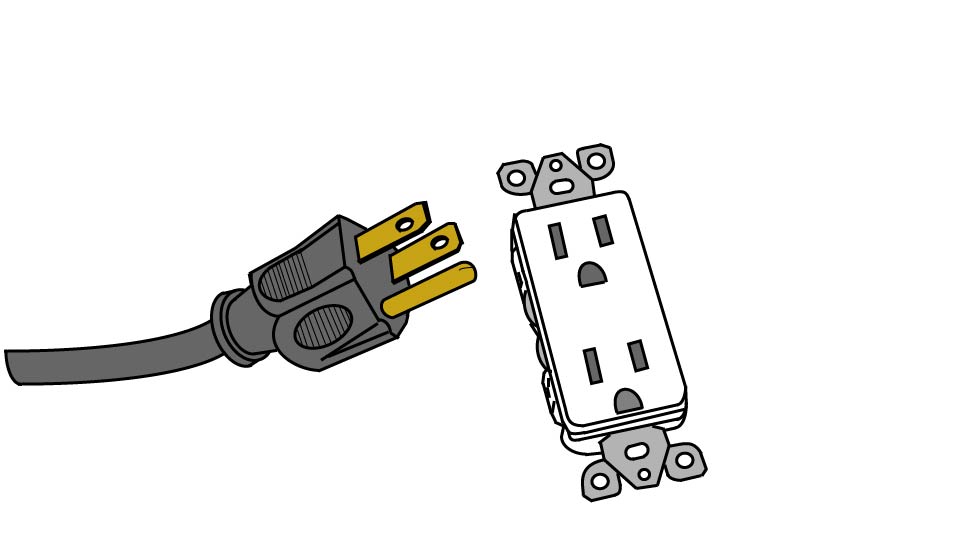
(Or: How to touch the wires and live to tell about it)
Electricity is not complicated. It is simply unforgiving.
It supports everything in your life, from your cell phone to the ceiling fan to the satellites that explain the rain.
You cannot see it. You cannot smell it. You cannot negotiate with it.
And yet, every homeowner will eventually need to replace a light fixture, swap an outlet, install a ceiling fan, or troubleshoot a dead switch.
Your House Is an Electrical System
Think of your house as a system, not a pile of wires.
Electricity enters from the street.
It passes through the meter (the utility’s measuring point).
Then it reaches the main electrical panel.
From thereon, electricity is like blood in the veins of your house, and that panel is the heart.
From there, power is pumped through circuits that branch out to lights, outlets, appliances, and tools — each one a smaller pathway carrying energy where it’s needed.
When you flip a breaker off, you’re not “killing the house.”
You’re just isolating one artery.
When you shut off the main breaker, then you’re stopping the heart.
That’s why the main breaker matters.
That’s why panels matter.
And that’s why understanding flow matters before you ever pick up a screwdriver.
What Electricity Actually Is
In most American homes, standard outlets deliver:
- 120 volts for lights and receptacles
- 240 volts for large appliances (dryers, ranges, HVAC)
Electricity can only flow in a loop:
- Hot wire – carries power from your household electrical panel
- Neutral wire – returns power to the electrical panel to close the loop
- Ground wire – safely shoots the power down a path to the ground in case something goes wrong
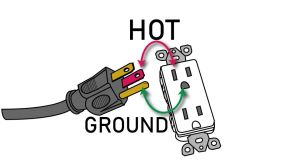
If that loop is broken correctly, like turning off a light, nothing happens.
If that loop is touched while energized, like sticking your finger in a live light socket, something absolutely does.
The Four Rules of Electrical Safety
These rules prevent almost all DIY electrical injuries.
1. Assume It’s Live Until Proven Otherwise
Never trust:
- Wire color alone. You’ve heard the term “getting wires crossed.”
- A switch position. That switch may say off, but this switch is one of two switches, and the second one may be reversed, meaning this off is actually on.
- A breaker label. Who labeled that, and when?
- Someone else’s word. “I’m sure it’s off, I think…”
Trust a tester.
2. Turn Off the Breaker — Then Verify
Go to your electrical panel and turn off the breaker.
Then use a voltage tester from brands like:
Before touching any wires, perform Live–Dead–Live testing: confirm your tester works on a known live outlet, test the circuit you’ve shut off, then re-test the live outlet to ensure your tester didn’t fail.
If you skip these verifications, you are gambling with your life.
(As an Amazon affiliate, I earn from qualifying purchases)
3. Never Work on Live Circuits
Professionals sometimes do.
Homeowners should not.
There is no DIY task important enough to justify that risk.
4. Stop If You Don’t Understand What You’re Seeing
Multiple wires in one box.
Unexpected colors.
Aluminum wiring.
No ground wire.
Those are not “figure it out as you go” moments.
They are pause-and-research moments.
Or call-an-electrician moments.
The Basic Electrical Tools Every Homeowner Should Own
These tools are not optional.
- Non-contact voltage tester
- Multimeter
- Insulated screwdrivers
- Wire strippers
- Electrical tape
That’s your starter kit.
Common DIY Electrical Projects (And Their Risk Level)
| Project | Skill Level | Risk Level |
|---|---|---|
| Replace a light switch | Beginner | Low (if power is verified off) |
| Replace an outlet | Beginner | Low–Moderate |
| Install a ceiling light | Intermediate | Moderate |
| Install a ceiling fan | Intermediate | Moderate |
| Add a new circuit | Advanced | High |
| Upgrade service panel | Professional only | Very High |
Why it’s Good to Be Afraid
Electricity deserves respect.
Confidence without procedure causes accidents.
Caution with procedure prevents them.
The goal is not fearlessness.
The goal is disciplined process.
When to Call an Electrician
Call a licensed professional if you encounter:
- Burning smells or sparks from an outlet
- Frequently tripping breakers
- Flickering lights throughout the house
- Aluminum branch wiring
- Old, two-prong outlets with no ground
- Service panel work
If your DIY electrical project starts popping up puzzles you can’t easily solve, you may be in over your head. Remember, electricians exist for a reason.
DIY projects involve risk. Always follow manufacturer instructions and use appropriate safety precautions.
9010
 Skippity Whistles