
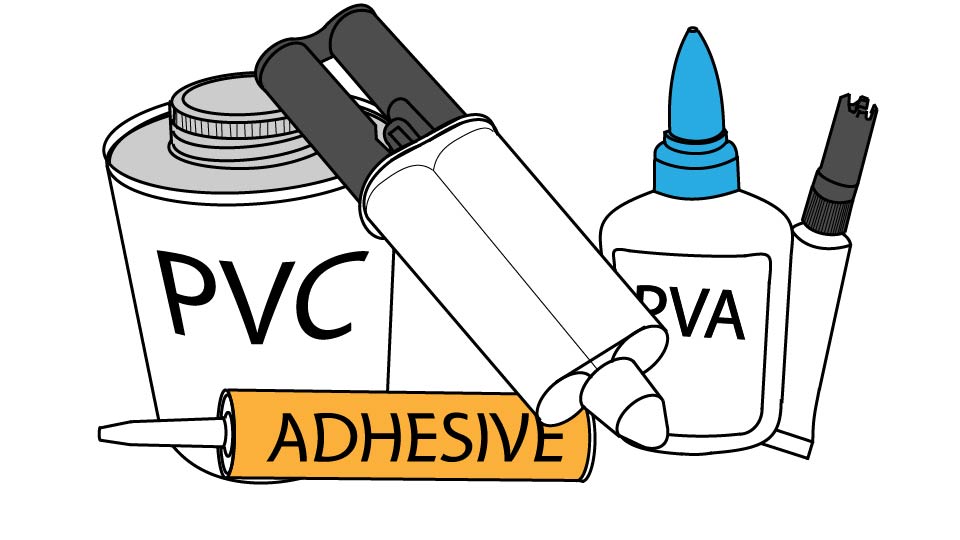
Quiet on the workbench… it’s glue o’clock.
We’ve spent hours talking about screws, bolts, rivets, and fasteners. We’ve counted threads per inch, compared metal grades, and debated whether a pilot hole is your friend.
And all the while, quietly sitting on the shelf, are the bottles of glue. Two little bottles of Super Glue, a tube of wood glue, a can of PVC cement — patient, unassuming, ready to fix what screws can’t.
Glue doesn’t clang. It doesn’t require torque. It doesn’t even look impressive while working. But choose the right one, and it performs miracles. Choose the wrong one, and you’ll spend an afternoon wiping PVC cement off your hands, your floor, and your dignity.
Let’s make sure you never do that again.
The Four Questions That Choose the Glue
Stop memorizing brands. Start thinking like a chemist. Ask yourself:
1. What materials are you bonding?
- Wood to wood
- Metal to metal
- Plastic to plastic
- Ceramic or porcelain
Different adhesives are chemically compatible with different surfaces. You wouldn’t use wood glue on PVC, and you wouldn’t use Super Glue to hold a subfloor in place.
2. Structural or cosmetic?
- Structural: Will the joint carry weight or resist stress? Epoxy and construction adhesive shine here.
- Cosmetic: Is it just holding something in place, fixing a mug, or repairing a figurine? Super Glue or model cement may suffice.
3. Environment matters
- Will it get wet?
- Will it see heat or vibration?
- Indoors or outdoors?
Outdoor furniture? PVC plumbing? Dishwasher-safe ceramics? These environmental factors dictate your choice more than sheer strength.
4. Working time
- Seconds: Cyanoacrylate (Super Glue)
- Minutes: 5-minute epoxy
- Hours: Wood glue, PVC cement
If you need to adjust pieces, instant glue is your enemy. If you want a quick fix, a slow epoxy is frustrating. Match working time to your project’s pace.
Meet the Families: Adhesives You Actually Need
Let’s get to the good stuff. We’ll keep this useful, not catalog-y. Each family is about when and why to use it, with links to the deeper, child “how-to” posts.
Cyanoacrylate (Super Glue)
Best for: Quick fixes on small, non-porous surfaces.
- Strength: Instant bond, brittle under stress
- Gaps: Poor filler, works best on tight fits
- Example: Ceramic figurine chip
→ Child post: How to Use Cyanoacrylate Adhesive
2-Part Epoxy
Best for: Heavy-duty, structural repairs.
- Strength: Very strong, gap-filling, versatile
- Cure time: Varies (5-min, 30-min, 24-hour)
- Example: Metal bracket repair, structural wood joint
→ Child post: Working with 2-Part Epoxy
3. Wood Glue (PVA)
Best for: Wood-to-wood projects.
- Strength: Often stronger than the wood itself
- Pressure: Needs clamping for full cure
- Example: Bookshelf, furniture joints
(Potential future child post: “How to Use Wood Glue Effectively”)
4. Construction Adhesive
Best for: Subfloors, framing, heavy materials.
- Strength: Strong, flexible, gap-filling
- Vibration & squeaks: Great for subfloor repairs
- Example: Attaching panels, underlayment
5. Plastic Cements & Solvent Welds
Here’s where things get interesting for our Home Depot PVC hero.
Best for: PVC pipe, ABS pipe, and polystyrene model kits.
- Method: Solvent softens plastic surfaces and fuses them — chemically creating one piece.
- Limitations: Only works on compatible plastics, no gap filling, irreversible
- Example: Household plumbing, model kits, PVC furniture
→ Child post: Working with PVC Cement
Tip: Always read the label. Some PVC cements require primer. Some ABS cements cannot touch CPVC. Don’t spill it on your shiny white pipe like I did — you’ll regret it.
6. Specialty Adhesives
- Silicone, contact cement, spray adhesive — useful for flexibility, surfaces that vibrate, or temporary bonds.
- These are situational heroes, not core family members.
Glue vs Fasteners
Sometimes a screw is better. Sometimes glue is better. Sometimes, the magic happens when you combine both.
- Glue distributes stress evenly across surfaces.
- Fasteners concentrate stress at single points.
- Combination: Clamps + glue + screws often give the strongest results.
Take a look at our Working with Fasteners post for more detailed information.
Quick Reference Table
| Material | Best Adhesive | Notes |
|---|---|---|
| Wood to Wood | Wood Glue | Clamp for full cure |
| Metal to Metal | 2-Part Epoxy | Clean surface first |
| Plastic (PVC/ABS) | PVC/ABS Cement | Primer may be needed |
| Plastic (Model Kits) | Model Cement | Tight fit only |
| Ceramic/Porcelain | Epoxy or Super Glue | Consider aesthetics |
| Subflooring | Construction Adhesive | Reduces squeaks |
When NOT to Use Glue
- If the joint needs to come apart later
- High heat application (glue melts or weakens)
- Load exceeds the adhesive’s rated strength
- Mechanical fastening is safer
Final Thoughts
Glue is patient. Glue is quiet. Glue doesn’t ask for applause.
Choosing the right adhesive isn’t about the strongest bottle on the shelf. It’s about matching chemistry to material, environment, and your project’s patience level.
Understand your options, and your workbench becomes a problem-solving lab instead of a mess of spilled PVC cement and frustration.
Related Posts:
DIY projects involve risk. Always follow manufacturer instructions and use appropriate safety precautions.
2010
©2026 SkippityWhistles.com All rights reserved
 Skippity Whistles