
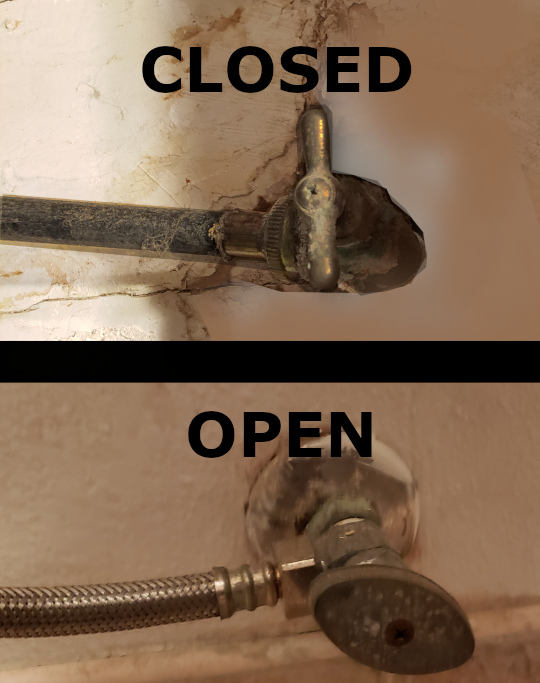
Valve nomenclature. It’s a thing. And it works for door locks, too.
It’s the simplest thing in the world, but it’s so logical that you’ll be surprised that you hadn’t seen it before.
A valve, be it gas, air, or water, has two states: open and closed. The same is true for a door lock: it’s either open or closed.
If the valve has a tee-shaped handle, or is wedge-shaped like a deadbolt handle, your eyes can tell you it’s status with hardly a glance.

When the handle is lined up with the pipe, or when a deadbolt points up and down, that means the valve or the lock is open. You know because it’s showing you a straight line along either the pipe or the doorway.
When that handle lies across the pipe, or the the deadbolt points across the doorway, that means the valve or lock is closed: the path is barred.
See how easy that is? And how efficient?
Of course, you can’t solely rely on this nomenclature, after all, there’s always the possibility that someone put the handle on incorrectly. Always, always test it before assuming it’s open or closed.
If the valve has a round handle, you’re pretty much out of luck. You’ll have to turn the handle clockwise to see if it’s open, or counterclockwise to see if it’s closed. Those round handles are mostly old school or decorative, and are quickly falling out of use because, well, they’re out of date.
So now you are the valve master!
DIY projects involve risk. Always follow manufacturer instructions and use appropriate safety precautions.
3011
©2026 SkippityWhistles.com All rights reserved
 Skippity Whistles