
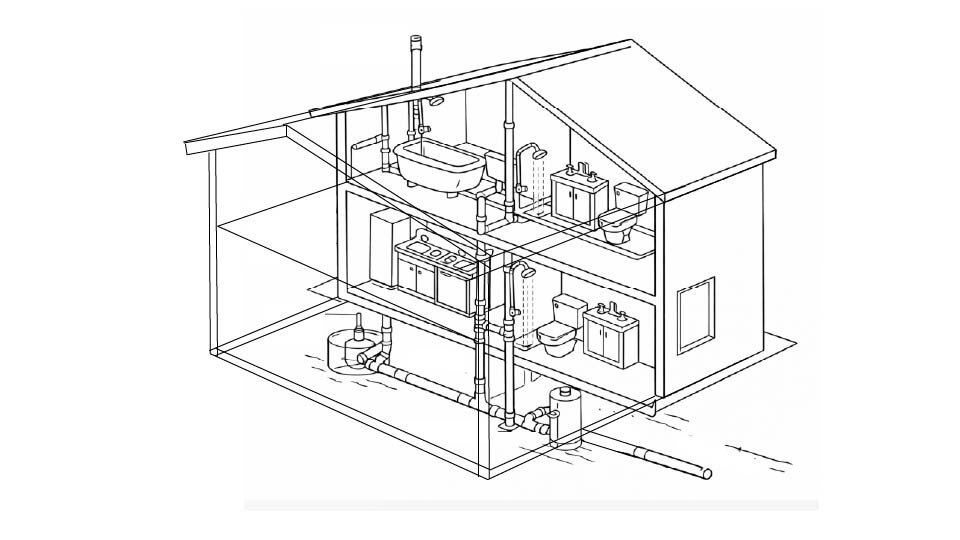
Or: From Street to Sink to Sewer — Understanding the System Beneath Your Walls
Plumbing Is a System, Not a Mystery
Turn on a faucet.
Water flows.
Flush a toilet.
Water disappears.
Simple, right?
Except behind those simple actions is a coordinated system of pressure, pipes, traps, vents, and valves working together inside your walls.
Most first-time DIYers are taught how to fix a clog.
Very few are taught how the system actually works.
This guide changes that.
Because once you understand the system, you stop guessing.
The Three Parts of Your Home’s Plumbing System
Your plumbing isn’t one thing. It’s three coordinated systems:
- Water Supply System
- Drain-Waste System
- Vent System
They work together constantly.
Let’s walk through them.
The Water Supply System (Pressure Does the Work)
Water enters your home through a main supply line, usually underground. The amount of pressure in your water system – the flow rate of your shower, for example – is primarily determined by the water pressure supplied by the city, or municipality. Although it varies, the goal is to have 50 pounds psi in your pipes.
From there:
- It passes through a main shut-off valve
- It may move through a pressure-reducing valve
- It splits into cold and hot supply lines
- It travels through pipes to sinks, showers, toilets, and appliances
Cold Water
Comes directly from the main line.
Hot Water
Cold water enters the water heater. Heated water then travels through separate hot-water pipes.
This system works because of pressure from the original water supply — not gravity.
Water is pushed to every fixture in your home.
The Drain-Waste System (Gravity Takes Over)
Once water leaves your faucet, pressure stops mattering.
Gravity takes over.
Drain pipes are angled slightly downward so wastewater flows toward:
- Larger branch drains
- The main drain line
- Eventually the sewer or septic system
There are no pumps here (in most homes), just slope and gravity.
If the slope is wrong? You get slow drains.
Understanding that one principle alone prevents a lot of confusion.
The Vent System (The Silent Hero)
The vent system connects drain pipes to the outside air — usually through pipes that exit your roof.
Why?
Because water flowing down a pipe creates pressure changes. The vents average out those changes and keep pressure from building anywhere in the drain system.
Without air entering the system:
- Drains would gurgle
- Traps would siphon dry
- Sewer gases could enter your home
Vents keep everything balanced. They are the invisible stabilizers of the entire plumbing system.
How It All Works Together
Here’s what happens when you wash your hands:
- Pressurized water travels through supply pipes.
- You control flow using a valve (your faucet).
- Water enters the drain.
- Gravity carries it through sloped pipes.
- A P-trap holds water to block sewer gases.
- Vent pipes balance air pressure.
- Wastewater exits the home.
That entire sequence happens in seconds, and automatically.
The Key Components We Need to Know:
As a homeowner, it’s important to know these parts:
- Main shut-off valve
- Fixture shut-off valves
- Water heater connections
- P-traps
- Drain lines
- Vent pipes
- Pipe materials (PEX, copper, PVC)
- Seals and gaskets
You don’t need to repair them yet, just recognize them.
Why Understanding Plumbing Changes Everything
When you understand the system:
- A leak feels manageable.
- A slow drain makes logical sense.
- You know what questions to ask.
- You avoid accidental damage.
- You work smarter, not harder.
This is not about becoming a plumber – just about recognizing that the house’s plumbing is a system, and understanding how that system works.
Final Thought
Even though water can sometimes burst from a broken valve and seem totally out of control, plumbing is not chaos inside your walls. It is a logical, pressure-and-gravity-based system, developed over the course of at least a hundred years, designed to move water safely and efficiently.
DIY projects involve risk. Always follow manufacturer instructions and use appropriate safety precautions.
3019
©2026 SkippityWhistles.com All rights reserved
 Skippity Whistles