
Nothing kills the flow like pulling the handle… and nothing happening. The good news? Most non-flushing toilets aren’t broken — just fixable with the right tools and parts.
Best of all, you can almost always do it yourself!
Whether the chain slipped off, the flapper isn’t lifting, or your tank just isn’t filling with water, this guide will walk you through every step — including what you should have on hand to fix it in one trip to Amazon (I’m an Amazon associate. I earn from qualifying purchases).
If you need these parts, you’ll be thrilled to know they are all designed for easy DIY replacement, which means no plumber required.
Here’s what we’ll cover:
- Step-by-Step Fix
- See if Anything Needs to be Replaced
- Check for Other Issues
- List Replacement Parts (just in case)
- Look at Related Topics
Step-by-Step Fix (No Plumber Needed)
Lift the Lid
Remove the lid from the toilet tank and set it aside safely — porcelain breaks easily.
Make Sure the Tank Has Water
If there’s no water in the tank, or it’s very low, the tank might simply be empty.
- Check the water supply valve (on the wall near the base of the toilet) and turn it fully counter-clockwise to let water in.
- When the water comes in, the flow should stop once the level is well above the float and roughly 1″ below the overflow tube.
If water still doesn’t fill, you may have a larger plumbing issue — but most of the time, it’s just a closed valve.
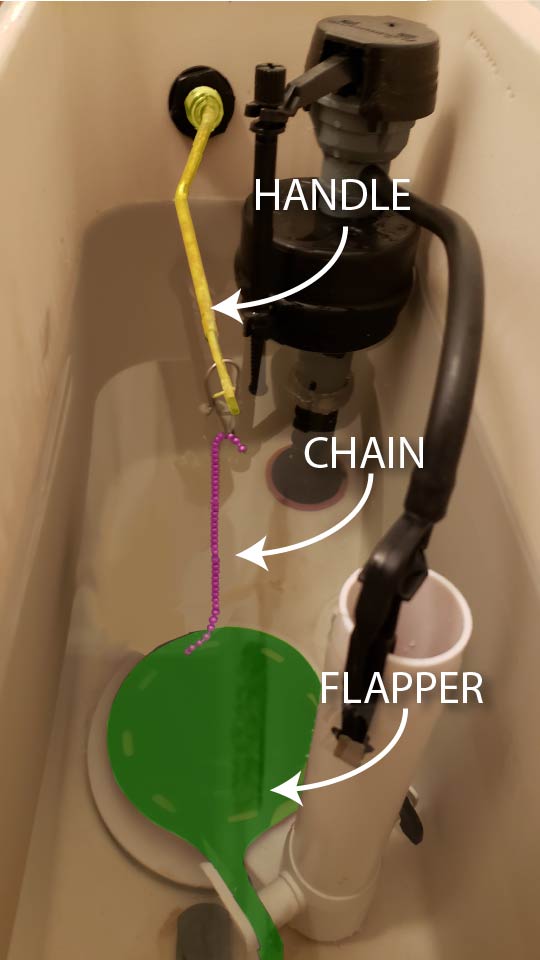
If you press the flush handle and nothing happens, the link between the handle and the flapper is usually the culprit: the chain may have slipped off, snapped, or gotten too loose.
Check the Chain
- Look at the rod attached to the handle. Locate the chain connecting it to the flapper.
- If the chain is disconnected or too slack, reconnect it so that it lifts the flapper fully when you push the handle. There’s a little hook on the end of the chain. This fits into one of the holes on the handle.
- If there is no hook, bend a paper clip to make the connection.
Tip: The chain should have just a little slack — not too tight, not too loose.
If your chain keeps popping off or the handle feels loose, a complete tank repair kit gives you all the parts you need — handle, lift chain, and a new flapper — in one inexpensive bundle. This avoids multiple trips to the store and solves most common flush failures in under 10 minutes
When to Replace Parts (and What to Replace)
Worn or Warped Flapper
Toilet flappers wear out over time, preventing the tank from releasing water properly.
Solution1: Run your finger around the bottom side of the flapper – the flapper portion, to clean the mating surface. If it’s slippery and slimy, that slime could cause your toilet to leak. Also run your finger around the lip where the flap rests – that may be slimy, tool.
Solution 2: Replace the flapper with a new one from a repair kit.
It’s one of the cheapest and most effective fixes you can do yourself.
Too-Loose or Broken Chain
If reconnecting the chain doesn’t fix it, then installing a new lift chain and handle from a repair kit usually does the trick.
Flush Handle
If it’s an older toilet, there’s a chance the inside of the flush handle has rusted away where it passes through the side of the toilet. If it’s damaged, the handle no longer pivots correctly, and the chain no longer lowers the flapper valve to the right spot. Replace the handle with one from a kit.
Other Issues to Watch For
While rare, your toilet might also be clogged — something stuck in the channel between the toilet tank and the bowl. In that case, you’ll need to detach the tank to gain access to the bowl’s internals. This is an extremely rare situation.
What You Might Need (Replacement Parts)
You can often quickly and easily fix a non-flushing toilet without any tools or parts at all. If it turns out you DO need parts, here are the exact parts that solve most toilet flush problems:
- Toilet Tank Repair Kit – includes a new handle, lift rod, chain, and flapper — so you replace everything that can wear out in one go.
Example: Universal Toilet Flusher Replacement Kit - Replacement Flapper Valve (if that’s all that’s failing) Example: Universal Toilet Flapper Replacement Kit)
- Adjustable Wrench & Screwdriver (essential tools) Example: 20 Piece Home Tool Set
Tip: Buying a complete toilet tank repair kit saves time and frustration — and usually costs less than buying parts one at a time.
That’s it. Once you’ve restored the glorious flushing action, you can carefully put the lid back onto the tank and call it a day.
DIY projects involve risk. Always follow manufacturer instructions and use appropriate safety precautions.
Related Posts
3010
©2026 SkippityWhistles.com All rights reserved
 Skippity Whistles