
Ron spent a solid four minutes trying to grip a fat plumbing fitting with his slip-joint pliers, which opened about half as wide as the job required, and then another two minutes trying to convince himself that squeezing harder was a legitimate engineering strategy. It was not. His knuckles found the pipe twice. The fitting did not move once. Somewhere in his garage, a pair of channel-lock pliers sat quietly, capable of solving this entire problem in one confident squeeze, judging him.
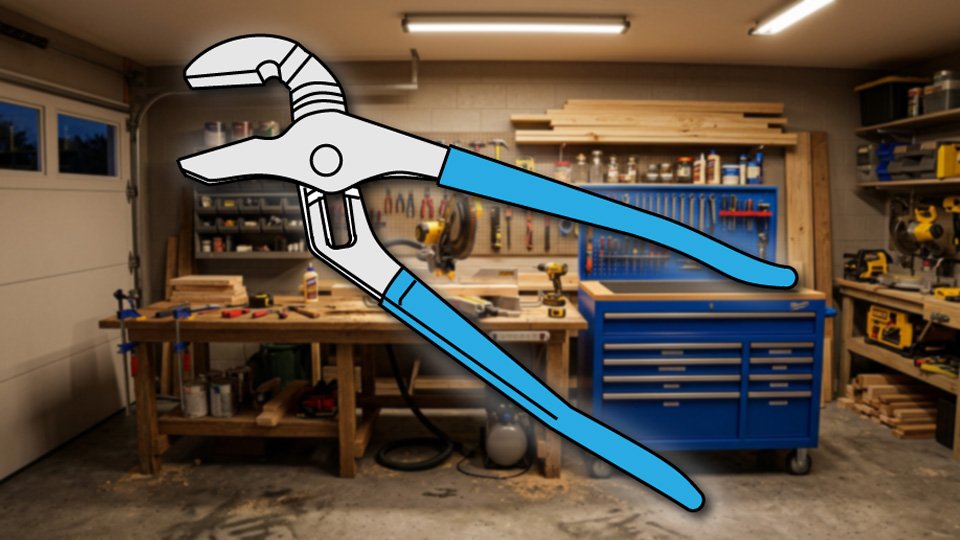
Channel-lock pliers exist for exactly the moment your other pliers tap out. They’re bigger, they open wider, and they have opinions about leverage that your slip-joint pliers were simply never built to have.
🔩 What Makes Them Special
Channel-lock pliers, also called groove-joint pliers, work off the same basic idea as slip-joint pliers — an adjustable pivot — but taken several steps further and with noticeably more attitude. The pivot slides along a whole row of grooves instead of just two positions, which means the jaw opening ranges from “small nut” to “honestly, alarming.”
That extra range is the entire point. Where a slip-joint pliers gives up, a channel-lock pliers is just getting started.
🎚️ Adjusting the Jaw Width
Open the handles all the way — properly wide, not a polite little stretch.
Slide the pivot along the grooves until the jaw gap roughly matches whatever you’re about to grip. There’s no shame in sliding it back and forth a bunch of times to find the right one; that’s what the grooves are for.
Close the jaws around the object and give it a test squeeze before committing to full force. A little preview now saves a lot of slipping later.
🧲 Gripping Round or Awkward Objects
This is the job channel-locks were basically born for — pipes, round fittings, oddly shaped hardware, anything a flat-jawed wrench looks at and quietly declines. The wide grooved jaws wrap around curves that would make a wrench throw up its hands and go home.
🔩 Turning Nuts and Bolts (When a Wrench Won’t Fit)
When a fastener is too large, too round, or too stubborn for the wrenches on hand, channel-locks step in with real leverage to spare. Match the groove size to the fastener before applying force — an ill-fitting grip here is exactly how a good fastener turns into a rounded, defeated one. Once it’s seated properly, it holds like it means it.
〰️ Bending Light Metal
Channel-locks can bend a light metal rod or nudge a stubborn wire into shape in a pinch. For anything genuinely hard or thick, that’s a job for a dedicated tool — channel-locks are strong, not infinite.
🚫 What Not to Do (a Short but Important List)
Don’t use them on live electrical work — that rule never takes the day off. Don’t use them as a hammer, no matter how tempting the handle looks in that moment. And don’t use them as a pry bar; they’re built to grip and turn, not to lever something apart, and asking them to do both at once tends to end in a bent tool and a bad mood.
🛡️ Safety Basics
Wear safety glasses whenever you’re gripping, bending, or working near anything that could slip or fly loose. Test the grip before applying full force — every single time, not just the times you remember to. And if the pliers are straining against something, that’s the tool politely telling you to grab a bigger one, not a cue to lean in harder.
🛒 Gear Worth Having
CHANNELLOCK 12-Inch Straight Jaw Tongue-and-Groove Pliers — The genuinely satisfying size upgrade from a slip-joint pair — enough reach and grip range to handle the job that started this whole mess.
CHANNELLOCK 6.5-Inch Mini Tongue-and-Groove Pliers — A compact version for tight spaces where the full-size pair simply doesn’t fit — same grip logic, smaller footprint.
3M Impact-Resistant Safety Glasses — Cheap protection for the moment something finally lets go all at once, which it eventually will.
As an Amazon affiliate, I earn from qualifying purchases. Thank you for supporting SkippityWhistles.
📖 Related Reads
SkippityWhistles is part of the WhistleBump group – find the rest of the family at WhistleBump.com.
7024
©2026 John D Reinhart/Skippitywhistles.com — All rights reserved