Ron had a joint with a visible gap on one side, and his solution was more glue — reasoning that if a little glue holds two tight pieces together, a lot of glue should hold two not-quite-tight pieces together even better. It looked great until it fell apart – wood glue is great for gluing stuff, but not for filing gaps.
Wood glue doesn’t bond the way epoxy or super glue does. Understanding the difference is the entire reason some glued joints outlast the wood itself, and others quietly come apart.
🧬 Mechanical Lock, Not Chemistry
Wood glue is polyvinyl acetate (PVA) — a water-based adhesive that hardens as its water evaporates. It bonds through mechanical interlocking rather than a chemical reaction.
As the glue dries, it wedges into the wood’s own fibers and hardens there, physically gripping the grain rather than dissolving or fusing it the way super glue or epoxy would.
That’s why a well-fitted PVA joint can be stronger than the wood around it — you’ll break the board before that joint gives way.
It’s also why a loose joint fails no matter how much glue goes into it: there’s nothing for the glue to mechanically lock into across an actual gap.
🧴 Four Types Worth Knowing
- Standard yellow wood glue is the everyday default — fast setting, full strength at 24 hours, and the right choice for most interior furniture and general woodworking.
- White glue (the same PVA family, sometimes called school glue) is slightly weaker but better suited to paper, cardboard, and other porous craft materials rather than structural wood joints.
- Waterproof wood glue swaps in additives that make it genuinely waterproof once cured, not just water-resistant — worth the extra cost for anything going outdoors, since standard glue will fail on exterior furniture eventually.
- Cross-linked, polyurethane-modified glue is the heavy-duty option for high-stress or load-bearing joints and oily woods that resist standard PVA — overkill for most projects, but the right call when a joint’s failure would be a real problem.
📏 Fit Beats Quantity, Every Time
Dry-fit the joint before any glue touches it — pieces should come together smoothly with no forcing.
Any gap wider than about 1/32 inch is a real weakness that glue alone can’t bridge, no matter how much you stuff in it.
The actual goal is a thin, even coat on one surface only, applied so that clamping produces a small, visible bead squeezed out along the seam — that bead is proof the joint is filled and seated, not evidence of excess.
A gluey mess oozing everywhere means too much was used on a joint that probably needed re-cutting instead. Cut once, measure twice is not a thing.
🛠️ Clamp Properly, Then Leave It Alone
Assemble and clamp promptly once glue is applied — it starts setting within minutes.
Firm, even pressure is enough; wood glue doesn’t need bone-crushing force, and over-tightening can bow a panel or squeeze out more glue than the joint actually needs.
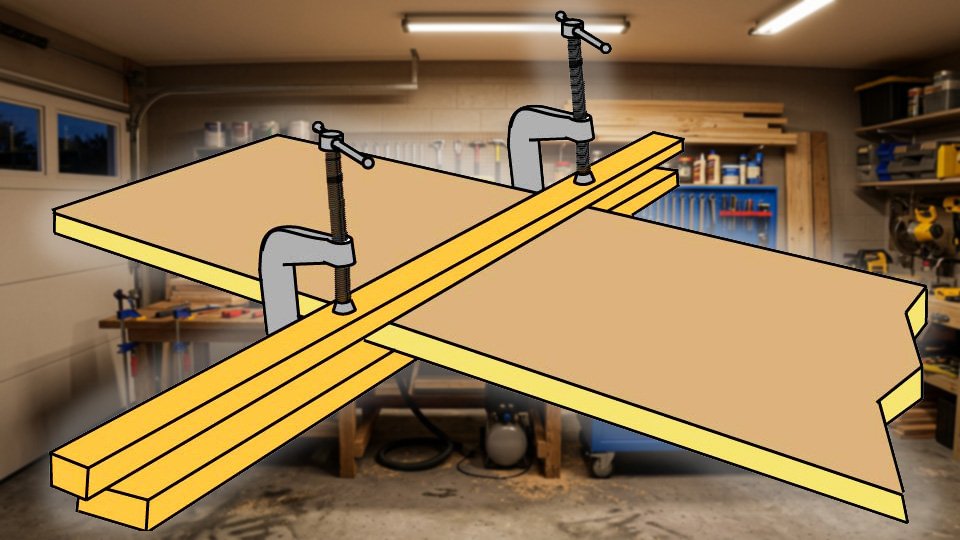
Wipe excess while it’s still wet, since dried glue has to be sanded off instead. For large panels, cauls (straight scrap boards clamped across the top and bottom of a panel) prevent the panel from bowing under clamp pressure.
⏳ Patience Is the Last Ingredient
Wood glue reaches roughly 50 percent strength at 30 minutes — enough to unclamp for light handling — but full strength doesn’t arrive until close to 24 hours.
Testing a joint’s strength right after unclamping is one of the more common ways a genuinely good glue-up gets blamed for a failure that was really just impatience.
Cold workshops slow the whole process down further, so give a joint extra time in a chilly garage.
🧻 Where PVA Works Beyond Wood
Because it bonds through mechanical interlocking rather than chemistry, wood glue works on any porous material — paper, cardboard, cork, natural-fiber fabric, and MDF all take PVA well.
It won’t bond to non-porous surfaces like plastic, metal, or glass at all; those need an adhesive that works through actual chemistry, which is exactly the ground epoxy and super glue cover instead.
🛒 Gear Worth Having
Titebond Original Wood Glue — The industry-standard yellow glue that covers the overwhelming majority of interior woodworking without needing anything fancier.
Titebond III Waterproof Wood Glue — Genuinely waterproof once cured, not just water-resistant — the one to reach for on anything headed outdoors.
IRWIN Quick-Grip Bar Clamp Set — Even, adjustable pressure across the whole joint, which matters more to the final bond than the glue itself does.
As an Amazon affiliate, I earn from qualifying purchases. Thank you for supporting SkippityWhistles.
📖 Related Reads
SkippityWhistles is part of the WhistleBump group – find the rest of the family at WhistleBump.com.
2024
©2026 John D Reinhart/Skippitywhistles.com — All rights reserved