
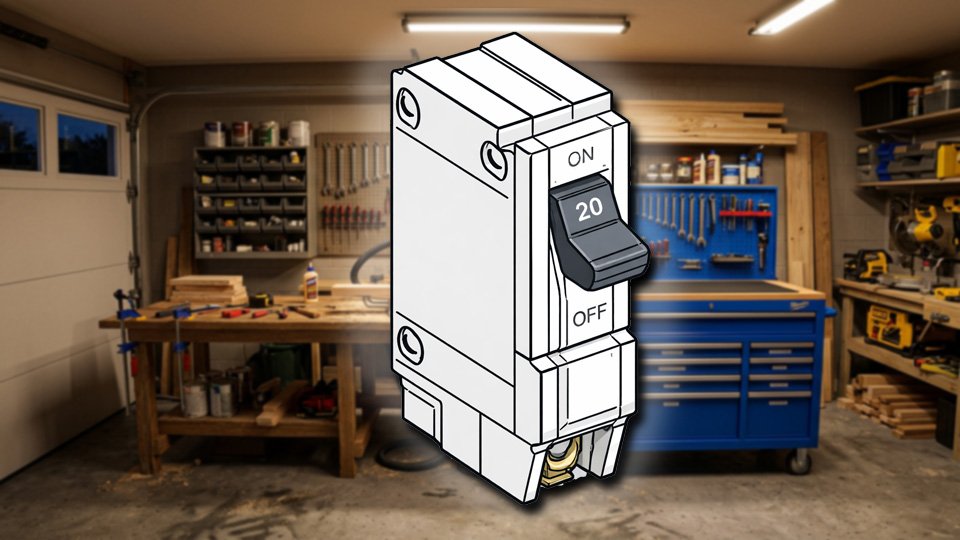
Ron ran his toaster, his microwave, and his coffee maker at the same time every single morning, and every single morning the kitchen breaker tripped somewhere around minute two. His fix was consistent: walk to the panel, flip it back on, walk back to the kitchen, repeat tomorrow. He’d been doing this for months. The breaker had been trying to tell him something the entire time, and Ron had been answering by hitting snooze.
A breaker that trips repeatedly isn’t malfunctioning. It’s doing exactly the job it was built for — and ignoring that message by simply flipping it back on, over and over, is how a minor annoyance turns into a genuine hazard.
⚡ The Core Principle: It’s a Hero, Not a Villain
A circuit breaker watches the current flowing through its circuit, and if that current exceeds the breaker’s rating, it trips and cuts power immediately. Too much current generates heat; too much heat melts wire insulation; melted insulation is how house fires start. A tripping breaker isn’t the problem. It’s the thing standing between a problem and a much worse outcome.
🔥 The Five Reasons a Breaker Actually Trips
- Overloading the circuit is the most common cause, and it’s exactly what caught Ron every morning. A 120-volt, 20-amp circuit tops out around 2,400 watts — Ron’s toaster (1,200W), microwave (1,000W), and coffee maker (1,000W) running together add up to 3,200 watts, well past what the circuit can carry. This is a spread-the-load problem, not a broken-breaker problem.
- A short circuit happens when the hot and neutral wires touch directly instead of routing current through whatever’s plugged in — often from damaged internal wiring in an appliance — and trips the breaker instantly and forcefully.
- A ground fault occurs when current escapes to ground through an unintended path, commonly water or moisture near an outlet.
- Faulty wiring — old, damaged, or loosely connected — creates resistance, and resistance generates heat that eventually trips the breaker even without an obvious overload.
- And, rarely, the breaker itself is simply wearing out and tripping without any real fault behind it at all.
🔍 Diagnosing It Yourself
Don’t just keep flipping it back on — that’s answering a warning by muting it, not solving it.
Note what was actually running the moment it tripped; that alone often points straight at the answer.
Unplug everything on that circuit, then reset the breaker:
- If it holds with nothing plugged in, the problem is overload, not a wiring fault.
- If it trips again with nothing plugged in at all, that’s a deeper problem — short circuit, ground fault, or faulty wiring — and not something to keep testing alone.
Once it holds, reintroduce devices one at a time until the culprit reveals itself.
🚫 What Never to Do
- Never replace a breaker with a higher-amp one to make the tripping stop — the wiring behind it is only rated for the original amperage, and a bigger breaker just means the wiring overheats before anything trips to stop it.
- Never wedge a coin or any object behind a breaker to hold it on — this has genuinely happened, more than once, and it completely defeats the one thing standing between an overload and a fire.
- Never treat occasional trips as fine just because they’re infrequent; infrequent is still a warning.
- And never route a high-draw appliance through an extension cord to another circuit as a workaround — that doesn’t solve the overload, it just relocates it somewhere with its own limits.
📞 When to Call an Electrician
- A breaker that trips with absolutely nothing plugged in
- A breaker that trips consistently at a specific outlet
- A breaker that had been tied to a specific appliance and continues to trip even after the appliance is confirmed faulty
- or any hint of a burning smell or scorch marks near the panel
All of these are past the point of DIY troubleshooting. That’s not a failure to solve it yourself. It’s recognizing exactly where the line sits.
🛒 Gear Worth Having
Klein Tools NCVT-3 Non-Contact Voltage Tester — Confirms what’s actually live before any hands-on diagnosis starts — the same first step worth taking every time.
Basic Digital Multimeter — Measures voltage and current directly, which turns a guessing game about an overloaded circuit into an actual number.
Heavy-Duty Surge Protector Power Strip — Rated for real appliance loads, not the flimsy strip that turns three high-draw devices into one overloaded outlet.
As an Amazon affiliate, I earn from qualifying purchases. Thank you for supporting SkippityWhistles.
📖 Related Reads
SkippityWhistles is part of the WhistleBump group – find the rest of the family at WhistleBump.com.
9020
©2026 John D Reinhart/Skippitywhistles.com — All rights reserved