Ron’s breaker labels were mostly guesswork — half of them read “???” from a previous owner who clearly gave up at the same point Ron eventually would. His method for finding the right breaker during any given problem was flipping switches one at a time and waiting to hear which room went quiet. It worked, eventually, the way hitting every button in an elevator eventually gets you to your floor. It’s just not what anyone would call reading the panel.
An electrical panel looks like a wall of identical switches guarding a mystery, but it’s really just a traffic cop — deciding how much power goes where, and giving you a way to shut any of it off. Once you know what you’re actually looking at, the guessing stops.
🚦 The Main Disconnect: The Big Switch
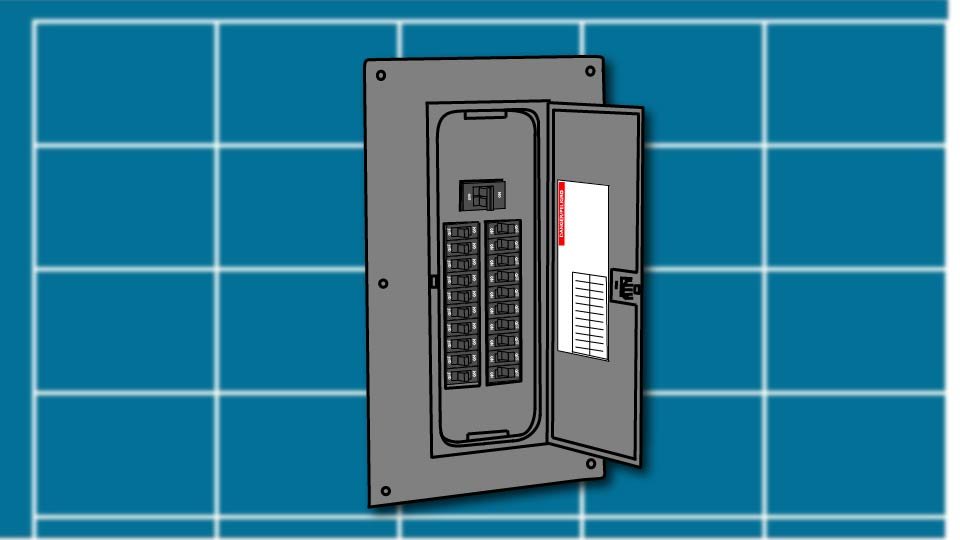
Near the top of most panels sits one larger breaker, usually labeled MAIN, with its own amperage rating printed on it — 100, 150, or 200 amps in most homes. This is the main disconnect, and it cuts power to the entire house at once. In some homes, especially older or larger ones, the main disconnect sits outside the panel entirely — worth knowing where yours actually is before an emergency makes that knowledge urgent.
🔌 Breakers: Single-Pole and Double-Pole
Below the main sit columns of smaller breakers, each protecting one circuit — a single circuit might feed several outlets or lights, but they all answer to the same breaker. A single-pole breaker (narrow, one switch) handles standard 120-volt circuits — most of the outlets and lights in a house. A double-pole breaker (wider, looks like two switches joined together) handles 240-volt circuits — the water heater, central air, an electric range, a dryer, anything genuinely power-hungry enough to need double the voltage.
🔗 The Neutral and Ground Buses
Along the sides of the panel sit two metal bars with wires clustered onto them. The neutral bus (usually silver or gray, with white wires attached) completes the circuit, carrying current back out. The ground bus (usually green or bare copper) provides a safety path for electricity if something goes wrong elsewhere in the circuit. Neither is a random cluster of wires — both are doing specific, structural work every time anything in the house draws power.
🏷️ Reading the Labels
A properly labeled panel tells you exactly what each breaker controls and how much current it allows — “Kitchen 20A,” “Bedrooms 15A,” “Water Heater 30A.” If the labels in a panel are faded, vague, or missing entirely, that’s genuinely worth fixing: flip one breaker at a time, note what goes dark, and write it down. Thirty minutes now saves a lot of Ron’s elevator-button guessing later.
🎨 What Breaker Colors Actually Mean
Color signals the type of protection, not how strong the breaker is — a red breaker isn’t more powerful than a black one, it’s just wired for a different voltage.
Black breakers are standard single-pole, 120-volt. Red breakers are standard double-pole, 240-volt. Yellow often indicates AFCI (arc fault) protection. Blue or green often indicates GFCI (ground fault) protection or a specialty breaker type.
Tandem or “twin” breakers — two thin breakers sharing one slot — show up in some panels and not others, since not every panel is rated to accept them. If a panel already has some, that’s useful to recognize when reading it — but whether more can safely be added is a question for whoever’s actually working inside that panel, not something to figure out by inspection alone.
⚡ Amperage: What the Numbers Actually Mean
The number stamped on each breaker — 15, 20, 30, 40 — is the maximum current that circuit is rated to carry before the breaker trips.
- 15A handles light-duty circuits like bedroom outlets and lighting.
- 20A is the general-purpose standard for kitchens and bathrooms.
- 30A and up covers heavy-duty appliances like water heaters and dryers.
🏠 Service Size: How Much Power the House Has
The number on the main breaker is the house’s total service size — its overall electrical capacity.
- 100A service is common in older homes and can feel tight running AC, a water heater, and an oven at once.
- 150A covers a modest modern home reasonably, though it can get crowded with an EV charger or heat pump added later.
- 200A is the standard for most homes built or renovated recently, and handles the typical mix of major appliances comfortably.
Anything beyond that is generally reserved for larger homes or all-electric construction.
🔄 What a Tripped Breaker Actually Means
A tripped breaker did its job — it caught an overload, a short, or a ground fault before that fault became something worse.
Unplug what’s on that circuit, flip the breaker fully off and back on, then reintroduce devices one at a time to find the culprit.
A breaker that trips immediately, every time, points to a real fault, not a coincidence — that’s an electrician’s call.
A breaker that won’t stay reset at all is a genuine red flag, not something to keep pressing and hoping.
🛡️ The Golden Rule: Look, Don’t Touch
Understanding a panel and working inside one are two completely different things.
Turning breakers on and off, testing GFCI and AFCI devices monthly, and keeping the panel clearly labeled and unobstructed are all reasonable homeowner territory.
Touching the main lugs or service entrance wires, sticking anything into the panel, or opening it up for repair work is not — those wires carry deadly voltage regardless of whether the main breaker is on or off, and that’s a licensed electrician’s job, every time, no exceptions.
🛒 Gear Worth Having
Klein Tools NCVT-3 Non-Contact Voltage Tester — Confirms what’s actually live near a panel before anything gets touched — a genuinely essential first step, not an optional one.
Label Maker for Breaker Panels — Turns a wall of guesswork into an actual reference, so the next person opening this panel doesn’t inherit Ron’s elevator-button method.
Circuit Breaker Finder and Outlet Mapper — Plugs into any outlet and identifies its breaker automatically, which turns labeling from an afternoon guessing game into a five-minute task.
As an Amazon affiliate, I earn from qualifying purchases. Thank you for supporting SkippityWhistles.
📖 Related Reads
SkippityWhistles is part of the WhistleBump group – find the rest of the family at WhistleBump.com.
9015
©2026 John D Reinhart/Skippitywhistles.com — All rights reserved