
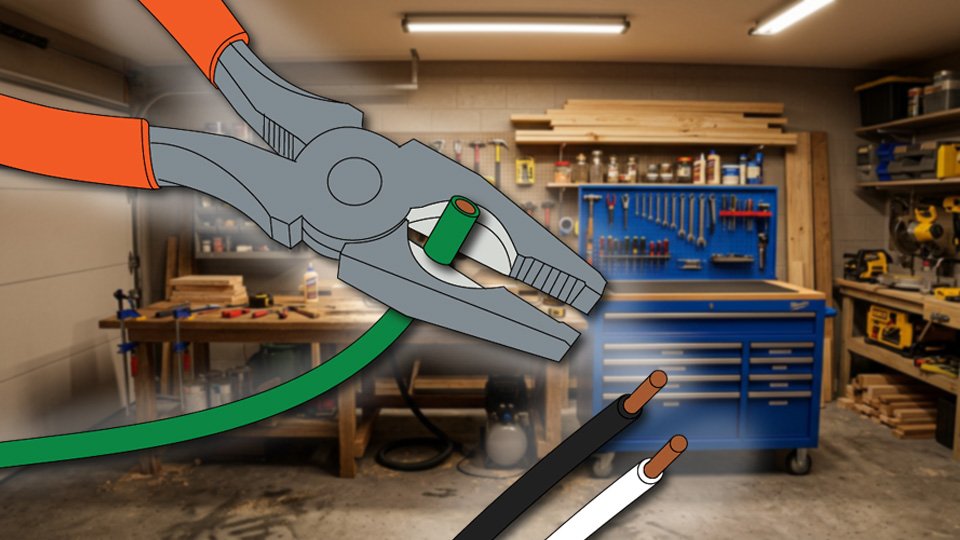
Ron lined up a wire clearly marked 12-gauge with the 12-gauge notch on his strippers, and the wire flatly refused to fit. He tried the 10-gauge slot instead, which was obviously too big and did nothing useful. For a solid minute, Ron was ready to declare the tool mislabeled, defective, or possibly both. It was neither. The gauge stamped on the wire refers to the bare copper hiding inside — the notch was never going to accept the wire with its insulation jacket still on, and that’s not a flaw, that’s just what stripping a wire actually means.
Stripping a wire — removing a section of insulation to expose the bare conductor underneath — is one of the most basic skills in home electrical work, and also one where a little bit of understanding prevents a surprising number of “wait, why won’t this fit” moments.
🦺 Power Off, Every Single Time
Before any wire gets anywhere near a stripper, turn off the breaker for that circuit, then confirm with a non-contact voltage tester (a tool that detects live current without needing direct contact with the wire) rather than trusting the breaker label alone.
This step never gets skipped, not for a wire that looks disconnected, not for one you’re “pretty sure” is dead. Confirm it every time.
📏 The Gauge Mismatch Ron Didn’t See Coming
Wire gauge is the number describing the thickness of the copper conductor — lower numbers mean thicker wire. It is measured on the bare copper, not the insulated jacket surrounding it. A stripper’s gauge notches are sized for that bare copper too, which means the insulated wire genuinely will not slide into its matching slot — it’s supposed to look like it doesn’t fit.
Of course the wire won’t fit in the slot, Ron. That’s the whole point of the wire stripper. It will cut through the insulation, no matter how thick, but won’t nick the copper underneath.
✂️ Stripping Solid vs. Stranded Wire
Solid wire has a single, unbroken copper core and is standard in most household wiring — straightforward to strip, since there’s only one strand to protect from nicks.
Stranded wire is made of many thin copper strands bundled together, common in cords and fixtures, and needs gentler pressure from the wire stripper since they can shear off individual strands if squeezed too hard.
After stripping stranded wire, twisting the exposed strands together keeps them neat and prevents stray ones from wandering outside a connection.
📐 How Much Insulation to Remove
Outlets and switches: about 1/2 inch is standard
Wire nuts: about 3/4 inch. Stripping too little leaves too little bare copper for a solid connection. Stripping too much leaves exposed copper sitting outside the connector once everything’s assembled, which is a real safety issue, not just an untidy one.
🔍 Reading a Good Strip vs. a Bad One
A properly stripped wire shows bright, clean copper with no nicks, gouges, or thinned spots, and for stranded wire, no loose or cut strands sticking out.
Any of those signs means cutting the damaged section off and stripping again — a nicked or weakened wire is a genuine point of failure, not a cosmetic flaw to live with.
🚫 The Mistakes Worth Avoiding
- Using a utility knife instead of proper strippers is how copper gets nicked or partially sliced through.
- Stripping too much insulation leaves bare wire exposed outside a connector.
- A dull or damaged stripper crushes and weakens wire instead of cleanly cutting the jacket.
- And guessing the gauge instead of checking it, printed right on the jacket, is exactly how Ron ended up fighting the wrong notch in the first place.
🛒 Gear Worth Having
Self-Adjusting Automatic Wire Strippers — Senses the gauge automatically and strips in one squeeze, which sidesteps the whole notch-matching guesswork entirely.
Gauge-Marked Manual Wire Strippers — Clear gauge labeling and built-in cutters, for anyone who prefers manual control over an automatic tool.
Klein Tools NCVT-3 Non-Contact Voltage Tester — Confirms a wire is actually dead before anything gets stripped, cut, or connected — the step that never gets skipped.
As an Amazon affiliate, I earn from qualifying purchases. Thank you for supporting SkippityWhistles.
📖 Related Reads
SkippityWhistles is part of the WhistleBump group – find the rest of the family at WhistleBump.com.
9007
©2026 John D Reinhart/Skippitywhistles.com — All rights reserved