
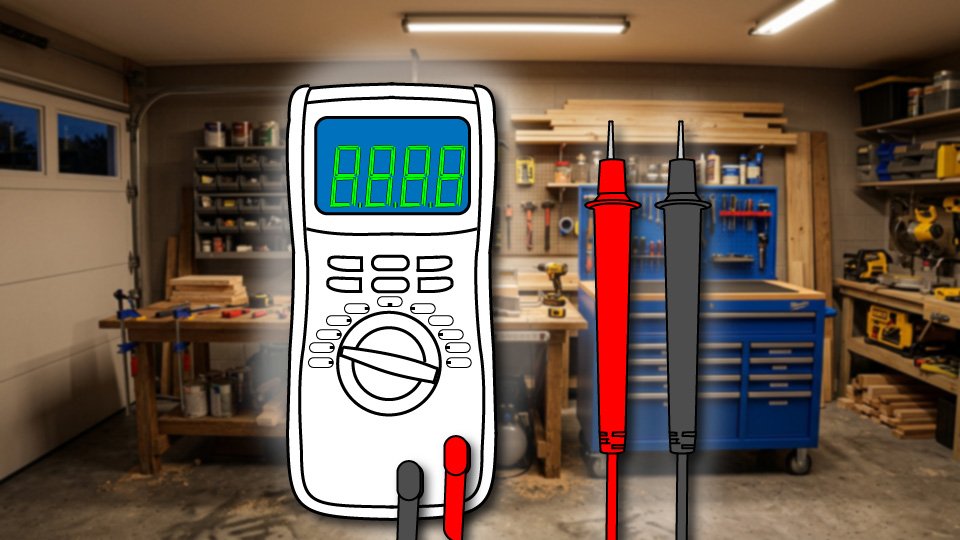
Electricity is invisible. That’s both its charm and its fundamental problem — like dating someone who thinks they’re always in a movie scene. You can’t see it, you can’t smell it in normal quantities, and you can’t know what it’s doing without a tool that translates it into numbers you can read.
That tool is a multimeter — also called a digital multimeter, or DMM. If you’ve ever heard the word “voltmeter,” that’s the same thing, or close enough: a voltmeter measures voltage specifically, while a multimeter measures voltage and several other things besides. When you go to buy one, you’ll find multimeters on the shelf, not voltmeters. They do more and cost about the same.
Here’s what a multimeter measures, how to use it safely, and which one to buy first.
📊 What a Multimeter Actually Measures
The three measurements you’ll use most as a homeowner are voltage, continuity, and resistance.
Voltage is electrical pressure — the force that pushes current through a circuit. When you want to know whether an outlet is live, whether a wire is carrying current, or whether a battery still has charge, you’re measuring voltage. It’s measured in volts (V), and the reading tells you how much electrical pressure is present at that point in the circuit.
Continuity is whether a circuit is complete — whether electrical current can flow from one point to another without interruption. A continuity test tells you if a wire is broken, if a fuse has failed, or if a switch is making proper contact. Most multimeters signal a complete circuit with an audible beep, which means you can run the test without looking at the display. The beep means connected. Silence means broken.
Resistance is the opposition a material presents to the flow of electricity. Measured in ohms (Ω), resistance readings help diagnose component problems and verify that wiring is intact. For most homeowner electrical work, voltage and continuity cover the situations you’ll encounter. Resistance becomes relevant in more involved diagnostic work.
⚡ AC vs. DC — The Setting That Has to Match
Before taking any measurement, the multimeter dial needs to be set to the correct type of voltage. Getting this wrong produces either a meaningless reading or zero when there should be a number — which can be dangerous if it leads to the conclusion that power is off when it isn’t.
AC (Alternating Current) is what comes out of your wall outlets — the standard household current in the United States runs at approximately 120 volts AC. The dial marking is V~ (the tilde symbol indicates alternating). Use this setting for outlets, switches, light fixtures, and anything connected to household wiring.
DC (Direct Current) is what batteries produce, and also what solar panels, car electrical systems, and low-voltage electronics run on. The dial marking is V⎓ (the straight line indicates direct). Use this setting for batteries, car systems, and low-voltage DC applications.
Mixing up the settings — testing an AC outlet on the DC setting, or testing a battery on the AC setting — produces a reading of zero or a nonsensical number. If the reading doesn’t match expectations, the first thing to check is whether the dial is on the correct type of voltage.
🔌 How to Test an Outlet — Step by Step
Set the dial to AC Voltage (V~). We know that the voltage in most home AC circuits should be 120V. Click the dial on the multimeter until it points at 200V. Some meters feature auto-ranging, which chooses the range for you.
Connect the probes: black probe into the COM port (the port labeled COM, usually in the center or bottom), red probe into the VΩ port (the port for voltage and resistance measurements, usually labeled V or VΩ). Never put the red probe into the port labeled A — that port measures current (amperes), and connecting it across a voltage source will blow the meter’s internal fuse immediately. The A port is only used when measuring current, which requires a completely different connection method. Avoid the A port!
With the probes in the correct ports, insert the black probe tip into the wider outlet slot (the neutral slot) and the red probe tip into the narrower slot (the hot slot — the one connected to the live side of the circuit). Yes, into the slots.
A note on the finger-in-the-socket concern: this is a reasonable instinct that turns out not to apply to properly used test probes. The probe tips are insulated except at the very tip. Your fingers stay well behind the insulated guards. The meter has very high internal resistance that limits the current that flows through it to a level far below what’s dangerous. Electricians do this dozens of times a day. A properly used multimeter does not meaningfully increase shock risk compared to handling a normal lamp cord. Be brave – you can do this.
A live, properly wired outlet reads approximately 110 to 125 volts. Zero means the breaker is off or the outlet isn’t receiving power. A reading significantly different from the expected range suggests a wiring issue worth investigating.
🔋 How to Test a Battery
Set the dial to DC Voltage (V⎓). Choose a range slightly above the expected voltage of the battery being tested, or use auto-range.
Touch the red probe to the positive terminal of the battery (marked + on the battery) and the black probe to the negative terminal (marked −). The reading tells you the battery’s current voltage.
A good-condition AA battery reads approximately 1.5 volts. Below 1.2 volts and the battery is getting weak. A 9-volt battery reads 9 volts when fresh. A car battery reads approximately 12.6 volts when fully charged — below 12.4 suggests it’s getting tired, and below 12 volts means it’s significantly discharged and may struggle to start the car in cold weather.
Battery testing is one of the most immediately useful things a multimeter does. The difference between a dead battery and a weak battery is the difference between throwing away something that still has useful life and diagnosing a device problem correctly.
⚠️ The Rules That Protect the Meter and the Person Using It
Never change the dial setting while the probes are in contact with a live circuit. Set the dial first, then connect the probes.
Never use the continuity or resistance settings on a live circuit. Power off first, then test.
Never put the red probe in the A (current) port except when specifically measuring current — and measuring current requires breaking the circuit and connecting the meter in series, which is a different procedure entirely. The A port connected across a voltage source blows the fuse immediately.
Verify the meter is working before trusting a zero reading. A dead battery in the meter, or a blown internal fuse, shows zero on a live circuit. If a circuit that should be live reads zero, confirm the meter is functioning on a known live source before concluding the circuit is off. This is the same Live-Dead-Live principle covered in the voltage tester post — applied here to the multimeter.
🛒 Gear Worth Having
AstroAI Digital Multimeter 2000 Counts — AC/DC Voltage, Resistance, Continuity, Diode, Blue — The entry-level multimeter that handles everything a homeowner needs: AC and DC voltage, resistance, continuity with audible buzzer, and diode testing. Manual ranging with clearly labeled positions. Backlit LCD for working in dim spaces. Double-fused for overload protection. Over 73,000 Amazon reviews at 4.5 stars. This is the meter that earns its place in the toolbox on the first use and stays there for years.
AstroAI TRMS 4000-Count Auto-Ranging Multimeter — AC/DC Voltage, NCV, Battery Test, Flashlight — The step-up option. Auto-ranging means the meter selects the correct measurement range automatically — no dial sub-setting required beyond choosing the measurement type. TRMS (True RMS) measurement provides accurate readings on modern electronics and appliances that use non-standard waveforms. Built-in NCV (non-contact voltage detection) function, flashlight, and specific battery test modes for 1.5V, 9V, and 12V batteries. The right choice for anyone who wants the meter to do a little more thinking.
Klein Tools MM325 Digital Multimeter — 600V AC/DC, Manual Ranging, Backlit Display — Klein’s entry into the homeowner multimeter category, built to the same standards as their professional electrical tools. 600V AC/DC range, resistance to 2MΩ, continuity with buzzer, diode test, and battery test. Tough rubber housing that survives the toolbox. The brand that professional electricians trust in a meter priced for the homeowner who wants professional-grade reliability without the professional price tag.
As an Amazon affiliate, I earn from qualifying purchases. Thank you for supporting SkippityWhistles.
📖 Related Reads
A multimeter doesn’t fix anything. It tells the truth — whether power is present, whether a circuit is complete, whether a battery has enough charge left to be useful. In DIY electrical work, truth is the tool. Everything else follows from knowing what’s actually there.
SkippityWhistles is part of the WhistleBump group – find the rest of the family at WhistleBump.com.
9012
©2026 John D Reinhart/Skippitywhistles.com — All rights reserved